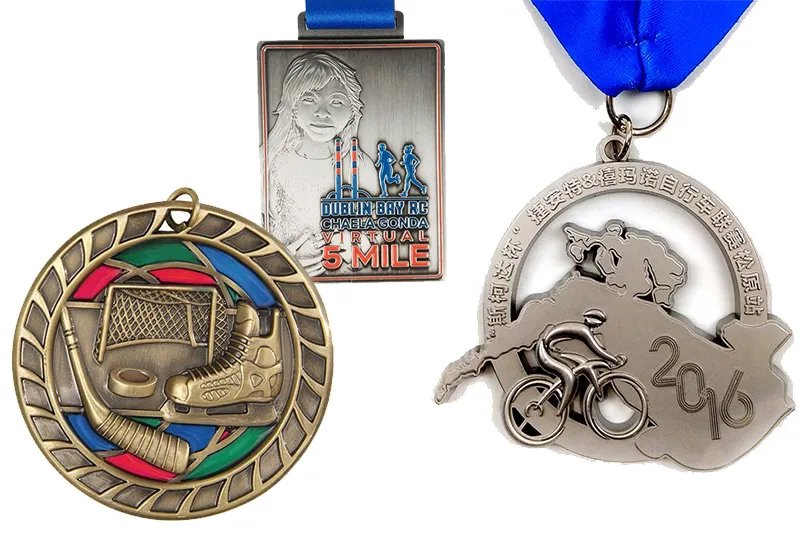
Every spring, league directors across the United States sit down with a spreadsheet of 300 kids, a fixed end-of-season date, and one question: what do we put around their necks? We have made custom baseball medals for youth leagues, travel-ball clubs, and tournament organizers for over fifteen years, and the baseball category has its own rules. A baseball medal is not a soccer medal with a different shape. The age range is wider, the plating conventions are stricter, and the design language is built around a very specific set of objects — the ball, the bat, the glove, the home plate, the pennant. This guide is the conversation we have with league directors every season, written down.
Why Baseball Medals Are Their Own Design Problem
Baseball is unusual among youth sports because the participants span an enormous range. A T-ball player is four or five years old and weighs thirty-five pounds. A senior Little League All-Star is thirteen and stands taller than some of the coaches. Both receive a medal at the end of the season, but those two medals should not be built the same way.
There are three forces that push baseball medal design in different directions:
Physical safety. Younger players put everything in their mouths, and they wear medals around their necks while running, sliding, and swinging. A heavy 60mm medal with a sharp die-cut point is a genuine hazard for a T-ball player. Size, weight, edge finishing, and ribbon length all have to bend toward the youngest player in the division.
Perceived value. Older players — the ones who just lost a district championship by one run — know the difference between a real medal and a giveaway. They compare medals across leagues. A thin, hollow-feeling disc with a flat printed logo reads as an afterthought. A substantial zinc alloy medal with a raised 3D baseball diamond reads as something earned.
Budget reality. Youth leagues are usually volunteer-run and cash-constrained. The registration fee has to cover uniforms, umpires, field permits, and awards. That means the award budget per player is often in the $2–$6 range, and every dollar of mold cost is spread across a small order. How you allocate that budget — mold detail versus plating versus ribbon — determines whether the medal looks like it cost twice what it did.
Getting all three right is why a baseball medal program is a design exercise, not a catalog pick.
The Youth Baseball Ladder: T-Ball, Little League, All-Star, and Travel Ball
Most American leagues we work with run some version of this ladder. Each rung has a different audience, a different message, and therefore a different medal.
| Tier | Typical Ages | Medal Diameter | Thickness | Plating | Ribbon Length | What It Says |
|---|---|---|---|---|---|---|
| T-Ball | 4–6 | 40–45mm | 2.0–2.5mm | Gold only (everyone same) | 700–800mm child | ”You showed up and had fun” |
| Rookie / Coach Pitch | 6–8 | 45–50mm | 2.0–2.5mm | Gold only | 800mm child | ”First real season” |
| Minor / Majors Little League | 9–12 | 50–55mm | 2.5–3.0mm | Gold, or gold + silver | 800–860mm | ”You played the season” |
| All-Star / District | 10–13 | 55–60mm | 3.0–3.5mm | Gold for champion, nickel silver for runner-up | 860–900mm | ”You were selected” |
| Travel / Club Tournament | 11–14 | 60–65mm | 3.0–4.0mm | Gold / silver / bronze placement | 900mm | ”You competed and placed” |
A few notes on how we actually apply this table.
T-ball and rookie divisions get one plating. Every child gets gold, even in a “championship” game, because at that age there is no meaningful second place. Leagues that try to introduce silver and bronze at T-ball level usually create more tears than excitement. One design, one plating, one ribbon color — a clean, low-cost program.
Little League regular season is the participation tier. The medal celebrates the season, not the standings. Most leagues we work with order a single design with a place for a division name (“MAJORS”, “MINORS”) and the year, and let the ribbon or a back engraving carry the individual child’s name.
All-Star and travel ball are the achievement tier. This is where placement plating belongs. The same die can produce a gold, a silver, and a bronze by changing only the plating step — you do not pay for three molds. See the custom event medals range for how tournament series handle multi-place awards with a single tooling investment.
The jump from 50mm to 60mm is mostly about hands, not egos. A 13-year-old’s hand wraps a 60mm disc comfortably. The same disc looks like a dinner plate on a five-year-old. Diameter should track hand size first and prestige second.
Designing the Baseball Relief: Ball, Bat, Glove, Home Plate, Pennant
Baseball gives you a deep library of instantly recognizable objects. The trick is choosing one hero element and letting everything else support it. Medals that try to cram a ball, a bat, a glove, and a stadium into one 50mm face end up as visual noise.
Here are the relief treatments that work, roughly in order of how often we produce them.
The stitched baseball as the hero. A circular medal where the face is a baseball, with the seam stitching raised in 3D and the two curved seam lines running across. This is the single most requested baseball design, and it works at every size from 45mm up. The stitching is the detail that sells it — real baseball seams are two rows of angled dashes, and when we cut them as raised relief with a 0.4mm minimum height they catch light and read clearly even on a 45mm medal.
Crossed bat and ball. The classic sports motif. Two bats crossed behind a ball, or a bat and ball in a “V”. This reads as baseball without needing color, which makes it a strong choice for a single-plating gold medal where you want the shape to carry the design.
Home plate as the medal shape itself. Instead of a circle, cut the entire medal as a home plate pentagon. This is the most distinctive option and it photographs well. It also gives you a natural flat area for a division name or year. We produce this shape regularly and it is a favorite for All-Star and travel-ball programs because it does not look like any other sport’s medal.
The glove. A glove with a ball nested in the pocket is a warmer, more nostalgic image. It works especially well for the younger tiers, where the glove is the object the child actually knows.
The pennant or banner. A triangular pennant shape, either as the medal outline or as an enamel element on the face, carries the “championship” message for tournament medals.
The team logo or mascot. Every league has a logo, and putting it on the medal is non-negotiable for most directors. This is where we have to talk about line width. A mascot with fine details — thin whiskers, small letters inside a shield, a script wordmark — will not reproduce cleanly as raised metal below a 0.3mm minimum line width. When a league sends us a logo with 0.1mm strokes, we redraw it at production weight before cutting the die. It is the same logo, just built for metal instead of for a screen.
Text elements that belong on the face: the year, the division (“MAJORS”, “12U”), the league name, and the word “CHAMPION” if it is a placement medal. Text that belongs on the back: the individual player’s name, the team name, and a date. Back engraving is essentially free real estate and it is what turns a league medal into a keepsake.
A practical note on combining elements: if the hero is a 3D baseball, keep the surrounding text flat and clean. If the hero is the home plate shape, the face can carry more enamel color because the outline is doing the work. The relief and the color should not compete.
Age-Appropriate Sizing and Safety
Youth baseball is the category where size and safety decisions matter most, because the youngest players are genuinely small. Here is how we advise leagues to set size by age.
Ages 4–6 (T-ball): 40–45mm diameter, 2.0–2.5mm thickness, 700–800mm ribbon with a breakaway clasp. Rounded or soft edges, no sharp die-cut points. Keep the total weight light. At this age the medal is a toy as much as an award, so it has to survive being dropped and chewed.
Ages 6–8 (Coach pitch / Rookie): 45–50mm, 2.0–2.5mm, 800mm child ribbon. This is the sweet spot for a single-plating gold medal with a simple ball or glove relief.
Ages 9–12 (Little League Majors/Minors): 50–55mm, 2.5–3.0mm, 800–860mm ribbon. Now you can introduce a two-color enamel design and more relief detail. The medal has enough surface for a team logo plus a division name.
Ages 10–13 (All-Star / District): 55–60mm, 3.0–3.5mm, 860–900mm ribbon. Placement plating becomes appropriate here. The medal is worn for photos, so the finish quality — a bright, even plating — matters more than at any other tier.
Ages 11–14 (Travel / Club): 60–65mm, 3.0–4.0mm, 900mm ribbon. This is adult-adjacent sizing. Players at this level notice weight and edge quality, and they keep these medals.
On safety specifically, three points we raise with every youth league:
-
Ribbon length is a safety parameter, not a style choice. A 900mm adult ribbon on a five-year-old puts the medal below the chest where it swings into the body while running. Child-length 700–800mm ribbons keep the medal high and controlled. We supply breakaway clasps as standard on youth ribbons so the lanyard releases under load rather than pulling on the neck. Our kids medals program is built around exactly these parameters.
-
Edge finishing. Die-cut shapes with acute points are the main laceration risk. We round or bevel the edges on youth sizes, and we steer leagues away from star or arrow shapes with sharp tips for the youngest divisions.
-
Materials. Zamak zinc alloy with lead-free plating is the standard for youth awards. All our production is lead-free and we can supply compliance documentation for school and municipal league requirements.
Single-Season Medals vs. Tournament and Championship Medals
This distinction drives the entire budget conversation, and leagues that blur it end up overpaying for one program and underpaying for the other.
A single-season participation medal is ordered once a year, in a known quantity, for a known number of registered players. Its job is to be a memory object for every child. It should be consistent year to year — leagues often keep the same die and just change the year and division text. Cost efficiency comes from ordering the full league quantity in one production run and from keeping the design to a single plating.
A tournament or championship medal is ordered in smaller quantities, often on a compressed timeline, and it must distinguish winners from runners-up. Its job is to be a hierarchy. The cost structure is different because you need multiple plating runs, and the timeline is tighter because tournament dates do not move.
A few practical rules we give leagues running both:
- Reuse the die across tiers where you can. A league’s season medal die can often be reused for the tournament medal with a different plating and a “CHAMPION” back engraving, if the design was built with that in mind. This is worth deciding at the design stage, not after tooling.
- Do not over-specify the tournament medal. Tournament medals are worn for a weekend and photographed, then usually retired to a shelf. The most important things are the plating quality and the ribbon, because those are what people see in the photo. Elaborate enamel on a tournament medal is money that could go into a better plating finish.
- Plan for the runner-up. Half the value of a placement medal is the silver and bronze. If you only budget for the gold, you will either cut the silver medal or blow the budget. Build all three placement levels into the original quote. The race medals line handles the same multi-place logic for timed events, and the structure is identical.
Materials and Finishing: What Actually Goes Into a Baseball Medal
This is the part we know best, because it is what happens on our floor in Huizhou, Guangdong. Here is what a baseball medal is made of and how it is finished.
The base metal. We die-cast in Zamak zinc alloy — Zamak 3, 5, or 7 depending on the required strength and detail. Zamak is the standard for custom medals because it takes fine relief, holds a crisp edge, and plates evenly. We cast on 88-ton die-casting machines at a melt temperature around 385°C. That temperature matters: too cool and the alloy does not fill the fine relief of baseball stitching; too hot and the surface degrades before plating.
Wall thickness and relief limits. A well-made baseball medal holds a minimum wall thickness of 2mm, a minimum relief height of 0.4mm, and a minimum line width of 0.3mm. Those three numbers govern everything about what your design can do. The 0.3mm line width is why a fine script logo has to be redrawn. The 0.4mm relief is why the baseball stitching reads as raised texture rather than a faint scratch. The 2mm wall is why a 60mm tournament medal feels solid instead of tinny.
Enamel. For color, we use soft enamel (baked paint) filled to a depth of about 0.3mm, which leaves the metal lines raised above the color — this gives a baseball medal its characteristic tactile, dimensional look. Imitation hard enamel is filled to about 0.5mm and polished flat so the metal and color sit level; it is smoother and more formal, and it is what we recommend for All-Star and championship medals where the finish is the point. Soft enamel is the better choice for young-player medals because it is more forgiving of handling and slightly more economical.
Plating. Plating is nine discrete stages, and the two that most affect the final look are the copper layers. We lay down an alkaline copper base for roughly 500 seconds to build adhesion and fill, then run acid copper for 20 to 60 minutes to build the brightness and level the surface before the final gold, silver, or bronze deposit goes on. Skipping or shortening the acid copper stage is the most common reason a cheap medal looks dull and uneven. A properly plated medal has a bright, consistent, mirror-clean finish that photographs well under field lights.
Gold, silver, bronze. The plating choice defines the placement hierarchy. Gold is the default for every tier. Nickel silver is standard for second place. Copper or antique bronze is standard for third. Same die, same enamel, three plating runs — which is why placement tiers cost more in plating time but not in tooling.
The Cost Structure: Mold vs. Plating vs. Ribbon
Leagues ask us to explain the price of a medal more than anything else, so here is the honest breakdown of where the money goes.
Mold (tooling) cost is fixed and one-time. Cutting the die for a custom baseball shape — a home plate, a glove, a specific team mascot — is a fixed cost per design. It does not change whether you order 100 medals or 10,000. This is the entire reason our minimum order is 100 pieces per design: below that quantity, the tooling cost per medal becomes unreasonable. It also means that if you are ordering several similar designs, consolidating them into fewer dies is the single biggest cost lever you have.
Plating cost scales with placement tiers. Because gold, silver, and bronze are separate plating runs, a program that awards three placements costs more per unit than a program that awards one. The incremental cost is in plating time, not new tooling.
Enamel cost scales with color count. Each enamel color is a separate fill step. One or two colors is the economical range. Going from two colors to five increases handling time per medal meaningfully. If your budget is tight, cut colors before you cut plating quality — a two-color medal with a great plating finish looks better than a five-color medal with a cheap one.
Ribbon and attachment cost is per unit. This is where the medal ribbons decision lives. A plain ribbon, a printed ribbon with the league logo, and a custom-color woven ribbon are three different price points. For youth leagues, a printed ribbon with the league name is often the highest-visibility upgrade per dollar, because the ribbon is what people see first when the medal is worn. Breakaway clasps add a small amount per unit and are worth it for the younger tiers.
Quantity breaks. Per-unit cost falls as quantity rises, mostly because the fixed tooling is amortized and because production runs become more efficient. A league ordering 300 season medals gets a meaningfully better unit price than a club ordering 120. If you can, order the full season in one run.
A rough mental model: think of your award budget in three buckets — one-time tooling, per-unit metal and plating, and per-unit ribbon and packaging. Most leagues overspend on enamel color count (the least visible bucket) and underspend on plating (the most visible). Shift money from the first to the second.
Lead-Time Planning: Working Backward from Opening Day
Baseball has hard deadlines. The end-of-season ceremony happens on a date set in the spring calendar, and the medals have to be in the league’s hands before that. Here is the timeline we publish to customers.
Artwork: 24 hours. Send us your logo, your text, and your shape reference, and you will have a production-ready design proof within one business day. This is free and it is the step where you catch line-width problems.
Sampling: 7–10 days. We produce a physical pre-production sample for approval. For a new custom shape or a complex mascot, this step is worth the time. Do not skip it on a first order.
Bulk production: 7–15 days. Once the sample is approved, the full run is cast, enameled, plated, and assembled in 7 to 15 days depending on quantity and complexity. Our daily capacity is over 30,000 pieces, so a typical 300–2,000 piece league order moves quickly once it enters production.
Shipping: 3–5 days express, or 5–10 days by air freight. Add customs clearance time for international destinations.
Quality control. Every order passes three QC stages — incoming material inspection, in-process inspection during casting and plating, and final inspection before packing. For baseball medals, the final inspection checks plating evenness, enamel fill level, ribbon attachment strength, and edge finishing.
The practical rule: start the conversation 6 to 8 weeks before your ceremony date. That leaves room for a sample revision, a shipping delay, and a reorder if a division grows after registration closes. Leagues that come to us two weeks before the ceremony can usually be served with express shipping on a standard shape, but custom shapes and new tooling need the full runway.
Packaging: How the Medal Is Presented
The medal is only half the award. How it is handed over matters, especially for youth leagues where the ceremony is the memory.
We offer poly bags as the default, velvet pouches and boxes as upgrades, and full custom packaging for leagues that want a branded presentation box. For a season-ending ceremony where medals are handed out one by one, a simple pouch or box makes the moment feel deliberate. For tournament medals given at the field, a clear bag with the ribbon already attached keeps distribution fast. Our medal packaging line covers the standard options. If you are shipping medals directly to families, packaging also protects the plating in transit, which matters more than most leagues expect.
FAQ: Baseball Medals
What size medal should I order for a T-ball team?
40–45mm diameter at 2.0–2.5mm thickness, with a 700–800mm child-length ribbon and a breakaway clasp. At ages 4–6 the medal is both an award and a physical object the child handles, so light weight and rounded edges matter more than size. Every player gets gold plating — introducing silver and bronze at this age creates more disappointment than it resolves.
Should every player in a Little League season get the same medal?
Yes. The regular season medal celebrates participation across the whole league, so a single design in a single plating is both fairer and more economical. Differentiation belongs in the division name on the face and the individual player’s name engraved on the back, not in different plating levels. Save gold/silver/bronze placement for All-Star and tournament programs where standings genuinely separate teams.
Can I use the same mold for gold, silver, and bronze placement medals?
Yes, and this is the standard way to build a placement program. The die and the enamel are identical; only the plating step changes. That means you pay for one mold and three plating runs, not three molds. Design the medal with that in mind from the start so the back engraving can also distinguish “CHAMPION” from “RUNNER-UP”.
How fine can the details be on a baseball medal — stitching, small logos, script text?
The production limits are a minimum line width of 0.3mm, a minimum relief height of 0.4mm, and a minimum wall thickness of 2mm. Baseball stitching, small team logos, and script wordmarks all need to be redrawn to those minimums before the die is cut. If your logo has strokes thinner than 0.3mm, we thicken them at the design stage — the logo stays the same, it is just built for metal instead of for a screen.
What is the minimum order quantity and why?
100 pieces per design. The limit is driven by tooling: cutting a custom die is a fixed one-time cost, so below 100 pieces the tooling cost per medal becomes unreasonable. At 100 or more, the tooling is amortized sensibly across the order. If you need several related designs, consolidating them into fewer dies is the most effective way to lower your per-unit cost.
How far in advance should a league place its order?
Start 6 to 8 weeks before the ceremony date. Artwork is delivered within 24 hours, sampling takes 7–10 days, and bulk production runs 7–15 days, with 3–5 days of express shipping on top. That runway absorbs a sample revision, a customs delay, or a late registration surge. Orders placed closer to the date can often still be met with express shipping on a standard shape, but new custom tooling needs the full timeline.
Let’s Get Your League’s Medals Made
If you are planning a youth baseball season, a district All-Star run, or a travel-ball tournament series, send us your league logo and the number of players per division. Within 24 hours you will have a production-ready design and a quote that breaks out tooling, plating, ribbon, and packaging — no guesswork, no hidden line items. We have been casting custom medals in our own factory since 2010, we export to more than 50 countries, and we make baseball medals for leagues from T-ball through senior All-Stars. Tell us your ceremony date and we will tell you exactly when to order.
Recommended Reading
- Soccer Medals: A Complete Design and Ordering Guide
- Types of Custom Sports Medals: Which Is Right for Your Event?
- Custom Medal Size and Thickness: How to Choose
Related product page: medals with a rotating centre — custom spinning medals with a rotating centre — same Zamak die-cast base, MOQ 100 per design.