Choosing custom sports medals usually starts with “what looks cool” and ends with “wait, what’s the budget and deadline?” We make five main types in our Huizhou factory. Each has a different look, weight, and price. This guide matches the type to your event so you don’t overpay for a finish your finishers won’t notice — or underbuild a medal your podium winners will keep for years.
What we’ll cover:
- The five medal types and where each one earns its price
- How die-casting, stamping, and acrylic production differ in cost and speed
- Soft enamel vs imitation hard enamel, and the 0.3mm vs 0.5mm rule
- Standard ribbon specs and how to order them right
[Image: sports-medals.jpg — Assorted custom sports medals in gold, silver, and bronze with colorful event ribbons]
The Five Medal Types at a Glance
Five types cover nearly every sports award we cast. Here’s the honest rundown, then I’ll walk you through each one.
| Die-Cast Zinc | Stamped Iron/Brass | Acrylic | Spinner | LED | |
|---|---|---|---|---|---|
| Look | 3D relief, metallic | Flat, classic metal | Modern, full color | Rotating center | Light-up effect |
| Weight | Mid (6.7 g/cm³) | Light or heavy | Featherlight | Mid | Mid |
| Cost | $$ | $ to $$$ | $ | $$ | $$$ |
| Right for | Marathons, tournaments, 5Ks | School runs, budget races | Corporate runs, fun runs | Big expos, themed races | Night runs, awards galas |
There’s no wrong pick — there’s a wrong price for the wrong event. An LED medal at a kids’ fun run is overkill, and a stamped iron medal at a marathon feels cheap. If you’re unsure, start with zinc; it fits the widest range of events, and you can always add a spinner or LED center later.
Die-Cast Zinc Alloy: The 3D Relief Workhorse
Zinc die-cast is what most people picture when they think of a race medal. It’s our most-produced type for a reason.
Zinc melts at 385°C and flows easily into a steel mold, so it captures 3D relief — raised landmarks, mascots, lettering you can feel. We cast it on an 88-ton machine, a shot every 15-30 seconds. That’s how a 1,000-piece order stays affordable and on time. The metal is a mid-weight 6.7 g/cm³, solid enough to feel like a real award without dragging on a runner’s neck.
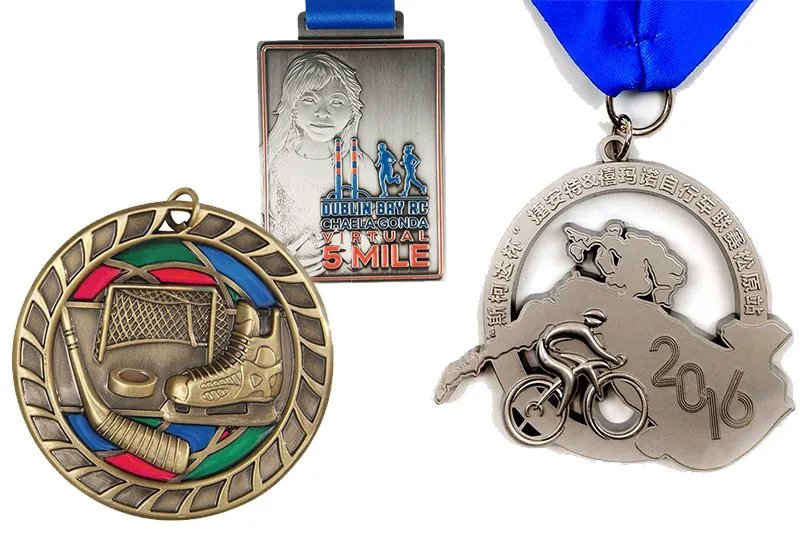
Zinc takes every finish we offer: gold, silver, antique bronze, dual plating, and the full enamel range. MedalOrigin has run this process since 2010, and 30,000+ pieces leave the factory on a busy day. If your race has a theme, zinc is the blank canvas. Most tournament and marathon medals are die-cast zinc with soft enamel fills. And because it’s the type we run the most, it’s also the type we turn around fastest at scale.
[Image: process-03-die-casting.jpg — Molten zinc alloy filling a die-cast mold on an 88-ton machine]
Stamped Iron and Brass: Budget or Heft
Stamping is the other metal path, and it splits into two very different purchases.
Iron stamped medals are the budget option. The material runs 7.8 g/cm³ but stamps thin, so they’re light and cheap to run in big quantities — think school fun runs and community 5Ks where you need 5,000 pieces and nobody expects to keep the medal for a decade. Brass stamped medals are the opposite: 8.9 g/cm³, heavy, and they engrave beautifully. We steer brass toward commemorative and championship awards where the weight is part of the point.
But stamping doesn’t do the deep 3D relief zinc does. Detail stays low and flat, which is fine for a simple logo on a round or shield shape.
Acrylic, Spinner, and LED: The Modern Three
Three types exist for events that want something a participant will post on social media.
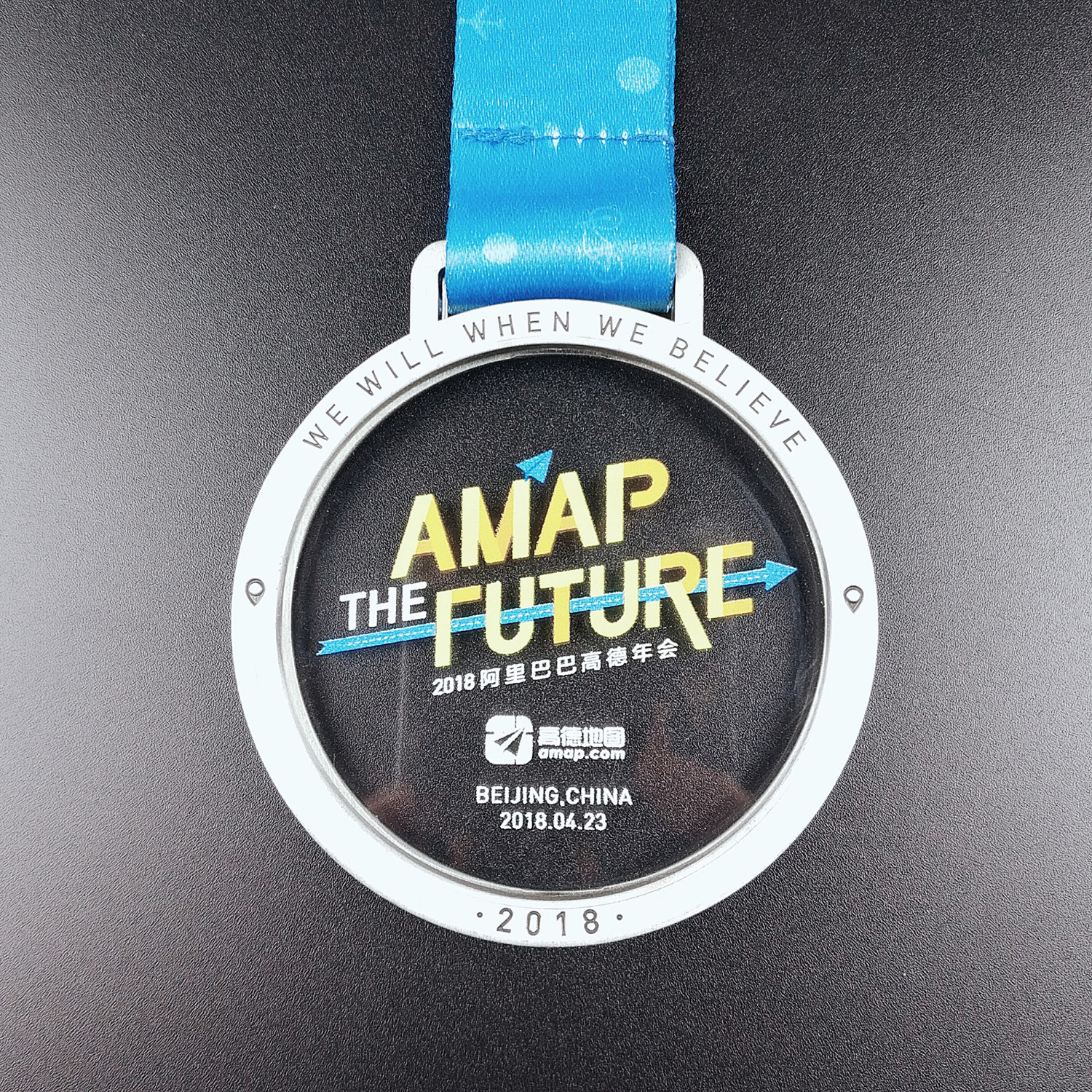
Acrylic medals are full-color and featherlight. No mold, no molten metal — a laser cuts the shape and a UV printer lays down full CMYK art, gradients included. They’re the cheapest type to produce because flat shapes skip the die-casting setup. See our acrylic medals page for the full rundown.
Spinner medals have a rotating center element. The middle disc spins on a rivet, so the design moves — a huge hit at expos and themed races where people fiddle with them on camera. We build them on our spinning medals line.
LED medals light up. A small LED and battery sit behind a translucent panel, so the medal glows when a switch is pressed. They’re the most expensive type and mostly show up at night runs and awards galas. And the electronics add cost and a little lead time, so order those early.
[Image: led-medals.jpg — A glowing LED medal lit up at an evening awards ceremony]
Soft Enamel vs Imitation Hard Enamel
The finish decision matters more than most buyers realize. It changes the look, the feel, and the price.
| Soft Enamel | Imitation Hard Enamel | |
|---|---|---|
| Surface | Recessed, raised metal lines | Flat and smooth, glass-like |
| Minimum fill area | 0.3mm | 0.5mm |
| Feel | Textured, traditional | Sleek, jewelry-like |
| Cost | Lower | Higher |
| Curing | Low-temp then 100°C cure | Thicker, longer cure |
Soft enamel leaves the metal lines raised, so you feel the texture — the classic race-medal look. It needs at least 0.3mm between areas for the color to hold. Imitation hard enamel fills flush with the metal and polishes to a flat, ceramic-smooth surface, but it needs 0.5mm of space, and it costs more because the enamel is thicker and the cure runs longer. We cure soft enamel at a low 60-70°C first, then a 100°C full cure for about 60 minutes. Colors are matched to Pantone either way. The choice usually comes down to budget and whether you want a textured, traditional feel or a smooth, jewelry-like finish. For finish examples, see our enamel medals page.
Ribbon Specs That Actually Matter
The medal is half the award. The ribbon is the other half, and it’s the part most buyers spec wrong.
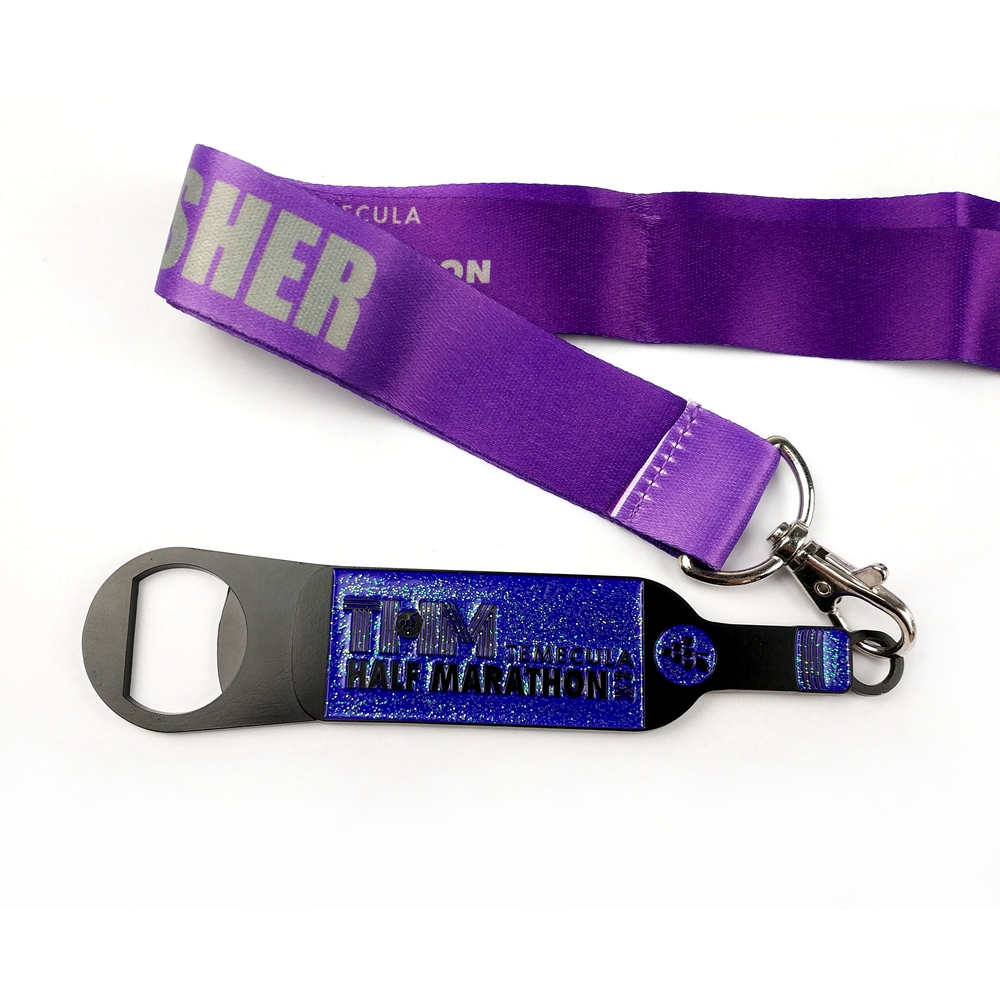
Our standard ribbon runs 860-900mm long and 20-30mm wide — long enough to slip over a head, wide enough to print your event name and year. We heat-seal the ends and weld the ribbon to the medal so it won’t fray or slip. Tell us the colors you want; we match Pantone and can print your race name, distance, or date along the length. If your event hands out medals on lanyards instead of neck ribbons, tell us — we print both the same way, and the width changes the cost more than the length. For the full material and cost breakdown, check our medal materials guide.
[Image: medal-ribbons.jpg — Rolls of custom printed medal ribbons in event colors with heat-sealed ends]
FAQ: Types of Custom Sports Medals
What’s the most common type of sports medal? Die-cast zinc alloy. It captures 3D relief at a mid-range price, and it’s what most marathons and tournaments order. Zinc is 6.7 g/cm³, cast on an 88-ton machine at 385°C.
What’s the cheapest medal type? Stamped iron for metal, acrylic for full-color designs. Both skip heavy mold work — iron stamps thin and fast, acrylic is laser-cut and UV-printed with no mold at all.
What’s the difference between soft enamel and hard enamel? Soft enamel leaves raised metal lines and needs at least 0.3mm of fill space. Imitation hard enamel fills flush and smooth but needs 0.5mm minimum, and costs more because the enamel is thicker and cures longer.
What ribbon size should I order? Our standard is 860-900mm long by 20-30mm wide. That’s long enough to slip over a head and wide enough for your event name and year in print.
Do LED and spinner medals cost more? Yes. Spinners add a rivet and a second die-cast part; LED medals add electronics and a battery, which also stretches lead time slightly. Budget for them at the top end of the range.
Can you match my event’s exact colors? Yes. We match ribbon and enamel to Pantone, and we print your event name, distance, or date directly on the ribbon.
Recommended Reading
- Custom Sports Medals: Design Guide for Soccer, Football & Tournament Awards
- Custom Medals for Swimming, Cycling & Triathlon Events
- Custom BJJ Medals: A Tournament Director’s Guide
Data to confirm: LED medal electronics and battery options vary by design — confirm current LED module specs and lead time with the production team before quoting a firm delivery date.