Size is the first thing a buyer picks and the last thing they think about. It sets how readable your artwork is, how heavy the medal feels in the hand, how much the order costs, and whether your ribbon sits right on a child’s neck. We cut moulds daily in our Huizhou factory, and the size brief is where most avoidable rework starts. This guide gives you the numbers up front — and it pairs with our medal design guide for artwork prep.
What we’ll cover:
- Standard medal diameters, by event type and audience
- Minimum and maximum thickness for each material
- How size changes cost, weight and production time
- Ribbon and lanyard lengths that match the medal
- The sizing mistakes that cause rework
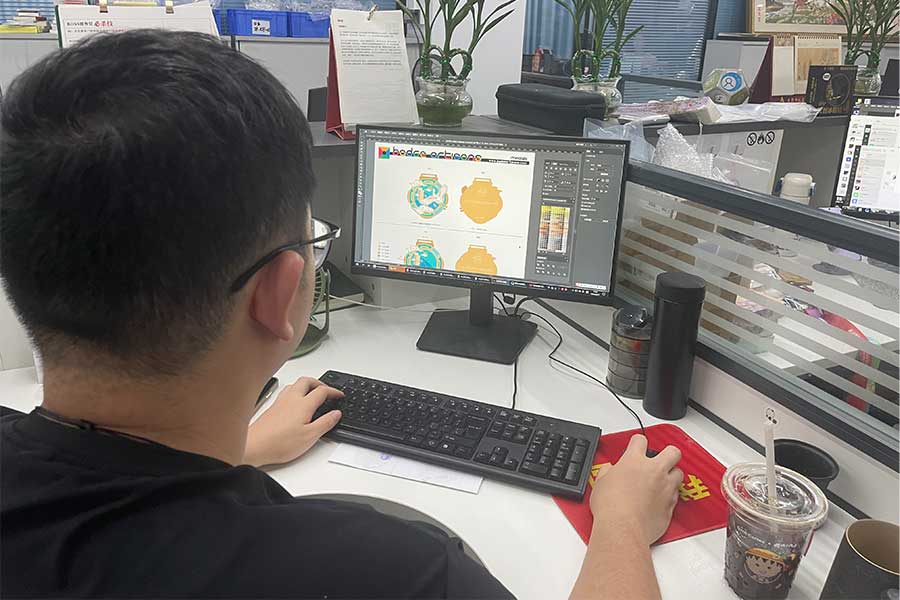
[Image: process-01-design.jpg — Medal artwork laid out on screen with diameter and thickness dimensions marked before mould cutting]
Standard Medal Sizes by Event
There is no single “standard” medal size, but the industry has settled into a few bands. Pick the band that matches your event, then adjust for audience age and whether the medal is worn or displayed.
| Event type | Typical diameter | Typical thickness | Why this size |
|---|---|---|---|
| Kids’ school sports | 40–50mm (1.6–2.0in) | 2–2.5mm | Light on small necks, lower cost at volume |
| Youth sports / leagues | 50–60mm (2.0–2.4in) | 2–3mm | Reads clearly in team photos |
| 5K / 10K / fun run | 60–70mm (2.4–2.8in) | 2.5–3mm | Standard finisher size, comfortable to wear |
| Marathon / half marathon | 70–80mm (2.8–3.1in) | 3–4mm | Premium finisher keepsake, heavier feel |
| Sports tournament awards | 50–65mm (2.0–2.6in) | 2.5–3mm | 1st/2nd/3rd sets, consistent look |
| Corporate / academic | 60–75mm (2.4–3.0in) | 3–4mm | Desk-display piece, weight signals value |
| Military / challenge coin | 45–60mm (1.8–2.4in) | 3–4mm | Handled constantly, needs rigidity |
| Commemorative / display | 80–100mm (3.1–3.9in) | 4–6mm | Wall or shelf piece, detail over wear |
Two inches — about 50mm — is the rough dividing line. Below it, a medal reads as a token for a child. Above it, it reads as an award for an adult. That is not a hard rule, but it is why kids’ events and marathon events land so far apart.
Our custom medals range covers all of these bands, and the sports medals line is built around the 50–70mm tournament range.
Thickness: The Constraint Most Buyers Hit
Thickness is not a free choice. Each material has a floor, and going below it means the metal will not fill the mould properly or will not hold its shape after ejection.
| Material | Forming process | Minimum thickness | Practical ceiling | Notes |
|---|---|---|---|---|
| Zinc alloy | Die-casting | 2mm | ~6mm | Best 3D and cut-out detail; the default |
| Brass | Stamping | 3mm practical | >3mm gets hard to press | Heavier, premium hand-feel |
| Iron | Stamping | 3mm practical | >4mm gets hard to press | Budget option, softer edges |
| Aluminium | Stamping | 2mm practical | — | Light, suits anodised colour |
| Stainless steel | Stamping | 2mm practical | — | Corrosion resistance, marine use |
Zinc alloy is the only material that comfortably does both fine detail and deep relief, because it melts at 385°C and flows into a mould with the viscosity of warm honey. That low viscosity is why it can hold a 2mm wall while still reproducing 0.3mm-wide lettering. Brass and iron are stamped instead — you press a flat blank, so the metal has to stay thick enough not to deform, which is why pushing brass past 3mm or iron past 4mm starts to fight the press.
If you want a heavier medal, the answer is usually more diameter, not more thickness. Going from 60mm to 75mm at the same thickness adds far more perceived weight than going from 3mm to 4mm at the same diameter, and it gives your artwork more room at the same time.
How Size Drives Cost
Size affects price through three channels: material volume, press cycle time, and mould complexity.
| Size band | Relative material cost | Press cycle | Mould cost | Per-unit impact |
|---|---|---|---|---|
| 40–50mm, 2mm | Lowest | Fastest | Lowest | Baseline |
| 50–60mm, 2.5–3mm | Low | Fast | Low | +10–20% |
| 60–70mm, 3mm | Moderate | Standard | Standard | +20–40% |
| 70–80mm, 3–4mm | Higher | Slower | Higher | +40–60% |
| 80–100mm, 4–6mm | Highest | Slowest | Highest | +60–120% |
The reason is straightforward: a bigger medal uses more grams of metal, and you pay for grams. Zinc alloy has a density of 6.7 g/cm³, brass 8.9 and iron 7.8 — so at identical dimensions, a brass medal weighs roughly a third more than a zinc one, and the material line reflects that.
Mould cost rises too, because a larger cavity needs more steel, longer machining, and more careful thermal control during the shot. That fixed cost is spread across your quantity, which is why the size premium is far more painful at 100 pieces than at 5,000. Our pricing breakdown shows how the mould fee amortises, and the bulk custom medals page covers the volume tiers.
[Image: process-02-mould-engraving.jpg — Steel mould for a large-diameter medal being engraved on a CNC machine]
Ribbon and Lanyard Lengths That Match
Size does not stop at the medal. The ribbon has to sit right, and it is the piece that most often gets ordered wrong.
| Medal size | Ribbon width | Ribbon length | Notes |
|---|---|---|---|
| 40–50mm (kids) | 20mm | 800mm | Shorter so the medal sits at chest height on a child |
| 50–65mm (youth / tournament) | 20mm | 860–900mm | Standard adult length |
| 65–80mm (race finisher) | 25–30mm | 860–900mm | Wider ribbon balances the heavier medal |
| 80mm+ (commemorative) | 30mm | 900mm+ | Display pieces often skip the ribbon entirely |
Our standard woven ribbon runs 860–900mm long by 20–30mm wide, with an 800mm × 20mm option for children’s events. Ribbons attach by ultrasonic welding or stitching, and the choice of neck ribbon versus lanyard depends on whether the medal is worn or carried — our ribbon materials guide covers that decision.
One sizing note that saves rework: if you increase the medal diameter by more than about 10mm, step the ribbon width up with it. A 30mm ribbon on a 45mm medal looks unbalanced, and a 20mm ribbon on an 80mm medal can twist under the weight.
The Sizing Mistakes That Cause Rework
Sizing by inches when the factory quotes in millimetres. A 2.5in medal is 63.5mm, not 60mm or 65mm. Rounding at the brief stage changes the mould, and the mould is the one thing you cannot adjust later. Convert once, confirm in mm, then freeze it.
Adding detail without adding size. Artwork that works at 70mm does not automatically work at 50mm. Every element scales down with the medal, so a 4pt line of text at 70mm becomes roughly 2.9pt at 50mm — below the threshold where enamel can hold it cleanly. If you shrink the medal, simplify the artwork.
Going thinner to save money. Below 2mm, zinc alloy will not fill the mould reliably, and you get short shots and weak edges. The saving is small and the failure rate is not. Adjust colour count or packaging instead — those are the levers that move price without risking the casting.
Forgetting that thickness affects the edge. A 4mm medal has a visible side wall, and that edge is where the plating meets the world. On thick medals it is worth specifying the edge finish — it is the part recipients see when the medal is in their hand.
Ordering one size for a mixed-age event. If your event covers under-12s and adults, one diameter will be wrong for someone. Many organisers run two sizes — 50mm for juniors, 65mm for seniors — with the same artwork scaled to fit. It costs marginally more and looks deliberate rather than improvised.
If you tell us your event type, audience age and quantity, we will recommend a diameter and thickness combination and show you what each size step costs — before a mould is cut.
Data to confirm: Confirm minimum thickness and maximum diameter for your chosen material with the factory before finalising a design, as press capacity and alloy supply can vary by production run.
FAQ
What is the standard size of a custom medal? There is no single standard, but 60–70mm (2.4–2.8in) is the most common band for adult race and sports medals, and 40–50mm for children’s events. Tournament awards typically sit at 50–65mm. Size is chosen to match the audience rather than a fixed industry number.
How thick should a custom medal be? Zinc alloy die-cast medals need a minimum of 2mm, with 2.5–3mm being typical for race medals and 3–4mm for premium or commemorative pieces. Brass gets hard to stamp past 3mm and iron past 4mm. Going below the minimum risks short shots and weak edges.
Does a bigger medal cost more? Yes. Larger medals use more metal by weight and need a bigger mould with a longer press cycle. A move from the 40–50mm band to the 70–80mm band typically adds 40–60% to the per-unit cost, and the premium is sharpest on small orders where the mould fee dominates.
How do I choose between a heavier or a bigger medal? Increase the diameter, not the thickness. Going from 60mm to 75mm adds more perceived weight than going from 3mm to 4mm, and it also gives your artwork more room. Thickness should be driven by the material’s minimum and the rigidity the medal needs.
What size medal ribbon do I need? Match ribbon width to medal diameter: 20mm for 40–65mm medals, 25–30mm for 65–80mm medals, and 30mm or wider above 80mm. Standard length is 860–900mm for adults and 800mm for children’s events. Step the width up whenever you increase the medal by more than about 10mm.
Can I order different sizes in one order? Yes. A common approach for mixed-age events is two sizes — for example 50mm for juniors and 65mm for seniors — using the same artwork scaled to each. Each size needs its own mould, so expect a separate tooling charge per size.
What is the largest medal you can make? We routinely produce 80–100mm commemorative and display medals at 4–6mm thick. Beyond that, weight and mould cost climb quickly and the medal stops being wearable. For very large display pieces, plaques often work better than medals — see our custom plaques range.
See also: hard enamel award medals — our hard enamel medal line: Pantone colour matching, 0.3 mm minimum fill and 100-piece minimum.