Soccer medals are the single highest-volume sport category we produce. That volume means we’ve seen every version of the ordering mistake — a club buying 400 identical medals when their tournament needed three distinct tiers, a league approving a ball design whose panel geometry was wrong, a youth program ordering 70mm medals for six-year-olds. We cast custom sports medals in Huizhou, so here’s what actually matters when you spec a soccer medal.
What we’ll cover:
- Club season medals vs tournament medals, and why they differ
- Getting the ball relief right, and why panel geometry matters
- Sizing by age group without breaking the budget
- How to structure tiers so the ordering math works
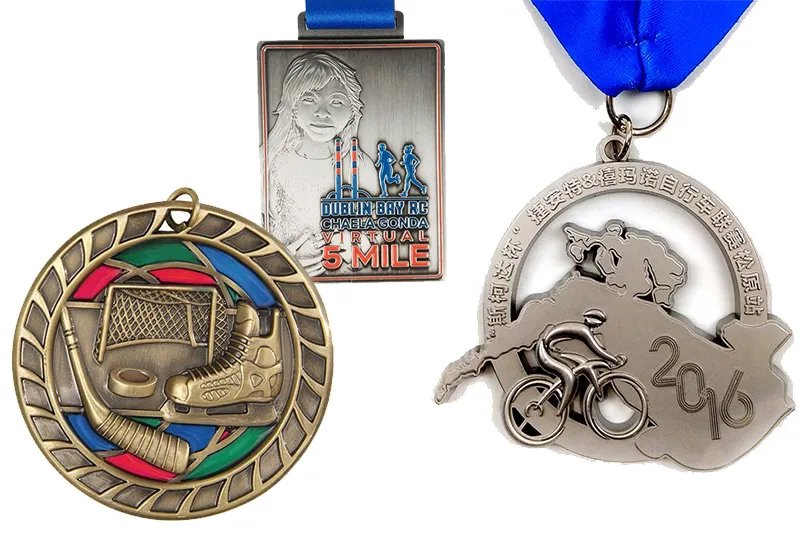
[Image: sports-medals.jpg — Custom soccer medals with 3D ball relief and colored enamel]
Club Season Medals and Tournament Medals Are Different Products
The first decision isn’t size or color. It’s which soccer event you’re buying for, because club seasons and tournaments have different award logic.
A club season runs months and produces a story: improvement, attendance, attitude, results. The award should reflect the season’s narrative. That means placement medals for the top teams plus a set of individual recognitions that reward things the table doesn’t show.
A tournament compresses into a weekend. There’s no improvement arc, only what happened over two days. The award should be tightly bound to that specific event — the tournament name, the year, the tier.
| Club season medals | Tournament medals | |
|---|---|---|
| Primary award | Placement + season-long categories | All-tournament + top scorer |
| Typical size | 55–65mm | 50–60mm |
| Design emphasis | Club crest, season year, division | Tournament name, host mark, year |
| Volume profile | Few designs, high quantity | More designs, moderate quantity |
| Turnaround pressure | Usually comfortable | Often tight |
That volume profile row is the one that changes your budget. A club orders two or three designs at high quantity — good for setup cost. A tournament orders more designs at lower quantity — more setup cost, so tournament organizers need to think harder about consolidation.
[Image: process-01-design.jpg — Design team laying out club crest artwork for soccer medals]
Getting the Ball Relief Right
Soccer medal artwork almost always centers on a ball, and the ball’s panel geometry is what makes it read as soccer rather than as a generic sphere. This is the detail we correct most often, and it’s expensive to fix after tooling.
A modern match ball uses a mix of pentagon and hexagon panels. When cast in relief, those panel edges are what catch light and create the visual signature of a soccer ball. If the proof shows a smooth sphere with a few curved lines, it will photograph as a marble. You won’t see the problem in a small on-screen mockup. You will see it in 500 medals in a box.
Check three things on the proof:
- Panel count and distribution. Pentagons surrounded by hexagons, evenly spaced around the visible hemisphere.
- Panel edge depth. The seams need enough relief to cast cleanly. Zinc alloy holds a 2mm minimum wall, and the seam geometry has to respect that.
- Ball orientation. Which way the ball faces changes which panels are visible. A ball facing straight-on looks flat; a slightly rotated ball shows more panel structure.
Zinc die-casting handles this well because Zamak 3, 5, and 7 melt at 385°C and flow into a mold cavity easily, so an 88-ton press captures fine relief in a single shot. That’s why soccer medals in zinc hold panel detail that stamped metals can’t reproduce at all.
Beyond the ball, the elements that matter most are the club crest or tournament mark, the placement number if applicable, and the year. Cast the year if the medal is a one-off. Engrave the year if you plan to reuse the tooling — that’s the difference between a one-season medal and a five-season design.
[Image: process-03-die-casting.jpg — 88-ton die-casting press forming soccer ball relief into a medal]
Sizing by Age Group
Soccer spans the widest age range of any sport we produce for, from four-year-old rec leagues to adult competitive divisions. Size should follow the recipient.
| Age group | Medal size | Priority | Notes |
|---|---|---|---|
| U6 rec | 45–50mm | Safety, bright color | Rounded edges, ribbon ≤20mm, no ordinal numbers |
| U8–U10 | 50–55mm | Durability, fun iconography | Standard ribbon, 25mm |
| U12–U14 | 55–60mm | Prestige, tier distinction | Cast placement numbers work now |
| U16–U18 | 60–65mm | Weight, formal finish | Heavier zinc or brass, mirror plating |
| Adult / competitive | 60–70mm | Weight, engraving | Display box or stand pairing |
The design implication of that table is simple. Under-6s get a friendly shape and no ranking, because ranking isn’t the point at that age and the medal’s job is to be a safe, bright object a kid wants to keep. By U12, cast placement numbers make sense and the medal becomes a competitive record.
Weight matters more than most buyers expect at the upper end. A U18 player who has just won a regional final reads a heavy medal as a serious award. That’s where brass at 8.9 g/cm³ or heavier zinc with a mirror gold plating earns its cost. For rec leagues, zinc with an antique finish delivers a good look at a lower finishing cost, because antique uses single-pass electrophoresis or barrel plating rather than full electroplating.
If your program covers more than soccer, our swimming, cycling, and triathlon guide covers how to run multiple sports as one combined production order.
Structuring Tiers So the Ordering Math Works
Most soccer clubs need three tiers: champion, runner-up, and a participation or placement medal for the rest. Each tier needs to look meaningfully different without requiring three separate molds.
The efficient approach is one mold with plating variants.
Cast one design that works for every tier — the club crest, the ball, the year, the tournament or division name. Then vary the plating: imitation gold for the champion, nickel silver for the runner-up, antique bronze or an entirely different shape for participation. Plating costs a moderate amount and requires no new tooling, so the tier distinction costs fractionally what a second mold would.
| Tier | Plating | Relative cost | Signal |
|---|---|---|---|
| Champion | Imitation gold (mirror) | $$ | Highest, brightest |
| Runner-up | Nickel silver (mirror) | $$ | Clearly distinct from gold |
| Placement / participation | Antique bronze or tin | $ | Inclusive, lower cost |
That third row is worth attention. Antique finishes are cheaper than mirror because they use electrophoresis or barrel plating in a single pass. So a participation tier that uses antique bronze costs less per piece than your champion tier while still looking deliberate. It reads as a designed choice rather than a downgrade.
If you’re running a multi-age tournament, consider ordering all age brackets in one combined run. Setup — loading the mold, mixing enamel colors, warming the plating tanks — costs about the same whether you run 100 pieces or 10,000. Our minimum is 100 pieces per design, and our floor runs over 30,000 pieces a day. Combining brackets into a single order spreads that setup across far more units.
Enamel color is where discipline pays. Every color is a separate fill-and-bake cycle: the low-temperature cure runs 60 to 70°C for 60 to 90 minutes for a half-set, and the full cure is 100°C for 60 minutes. A club that keeps to three or four colors — crest colors plus one accent — gets a sharper price than one that reproduces a full-color crest.
[Image: process-09-color-filling.jpg — Technician filling enamel colors into a soccer medal’s recessed areas]
Ordering Timeline and Practicalities
Soccer has the tightest calendar in youth sports. Fall and spring seasons compress into windows, and tournament dates don’t move. Plan backward from your presentation date.
Budget four to five weeks. A free design proof takes 24 hours with unlimited revisions, samples take 7 to 10 days, and full production ships in 7 to 15 days after you approve the sample. If you’re engraving individual player names or team records, add time for that step, since it happens after casting and finishing.
Two practical notes from years of soccer orders. First, order your ribbons with your medals in the same run so the ribbon colors match the plating. Mismatched ribbon-and-plating is the most common presentation complaint we field, and it’s entirely avoidable. Second, if your tournament has a title sponsor, get their logo into the design before tooling rather than trying to add it afterward — post-tooling changes mean a new mold.
Standard ribbon sizing runs 860–900mm long by 20–30mm wide, which covers everything from a U8 lanyard to an adult presentation ribbon. Our medal ribbons page covers printing and material options, and our medal manufacturing process page walks through all 12 production steps.
Send us your age brackets, tier structure, and crest through our contact page and we’ll quote it as one combined run with a free proof inside 24 hours.
[Image: factory-workshop-05.jpg — Medal factory production floor handling a soccer club’s combined order]
FAQ: Soccer Medals
What size are standard soccer medals? Most adult and competitive soccer medals run 60–70mm, while youth divisions work better between 45 and 60mm depending on age. Under-6s should get 45–50mm with rounded edges and a ribbon no wider than about 20mm. U12–U14 suits 55–60mm, where cast placement numbers start to make sense.
How do I make sure the ball on my medal actually looks like a soccer ball? Check the panel geometry on the proof before approving tooling. A match ball uses pentagons surrounded by hexagons, and those panel edges are what catch light and read as soccer when cast in relief. A smooth sphere with curved lines photographs as a marble. Confirm panel count, seam depth, and the ball’s rotation angle on the proof.
Can I use one design for champion, runner-up, and participation tiers? Yes, and it’s the most cost-effective structure. Cast one design that works across all tiers, then vary the plating: imitation gold for champion, nickel silver for runner-up, and antique bronze or tin for participation. Plating changes require no new tooling, so tier distinction costs a fraction of a second mold.
Is antique finish cheaper than gold on soccer medals? Yes. Bright imitation gold and nickel require full electroplating, including roughly 500 seconds of alkaline copper base and 20 to 60 minutes of acid copper to build shine. Antique bronze and tin use single-pass electrophoresis or barrel plating, which costs less — so your participation tier can cost less per piece than your champion tier.
How far ahead should a soccer club order medals? Allow four to five weeks. A free design proof comes back within 24 hours, samples take 7 to 10 days, and full production ships in 7 to 15 days after sample approval. Add time if you’re engraving individual player names or team records.
Can I reuse the same mold for multiple seasons? Yes, if you design for it. Cast the elements that stay constant — club crest, ball, division — and engrave the variable parts like the year afterward. That lets one tooling set serve several seasons instead of paying for a new mold each year.
Recommended Reading
- Types of Custom Sports Medals: Which Fits Your Event? — comparing medal types for athletic events
- Custom Sports Medals: The Tournament Organizer’s Guide — running medals across a multi-bracket event
- Kids Medals: Safety and Design Guide — spec’ing medals for young recipients
Data to confirm: age-group size ranges and ribbon widths reflect our standard guidance and common practice. Actual per-piece pricing depends on artwork complexity, color count, quantity, and plating choice. Confirm age-safety requirements against the standards that apply in your market.
Related reading: rotating-centre custom medals — our spinning medal range: a moving inner disc on a die-cast body, 100-piece minimum.