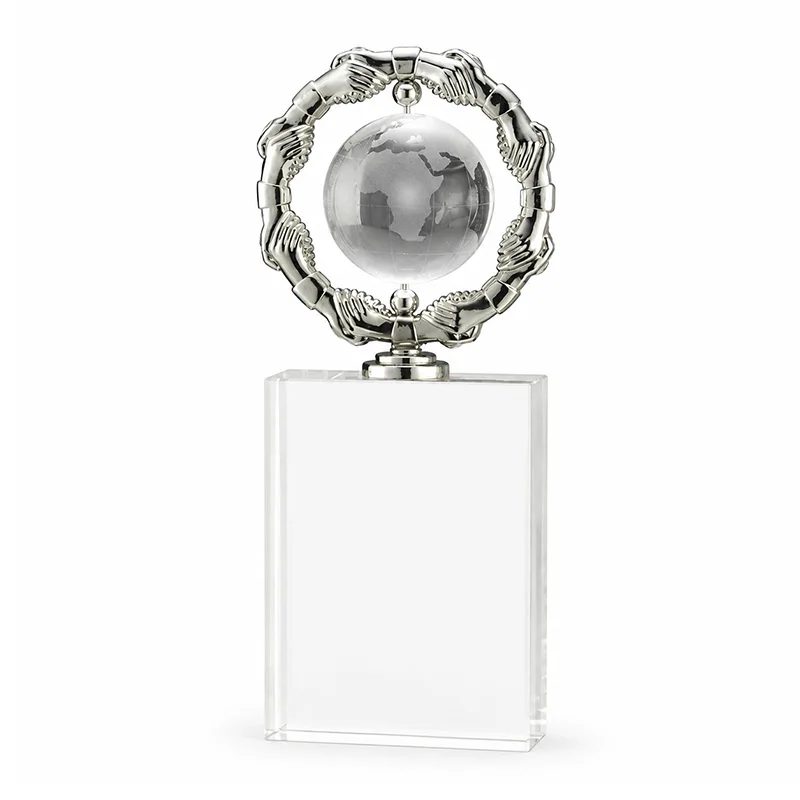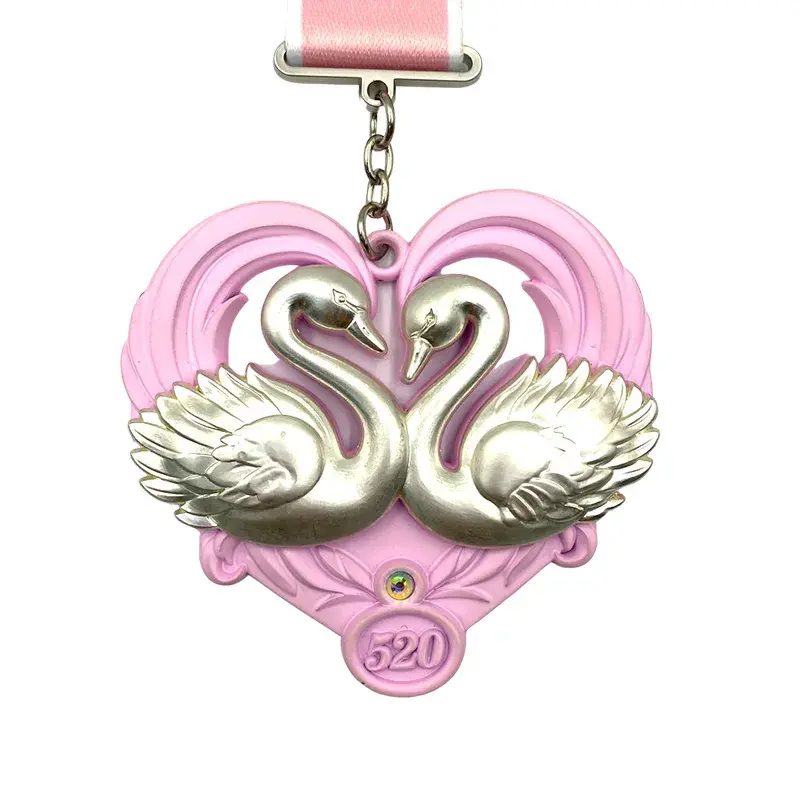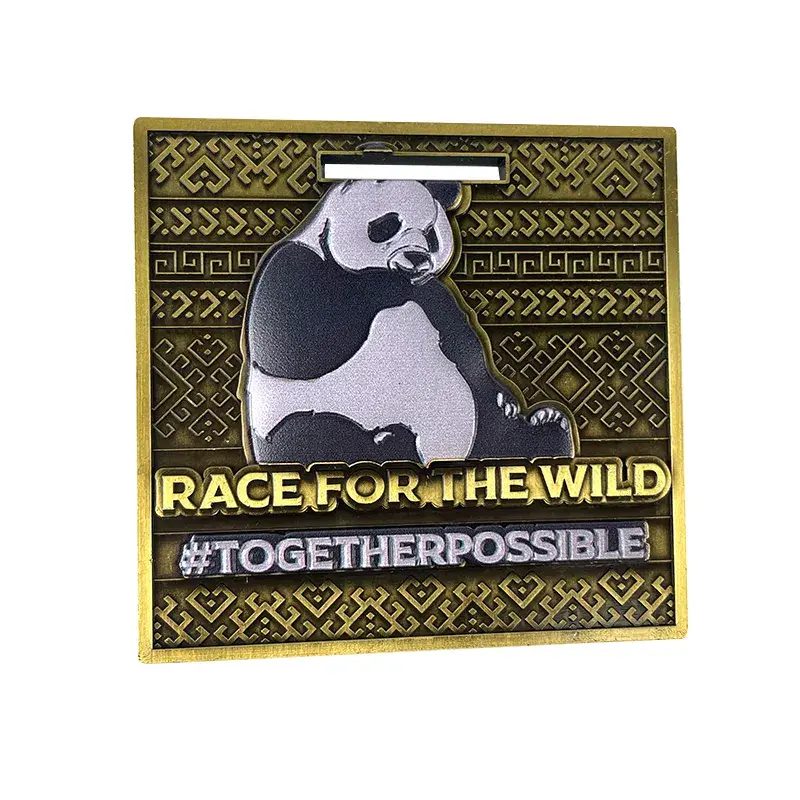
When a runner crosses a real finish line, the medal is handed over at a table, admired for ten seconds, and dropped into a kit bag. When a runner finishes a virtual race, that same medal goes into a mailer, passes through a sorting hub, rides in a van, and is either pushed through a letterbox or handed to a neighbour who may or may not keep it dry. Two completely different journeys, one object. We have been die-casting and finishing custom medals in Huizhou since 2010, and virtual events, medal-a-month subscriptions and corporate step challenges now make up a large share of the briefs that reach our desk — and almost none of the early questions are about the front artwork. They are about grams, millimetres, flat backs, bagging, and how to get four thousand addresses onto four thousand mailers without mixing two of them up. This guide is the version of that conversation we have before we quote, and it follows the same order as our custom medal production flow — design first, but weight and packing decided early, because those two decide your landed cost per finisher.
Why a virtual race medal is a shipping product, not a finish-line product
An event medal is judged by a person holding it in their hand, under event lighting, next to a timing mat. A virtual race medal is judged twice: once by the recipient opening an envelope on a kitchen table, and once by whoever handles the return, the replacement, or the complaint. There is no event staff to swap a scratched medal for a clean one. There is no “we’ll fix it on race day.” The medal that arrives is the whole product experience, and if it arrives with a chipped enamel edge, a bent pin or a crushed card, the organiser owns that failure in public.
That changes the brief. In a line-event project, maybe 70% of the design conversation is about the front face and 30% about mechanics. In a virtual project it inverts. The front still matters — it is what people photograph — but the decisions that determine whether the project is profitable sit on the back, on the edge, and in the bag.
| Design decision | Line-event medal | Virtual / mailed medal |
|---|---|---|
| Weight target | Heavier reads as premium; nothing to protect | Every gram is postage and every gram is momentum inside the mailer |
| Thickness | Chosen for feel and relief depth | Chosen for rigidity first; a thin disc bends in sorting |
| Relief depth | As deep as the artwork allows | Capped by what survives a padded envelope without snagging |
| Back face | Rarely seen, often rough | Must be flat, deburred and printable or laser-markable |
| Edge | Decorative | Rounded and de-flashed; a sharp edge cuts the bag |
| Attachment | Ribbon tied on site | Pre-assembled, because the recipient should not have to thread a ribbon |
| Packing | Bulk carton | One piece per bag, sometimes per card, sometimes per mailer |
| Personalisation | Optional, usually none | Often the point: name, bib number, finish time, month |
| QC focus | Visual, at the event | Visual plus packing accuracy plus address accuracy |
| Failure recovery | Replace at the venue | Re-ship internationally at your cost |
Start with grams: what the metal actually weighs
The fastest way to lose margin on a subscription programme is to approve a beautiful 70 mm, 5 mm-thick zinc medal and only then discover what 3,000 of them weigh. Density is the number that decides this, and it is not negotiable: zinc alloy sits at 6.7 g/cm³, copper at 8.9 g/cm³, iron at 7.8 g/cm³, and aluminium at 2.7 g/cm³.
| Material | Density | How it is formed | What it means for a mailed medal |
|---|---|---|---|
| Zinc alloy (3#, 5#, 7#) | 6.7 g/cm³ | Die-cast at 385℃ | Best 3D relief and openwork; heaviest common choice; needs thickness control |
| Aluminium | 2.7 g/cm³ | Stamped from sheet | Lightest option by far; flat graphics only; anodising instead of plating |
| Copper / brass | 8.9 g/cm³ | Stamped, hard to press above 3 mm | Heaviest; premium feel; postage punishes it |
| Iron | 7.8 g/cm³ | Stamped, hard to press above 4 mm | Cheap and magnetic; rust risk in humid transit |
| Stainless steel | — | Stamped | Corrosion resistance is the reason to choose it; hard on tooling |
Here is the arithmetic we actually run in quoting. A 60 mm round medal at 3 mm nominal thickness has a volume of roughly 8.5 cm³ (π × 3² × 0.3). In zinc alloy that is about 57 g before any relief; the identical blank in aluminium is about 23 g, and in copper about 75 g. Relief adds more than most people expect: a 2 mm raised rim running around the same 60 mm disc adds roughly 0.7 cm³, which is another 4.9 g of zinc. Multiply that by 5,000 pieces and you have added 24.5 kg to a shipment that was already crossing a postal weight band.
That is the first original number we put in front of organisers: design the relief, then re-weigh the model, then approve the artwork. Not the other way round. If a 57 g medal plus ribbon, card and bag lands at 90 g and your target band breaks at 100 g, you have 10 g of headroom and no more — and the cheapest way to find 10 g is usually a smaller diameter or aluminium, not thinner casting.
When aluminium is the right answer
For a virtual run where the medal is a token rather than a trophy, aluminium is often the correct call. At 2.7 g/cm³ a 60 mm disc is under half the mass, the anodised finish does not chip the way a coating can, and the flat graphic style suits a clean logo-based design. What you give up is depth: aluminium is stamped, so no sculpted mascot, no undercuts, no true cut-through openwork. If the artwork has a raised figure or a hollow frame, the material has already chosen itself. The trade-off is laid out in more detail in our size and thickness guide.
Thickness, draft and relief: the die-casting side
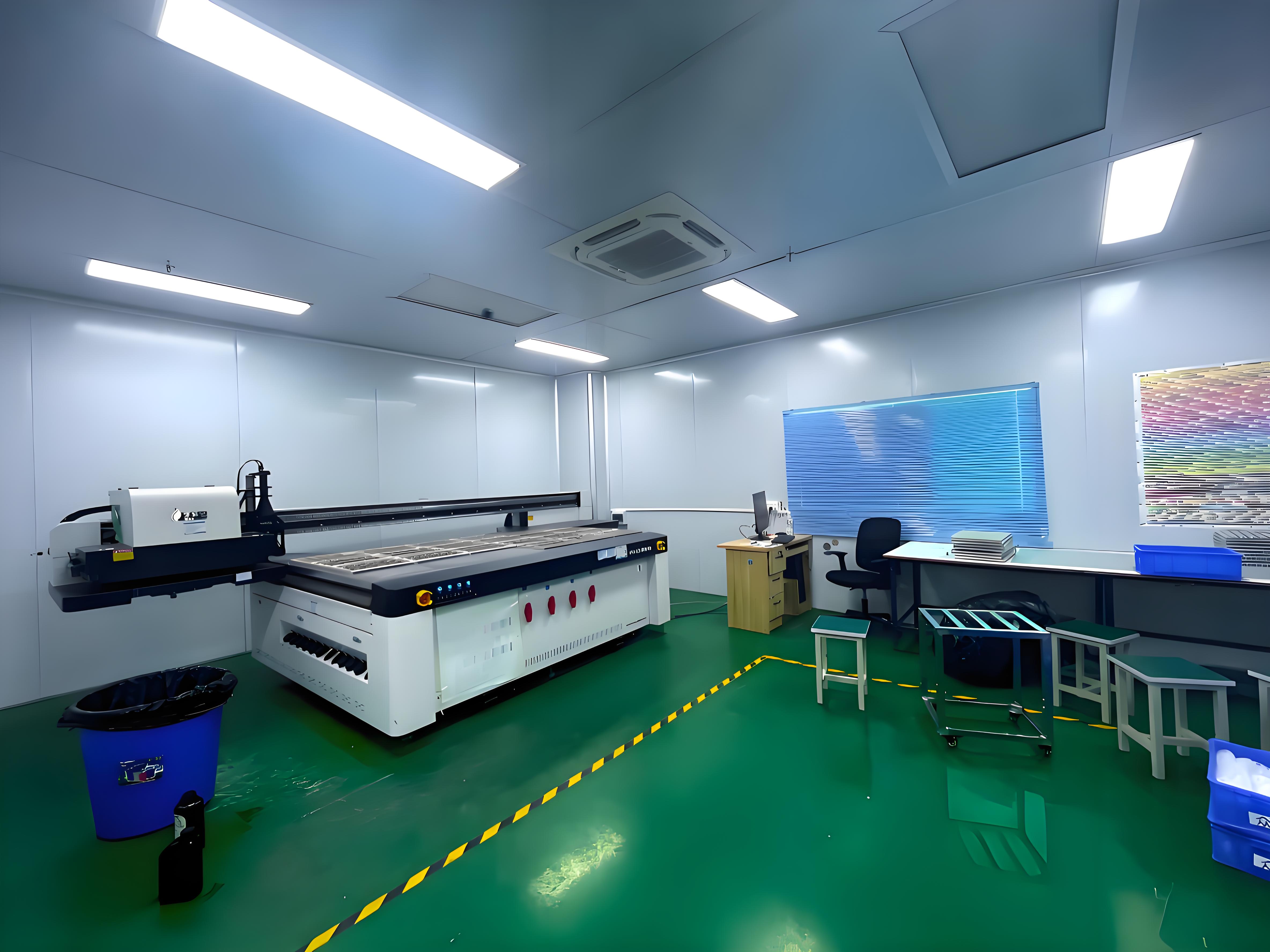
Everything we cast runs on an 88-tonne machine. Zinc alloy melts at 385℃ and is injected through a nozzle into a steel mould; the mould itself is cut from tool steel, and the cavity surface is finished by spark erosion, which leaves the fine matte skin that paint and plating key into. The tool is then heat-treated to harden it against wear, because a subscription programme may run the same design twelve times a year.
Two production realities drive virtual-race design more than any other:
- Minimum wall thickness is 2 mm. Below that the metal will not fill reliably at the far end of the cavity, and you get short shots — corners that never formed. A medal that looks elegant at 1.6 mm in a render is not a medal we can cast.
- A round medal gets four gates, evenly spaced around the circumference. That is how the metal reaches the rim at the same moment on all sides, which is what keeps the disc concentric. The trade-off is four small gate stubs on the edge. On an event medal nobody notices. On a mailed medal, where the recipient turns it over in their hand, you want those stubs sitting in a recessed border or a step, so the finishing department can grind them flush without touching the face.
Relief depth is where virtual-race design most often goes wrong. Deep 3D looks superb in a photograph and behaves badly in a padded envelope: tall relief catches on the bubble wrap, chips at the high points, and creates a pressure point that cracks enamel on the opposite face when the mailer is compressed. As a working rule, we push virtual-race relief into the 1–2 mm range on the main field and reserve the deep sculpting for a single focal element, ideally in the centre where the mailer has the most give.
Cracks in a casting are almost never the metal’s fault. They come from too few ejector pins, or pins distributed unevenly — the part is pushed out of the mould before it has shrunk evenly, and it tears. Other casting defects we chase down: water marks from a mould that is not polished clean, low injection pressure, or running the machine too fast; porosity from poor venting in the mould; and sharp corners that never fill because the pressure was not high enough to drive metal into the last corner. Every one of those is a tooling or parameter decision made before your first sample, which is why we would rather argue about wall thickness at the artwork stage than at the re-order.
The back face is not an afterthought
On a mailed medal, the back is seen more often than the front. The recipient turns it over to look for the date, the distance, their name. It is also the surface that touches the bag, the card and the sorting belt.
Three things matter:
- Flatness. A dished back rocks on a table and, more practically, will not sit flat against a printed card in a card-and-bag pack. We hold the back to a flat field with the ejector pin marks sunk into a recess rather than standing proud.
- Deburring. Any flash or gate residue on the back edge will cut through a 40-micron bag in transit. Edges get tumbled and hand-finished before plating.
- Variable data. This is the single biggest advantage of a mailed medal: laser engraving works on any surface and needs no tooling, so a name, a bib number, a finish time or a month can differ on every piece without a new mould. Laser is also the only sane way to run sequential numbering. We do not recommend printing names on the front — a printed name sits in the highest-wear zone and will abrade before the medal reaches the display shelf.
If you want the back engraved with a message from a charity sponsor, that is a second operation on the same blank and costs time, not a new tool. Plan it into the schedule rather than adding it after sampling.
Finishes: what survives a mailer
Our plating line runs nine stages: degreasing, ultrasonic cleaning, alkaline copper plating (about 500 seconds), acid copper plating (20–60 minutes, which is where the build and the brightness come from), electroplating colour, tunnel-oven drying at 100℃ for 40 minutes, lacquer sealing, and unhooking. The reason the copper layers exist at all is adhesion and levelling: a zinc casting plated straight to colour will blister the first time it meets humidity in a postal van. Plating blisters come from the part not being cleaned properly before it enters the bath — that is the cause, every time — and flow lines in the plating come from insufficient agitation or too much organic contamination in the bath.
Cost order in finishing is fixed: plating is the most expensive, then painting, then electrophoresis. That ordering explains why a fully plated mirror-gold medal with a lacquer seal costs more than a painted one, and why “just make it gold” is not a small change late in the project.
| Finish | Minimum detail | Scuff resistance in transit | Best use on a mailed medal |
|---|---|---|---|
| Bright plating (imitation gold, nickel, chrome, rose gold, black nickel, white K) | Fine | Lowest — mirror surfaces show every contact mark | Display pieces, low-volume premium tiers |
| Matte / frosted plating (matte gold, matte nickel, matte copper, matte rose gold) | Fine | High — micro-texture hides handling | Default choice for subscription medals |
| Antique finishes (bronze, tin, copper) and matte black | Medium | High — patina absorbs scratches | Heritage, charity, challenge-series designs |
| Soft enamel (0.3 mm minimum colour channel) | Finest — 0.3 mm | Medium; enamel sits below the metal line and is protected by it | Logo-heavy designs, fine text |
| Imitation hard enamel (0.5 mm, polished flat) | 0.5 mm | Medium-high; flat surface scuffs but does not chip at edges | Premium subscription tiers |
| Glass enamel / translucent enamel (0.5 mm) | 0.5 mm | Medium; translucent needs high-temperature tape on the back during curing | Depth and jewel-tone effects |
| UV print | Flat or 3D up to 7 mm of surface step | Medium-low; needs a protective coat | Full-colour gradients, photo elements |
| Epoxy dome over soft enamel | 0.3 mm base | High — the dome takes the abrasion | Budget medals that must survive rough post |
Two process notes that matter for virtual races specifically. First, soft enamel and imitation hard enamel run in opposite sequences: soft enamel is plated first, then filled, then cured; imitation hard enamel is filled first, polished flat, then plated. That reversal is why hard enamel holds a crisper line but costs more and cannot carry the same 0.3 mm detail. Second, UV printing handles gradients and four-colour artwork but registration is not exact, and the surface has a slight sandy feel — fine for a colourful challenge medal, wrong for a precise typographic back. Our plating finishes comparison covers the colour range in depth, including two-tone and vacuum-coated iridescent options.
Colour matching is done to Pantone, and curing has two settings worth knowing: a low-temperature cure at 60–70℃ for 60–90 minutes leaves the enamel semi-cured for a second colour pass, and a high-temperature cure at 100℃ for 60 minutes fully hardens it. Skipping the full cure to save a day is how you ship enamel that arrives soft and picks up bag texture.
Packing one piece at a time
This is where virtual-race projects diverge most sharply from event work, and where the per-unit cost is won or lost. A bulk carton of 500 medals is a logistics problem. Five hundred individual mailers is a fulfilment operation.
| Pack format | Protection | Relative cost | Where it fits |
|---|---|---|---|
| PP bag (self-seal) | Basic; dust and scuff only | Lowest | High-volume subscription runs posted in a padded outer |
| OPP bag | Basic, clearer presentation | Low | Retail-style unboxing on a budget |
| Zip bag | Basic, re-closable | Low | Kits where the medal is stored after the event |
| Paper card + bag | Good; card stiffens the pack and carries the message | Low-medium | The default for virtual races — card prints the event, date and sponsor |
| Bubble bag | Good against impact, poor against bending | Medium | Heavier medals, long-haul post |
| Velvet pouch | Presentation, no impact protection | Medium | Premium tiers, charity gifting |
| Paper box / velvet box / acrylic box | Best presentation | High | Tiered subscription boxes, corporate gifting |
| Blister | Rigid, retail-grade | High | Retail-channel medals, not typical mailers |
The practical recommendation for most virtual races is a paper card plus a PP or OPP bag, dropped into a padded outer mailer. The card does three jobs at once: it stiffens the pack so the medal cannot bend, it carries the personalisation (name, time, month), and it stops the medal from sliding. Where the medal is heavy — anything over roughly 60 g in zinc — we move to a bubble bag or a card with a die-cut window so the piece is held rather than loose.
Three small decisions that repeatedly save money:
- Round the outer edge. A 0.5 mm chamfer costs nothing at the mould stage and prevents bag punctures.
- Keep the attachment assembled. A ribbon threaded and ultrasonically welded at our bench arrives wearable; a loose ribbon in a bag arrives as a puzzle and generates support emails. Standard webbing runs 860–900 mm × 20–30 mm, with 800 × 20 mm for children’s events; four-fold, three-fold and angled single-loop seals are all done either by ultrasonic welding or stitching.
- Decide the magnet early. If the design doubles as a fridge magnet, the magnet is Φ2–20 mm and has to be set into a recess on the back before plating is sealed. It cannot be added later without rework.
Running a twelve-month subscription without twelve moulds
Medal-a-month programmes look like a design problem and are actually a tooling-amortisation problem. Our MOQ is 100 pcs per design, which means a twelve-design year is twelve separate tools unless you plan for reuse. Three ways we keep that affordable:
- One blank, twelve artworks. Keep the disc geometry identical across the year and change only the enamel fill, the plating colour and the laser-engraved back. The mould is cut once; the artwork changes monthly.
- Series logic. Design a twelve-piece set where each medal is a segment of a larger image. The collector incentive is built into the mould plan.
- Material mixing. A die-cast zinc centre with an acrylic or wood outer layer gives visual variety without a second casting tool — and our acrylic medal range covers the lighter, laser-cut end of that mix. Multi-material builds (wood, acrylic, resin combined with zinc) are a legitimate way to make month seven look different from month six.
Throughput is not the constraint. We run 30,000+ pieces a day, which is roughly 3,750 an hour across a shift — a 5,000-piece monthly drop is a bit over an hour of press time. The days are consumed by plating batches, enamel curing, assembly and packing, not by casting. That is why a re-order with an unchanged mould is fast and a new design is not.
Sorting, labelling and QC at volume
The failure mode that ruins a virtual race is not a bad medal. It is 4,000 good medals and 40 wrong addresses. We handle this as a production step, not an afterthought:
- Batch segregation. Each design and each personalisation batch is kept physically separate from the moment it leaves finishing. Mixed bins are how names end up on the wrong medal.
- Bag-then-label, never label-then-bag. The label goes on the sealed unit, and the unit is scanned against the batch list.
- Three-stage QC with a 100% pass target. Incoming material, in-process inspection at casting and finishing, and final inspection at packing. On a mailed order the final stage includes a pack check — correct design, correct name, correct card, seal intact.
- Defect logging by cause, not by symptom. A chipped edge is a symptom; the cause might be a gate stub left proud, a bag too thin, or a card that does not hold the medal still.
| Defect | Root cause we look for | Consequence in the mail |
|---|---|---|
| Crack across the face | Too few ejector pins, or unevenly distributed | Medal splits when the mailer is flexed |
| Water marks on the surface | Mould not polished, low pressure, machine run too fast | Visible ghosting under plating; customer complaint |
| Porosity / pinholes | Poor venting in the mould | Plating bubbles later, in the recipient’s hands |
| Plating blister | Part not cleaned before plating | Flaking after humidity exposure in transit |
| Flow lines in plating | Insufficient bath agitation, organic contamination | Streaky finish that photographs badly |
| Enamel contamination | Dirty paint booth | Specks visible on the finished face |
| Enamel bubbles | Part not cleaned, or air trapped in paint or tools | Pinholes that read as damage |
| Paint dirt spots | Surface not cleaned before spraying | Rejects at final inspection |
| Sags / runs | Over-spraying front and back, local build-up | Thick patch that chips first |
| Dense micro-pits | Moisture in the compressed air, wrong thinner | Rough texture that traps dirt |
Timelines and how the quote is built
| Stage | What happens | Time |
|---|---|---|
| Artwork and mock-up | We redraw your artwork into a production file and send a visual | Within 24 hours, free |
| Sampling | Physical sample cast, finished and shipped for approval | 7–10 days |
| Bulk production | Casting, finishing, assembly, packing | 7–15 days |
| Consolidation and dispatch | Cartons built, labels applied, export paperwork | Per schedule |
Pricing is quoted on a quantity ladder — unit cost falls as volume rises, because mould cost and set-up are spread across more pieces. We do not publish unit prices, because the honest number depends on diameter, thickness, material, finish, personalisation and packing format, and a price list would only mislead. Tell us the quantity and the pack format and you get a real figure. Payment terms are T/T 30% deposit and 70% before shipment for new customers; long-standing accounts can apply for Net 30 or Net 60. Our shipping and lead time guide explains what happens between dispatch and delivery, and the packaging guide lists every format we stock.
The brief we ask virtual race organisers to send
Before a quote, five answers remove most of the risk:
- Quantity per design, and whether the design repeats monthly or is a one-off.
- Target finished weight, or the postal band you are trying to stay inside.
- Diameter and thickness, even approximate — 50 mm and 3 mm is a very different quote from 70 mm and 5 mm.
- Personalisation: none, laser-engraved name, engraved time, or printed card only.
- Pack format: bag only, card and bag, or a boxed tier.
Add a photo or a sketch of the artwork, and we can usually tell you within a day whether the relief you have drawn will cast at 2 mm walls, whether the fine text needs soft enamel at 0.3 mm or will survive at 0.5 mm, and whether the weight lands where you want it. That conversation is cheaper than a second mould.
Frequently asked questions
What weight should a virtual race medal be?
For zinc alloy, most mailed medals land between 40 g and 70 g, which for a 60 mm disc means roughly 2.5–3.5 mm of thickness. Below about 40 g the disc starts to feel like a token and bends more easily in sorting; above about 80 g you are paying postage for metal the recipient will not notice. Aluminium at 2.7 g/cm³ gives you a 60 mm medal at around 23 g, which is the right answer when the postal band is tight.
Can every medal carry a different name or finish time?
Yes. Laser engraving needs no tooling and works on plated, painted and anodised surfaces, so each piece can carry different text — name, bib number, finish time, month. We engrave after finishing and before bagging, and each batch is kept segregated so names cannot cross over. Allow extra production days for high-volume personalisation, and send the data as a clean spreadsheet with one row per unit.
What is the cheapest packing that still protects the medal?
A paper card with a die-cut or printed face, sealed into a PP or OPP bag and posted in a padded outer mailer. The card stiffens the pack and stops the medal moving, which prevents most edge chips and enamel cracks. Bubble bags add impact protection but not rigidity; boxes add presentation but multiply both cost and postal volume.
Does a flat back really matter for a mailed medal?
It matters more than most buyers expect. A dished or domed back will not sit flat against a printed card, so the medal rocks in the bag and abrades its own edge. It also reads as a manufacturing defect when the recipient sets it down. We hold the back flat with ejector marks sunk into a recess, and we deburr the back edge so it cannot cut the bag.
What is your MOQ, and can we run twelve different designs a year?
MOQ is 100 pcs per design. A twelve-month programme is therefore twelve tools unless you plan reuse — the usual solution is one blank geometry with twelve different enamel, plating and engraving treatments, or a multi-material series where the zinc centre stays the same and the outer layer changes.
How long does a virtual race order take?
Artwork and a visual mock-up within 24 hours, physical sampling in 7–10 days, and bulk production in 7–15 days after sample approval. Add transit time for your destination. If your event date is fixed, tell us the mail-out date rather than the race date, because the mail-out is the deadline that actually matters.
If you are planning a virtual series, a subscription drop or a corporate step challenge, send us the artwork, the quantity and the postal band you are trying to hit. We will come back with a free mock-up within 24 hours and tell you honestly where the design will cost you money — usually in relief depth, pack format or personalisation, not in the metal itself. Badge Artisans has been casting in Huizhou since 2010, shipping to more than 50 countries, and the questions above are the same ones we ask every organiser before a mould is cut.
Related: custom enamel medals with Pantone colour matching — our hard enamel medal line: Pantone colour matching, 0.3 mm minimum fill and 100-piece minimum.