Every long-service programme hits the same wall around year three. The award has to read differently at five years, ten, fifteen, twenty and twenty-five, but the budget was approved for one design, and someone in procurement has just been told that five tiers means five sets of tooling. It does not. On a single die-cast tool, five tiers can be separated downstream — by plating, by enamel fill, by laser variable data, by ribbon, by box — with the casting geometry untouched. That is the engineering argument of this article, and it is how we build these programmes as custom medals for HR and reward teams.
Why Five Tiers Usually Becomes Five Molds
The default path is a design agency presenting five concepts, one per milestone. Each concept becomes an illustration, the illustration becomes a 3D relief, the relief becomes a die, and the die becomes a separate purchase order with its own plating setup, its own colour approval, its own QC sheet and its own inventory line.
The cost is not the problem people think it is. The problem is the tail. Tier five is used by the smallest group in the company — often two to eight people a year. That SKU sits in a warehouse for eleven months, gets re-ordered once, and then the programme changes hands and nobody knows which of the five dies is still serviceable.
The alternative is to design one medal that is structurally identical at every tier and let four variables carry the hierarchy:
- Plating — the colour step, and the most visible signal of seniority
- Enamel fill — whether the recess is empty, single colour, or flat-filled
- Variable data — the name, the years, the date, lasered per piece
- Presentation — ribbon width, box, and whether the piece is mounted
None of those four requires a new tool. Only a change in diameter, silhouette or relief layout does.
The Four Levers, in Factory Terms
Lever 1: the plating ladder
Plating is where the perceived value of a service award lives, and it is also the most expensive of the three colour routes we run — plating costs more than paint, which costs more than electrophoresis. So if you are going to spend money on a tier step, spend it here, where recipients actually notice.
Our line runs nine plating operations. The sequence starts with alkaline copper for 500 seconds, moves to acid copper for 20 to 60 minutes depending on the substrate and the required build, then colouring, then a tunnel oven at 100°C for 40 minutes. Those figures are measured on our own line, not copied from an industry reference table — acid copper time is the variable we actually adjust when a batch is running thin on the recess walls.
The tier logic that follows from this is simple: one bright finish at the entry tier, a warmer finish at the middle tiers, and a two-tone at the top. Two-tone means an extra masking operation between plating passes, which is why it belongs at the top and not in the middle. Our plating finishes comparison covers how the colours behave against skin, fabric and camera flash, which matters more than the swatch book suggests.
Lever 2: the enamel fill
Fill is the cheapest way to make two medals from the same die look like different awards. It is also where most briefs ask for something the tooling cannot deliver.
Minimum fill width, as we specify it in production:
| Fill type | Minimum feature width | Finish character |
|---|---|---|
| Soft enamel | 0.3mm | Recessed, metal lines stand proud |
| Imitation hard enamel | 0.5mm | Ground flat, smooth to the thumb |
| Solid glass paint | 0.5mm | Opaque, high gloss |
| Transparent glass paint | 0.5mm | Translucent, needs high-temp tape on the back |
Soft enamel is the entry lever because it tolerates the finest detail — 0.3mm — and it is the only fill type that will hold a small serif letterform cleanly. Imitation hard enamel needs 0.5mm, so any tier that uses it must be designed with slightly heavier line work from the start. That is a design decision made before the die is cut, not after. Transparent glass paint needs high-temperature tape applied to the reverse before curing, which is a hand operation and therefore belongs at the upper tiers where the volume is low.
Curing is two-stage: 60 to 70°C for 60 to 90 minutes as a semi-cure, then 100°C for 60 minutes to fully cure. We do not skip the semi-cure to save a shift; the two-stage ramp is what stops the fill from shrinking away from the metal wall on thin features. Full detail on fill types sits in our enamel medal programme page.
Lever 3: laser variable data
This is the lever that makes a shared die genuinely viable for a programme with names attached.
Laser marking handles variable content — surname, years of service, presentation date, an employee number — without any tooling. Every piece in the run can carry different text. Compare that with casting the name into the die, which locks the design to one recipient and forces a new tool per person.
Two practical constraints. First, laser needs a reasonably flat or gently curved field; a deep 3D relief will not take clean text, so reserve a dedicated marking panel in the design. Second, the name list has to arrive in a fixed format with a freeze date. We have written separately about how text behaves across marking methods in our engraving guide, and the short version is that laser is the only method that scales to a hundred different names at MOQ without touching the die.
Lever 4: ribbon and box
Neither touches the tool. A narrower ribbon at the entry tier and a wider ribbon with a printed repeat at the top tier is a real, visible step for a modest cost difference. The same applies to packaging: poly bag versus a fitted box versus a box with a printed sleeve. We treat both as tier levers because they change what the recipient sees when they open it, and neither adds a die.
The Tier Matrix
This is the matrix we quote against. Cost bands are relative indices, not prices — actual figures depend on quantity, and we quote by quantity band.
| Tier | Years | Plating | Fill | Die | Variable data | Cost band |
|---|---|---|---|---|---|---|
| Entry | 5 | Single bright finish | None, relief only | Shared die | Laser, name only | 1 |
| Mid | 10 | Warm gold tone | Soft enamel, 1 colour | Shared die | Laser, name + years | 2 |
| Upper | 15 | Gold with antique recess | Soft enamel, 2–3 colours | Shared die | Laser, name + years + date | 3 |
| Senior | 20 | Two-tone, masked | Imitation hard enamel, flat | Shared die | Laser, full block | 4 |
| Landmark | 25 | Two-tone, heavy build | Imitation hard, plus transparent accent | Shared die, or second die if a size step is required | Laser, full block | 5 |
Two notes on reading this table. The entry tier deliberately has no fill: leaving the recess empty keeps the piece at the lowest cost band and creates a genuine visual gap between five years and ten, which is the gap that matters most because it is the largest population. And the landmark tier is the only one where a second die is even arguable — if the 25-year award must be physically larger, that is a new tool, and it is the one place in the programme where a second tool is worth paying for.
What the Die Costs and How to Amortize It
A die is a one-time cost. It is not consumed by the run, it does not wear out at any rate that matters for a programme of a few thousand pieces, and we hold it in our tool library between orders so a re-order in year four does not repeat the tooling charge.
That has a direct consequence for procurement: there is no technical reason to buy three years of stock at once. The reasons to do it are commercial and organisational, and they should be weighed honestly.
| Annual honorees | Die strategy | Order rhythm | Main risk |
|---|---|---|---|
| Under 100 | One shared die, all tiers | Annual, combined tiers to reach MOQ | Per-tier volume below MOQ |
| 100–300 | One shared die, all tiers | Annual, single PO | Name list arriving late |
| 300–800 | One shared die, plus a second die only for landmark | Annual, or biennial with a stock buffer | Storage and logo change |
| Over 800 | One shared die, tier stock held separately | Twice yearly | Forecast error on headcount |
The MOQ is 100 pieces per design. That single number reshapes the programme more than any other constraint, because a company with 400 employees might have only three people reaching twenty-five years in a given year. You cannot order three. The workable answers are to combine tiers on one purchase order so the shared die carries the volume, to hold a small landmark buffer across two or three years, or to accept that the landmark tier ships every second year with the dates lasered at the last moment. All three work; only the first is invisible to the recipient.
Ordering three years at once has real advantages — one approval cycle, one freight movement, a better position in the quantity band, and protection against a supplier change mid-programme. It also has two costs that HR teams underestimate. The first is that the die is not consumed, so pre-buying buys price, not security. The second is that a rebrand, an acquisition or a change of award name strands the stock. Our view, after running these programmes for clients in more than fifty countries, is to tool once, order annually, and keep a buffer only for the landmark tier where the volume is too low to re-order cleanly. Our bulk custom medals page sets out how quantity bands work in practice.
What the Floor Adds
The casting side is where a tier plan either holds together or falls apart, because a design that reads well in a vector file can be uncastable at the wall thickness the relief implies.
We cast on 88-ton machines with a minimum wall of 2mm. Round medals get four gates around the perimeter so the cavity fills evenly; a single gate on a round part produces a cold shut on the far side that shows up as a hairline after polishing. Dies are cut in mold steel, and matte surfaces are produced by spark discharge (EDM) rather than by a chemical etch, which gives a consistent grain across the run.
Material choice sits underneath all of this:
| Material | Density | Castability note |
|---|---|---|
| Zamak 3 / 5 / 7 | 6.7 g/cm³ | Standard die-cast alloy, melts at 385°C |
| Copper | 8.9 g/cm³ | Walls above 3mm are difficult to die cast |
| Iron | 7.8 g/cm³ | Walls above 4mm are difficult to die cast |
| Aluminium | 2.7 g/cm³ | Light, lower perceived weight in hand |
| Stainless steel | — | Stamped, not die cast |
Zamak is the default for service awards because 6.7 g/cm³ at a 2mm wall gives a piece with enough mass to feel like an award without a heavy ribbon pull. Copper and iron are heavier and read as more substantial, but the wall limits above 3mm and 4mm respectively rule out the deep relief that a detailed anniversary crest usually needs. If weight is the point, the honest answer is a thicker Zamak casting, not a denser alloy. Our manufacturing process page walks the full sequence from die to packed carton.
Capacity is 30,000+ pieces a day, bulk lead time is 7–15 days, design drawings come back within 24 hours, and sampling runs 7–10 days. QC is three stages, and we hold the line at 100% pass on delivery rather than shipping a percentage of rework. The plant is in Huizhou with the office in Dongguan, we have been at this since 2010, and we hold BSCI, Disney, ISO9001, Reach, RoHS, TUV, Sedex and USJ.
Mixing Medals With Trophies and Plaques
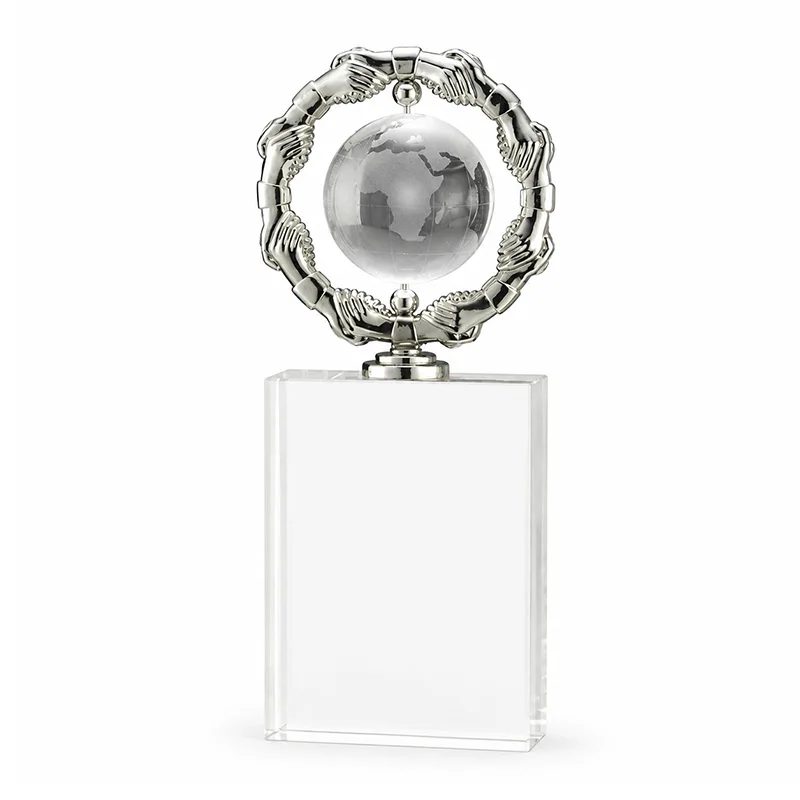
A 25-year award is rarely a medal on its own. The common shape of a mature programme is a medal for every tier, plus something larger at the landmark — a trophy, a plaque, a desk piece — presented on stage.
We produce metal die-cast awards, multi-material medals, trophies and complementary presentation items, and the value of sourcing them together is colour consistency. The gold on the medal and the gold on the trophy base should come off the same specification, and when they come from two suppliers they almost never do. Category-level comparisons, sizing logic and how a set is assembled are a separate conversation — we keep the process detail out of this article because the numbers differ by category and quoting them from memory would be worse than not quoting them at all.
One boundary worth stating plainly: we do not take embroidery, apparel, paper or silicone. If your programme includes a branded jacket, a printed certificate or a silicone wristband, that sits with another vendor, and we will say so at the quoting stage rather than after the PO is signed.
Five Ways These Programmes Fail
| Failure | Where it breaks | The fix |
|---|---|---|
| Name changes after sample approval | Names cast into the die cannot change | Design a laser panel, not a cast name |
| Colour drift between sample and bulk | Plating bath chemistry shifts | Approve a physical plated chip, not a screen proof |
| Delivery colliding with fiscal year end | November–December capacity | Book the slot when the budget is approved, not in December |
| Volume below MOQ on the top tier | 3 honorees against a 100-piece minimum | Combine tiers on one PO or hold a buffer |
| Logo change mid-programme | Stock already plated with the old mark | Order annually, keep the die, accept a re-run |
The name-change failure is the most expensive and the most avoidable. Sign-off on a sample approves the die, the relief and the plating — not the recipient list. Once the panel is designed for laser, names can change up to the marking stage, and the only thing you need to protect is the freeze date on the list.
The colour failure is subtler. A screen proof cannot represent a plated surface, because plating colour is a function of bath chemistry and build thickness, and it shifts under different light. Approve a physical chip under D65 lighting and keep it as the standard for the life of the programme. If a re-order is placed two years later, that chip is what we match against.
The fiscal-year failure is a scheduling problem, not a production one. Bulk runs at 7–15 days, but December is when every client wants the same week. If your ceremony is in January, the order needs to be placed in November. Rush options exist and are quoted separately; they are not a substitute for planning.
FAQ
Can one die really cover all five service tiers?
Yes, and it is the default for programmes above a few hundred pieces. The die fixes the silhouette, the diameter and the relief. Plating, fill, variable data, ribbon and box are all applied after casting, so five tiers can come off one tool. The only changes that force a second die are a different diameter, a different outline, or a materially different relief layout.
What happens if only a handful of people reach twenty-five years?
MOQ is 100 pieces per design, so a tier with three recipients cannot be ordered as a standalone run. The practical routes are to combine all tiers on one purchase order so the shared die carries the volume, to hold a landmark buffer covering two or three years, or to present the landmark tier every second year with dates lasered at the end. The first option is the one most clients take because it costs nothing in presentation.
How long does the whole programme take from artwork to delivery?
Design drawings within 24 hours, sampling in 7–10 days, bulk production in 7–15 days after sample approval. Add your own approval time on top — legal review of the logo, sign-off from HR and communications, and the name list. In practice the artwork and approval stage takes longer than production, which is why we push clients to start with a tier plan rather than a finished design.
Will the gold on this year’s batch match last year’s?
It will if the programme is specified properly. Plating colour depends on bath chemistry and build thickness, so the standard is a physical chip approved under D65 light and kept on file, not a Pantone number. We match re-orders against that chip and against the original die, which stays in our tool library. Ask for the chip to be retained as part of the programme record.
Can employee names be added after the design is approved?
Yes, if the design includes a laser marking panel. Variable data is applied at the marking stage, so the name list can change after the die is cut and after the sample is approved. The constraint is timing, not tooling: the list has to be frozen before marking begins. Send it as a plain spreadsheet with one row per recipient, and confirm the exact spelling convention — full name, initial plus surname, or name plus years.
Do you make the trophies and plaques as well, or only the medals?
We produce metal die-cast awards, multi-material medals, trophies and complementary presentation items, which is why we can hold one plating specification across a mixed set. We do not take embroidery, apparel, paper or silicone, so any textile or printed element in the programme needs a different supplier.
Getting a Quote That Is Actually Useful
Send us three things and the quote comes back with a design drawing inside 24 hours: the headcount per tier, the years you are covering, and the date of the ceremony. Everything else — plating ladder, fill plan, ribbon, box — we will propose against your budget band rather than asking you to specify it cold.
We quote by quantity band, so the same tier matrix can land in very different places depending on whether you are ordering 100 pieces or 3,000. That is also why we would rather see your three-year honoree forecast than a single year’s number: it changes which levers we recommend, and it usually changes the answer on whether a second die is worth cutting at all.
See also: medals with a moving inner disc — custom spinning medals with a rotating centre — same Zamak die-cast base, MOQ 100 per design.
Also relevant: corporate event medals — for the anniversary gala and service-award ceremony itself.