A gymnastics meet is not one award ceremony. It is a dozen small ones running in parallel — floor exercise results at one session, vault at the next, rhythmic apparatus rotations on a separate floor, and an all-around presentation squeezed in before the venue closes. Every one of those moments needs a medal in the right hand at the right time, and the person who has to make that happen is usually a club administrator with a spreadsheet, not a procurement department.
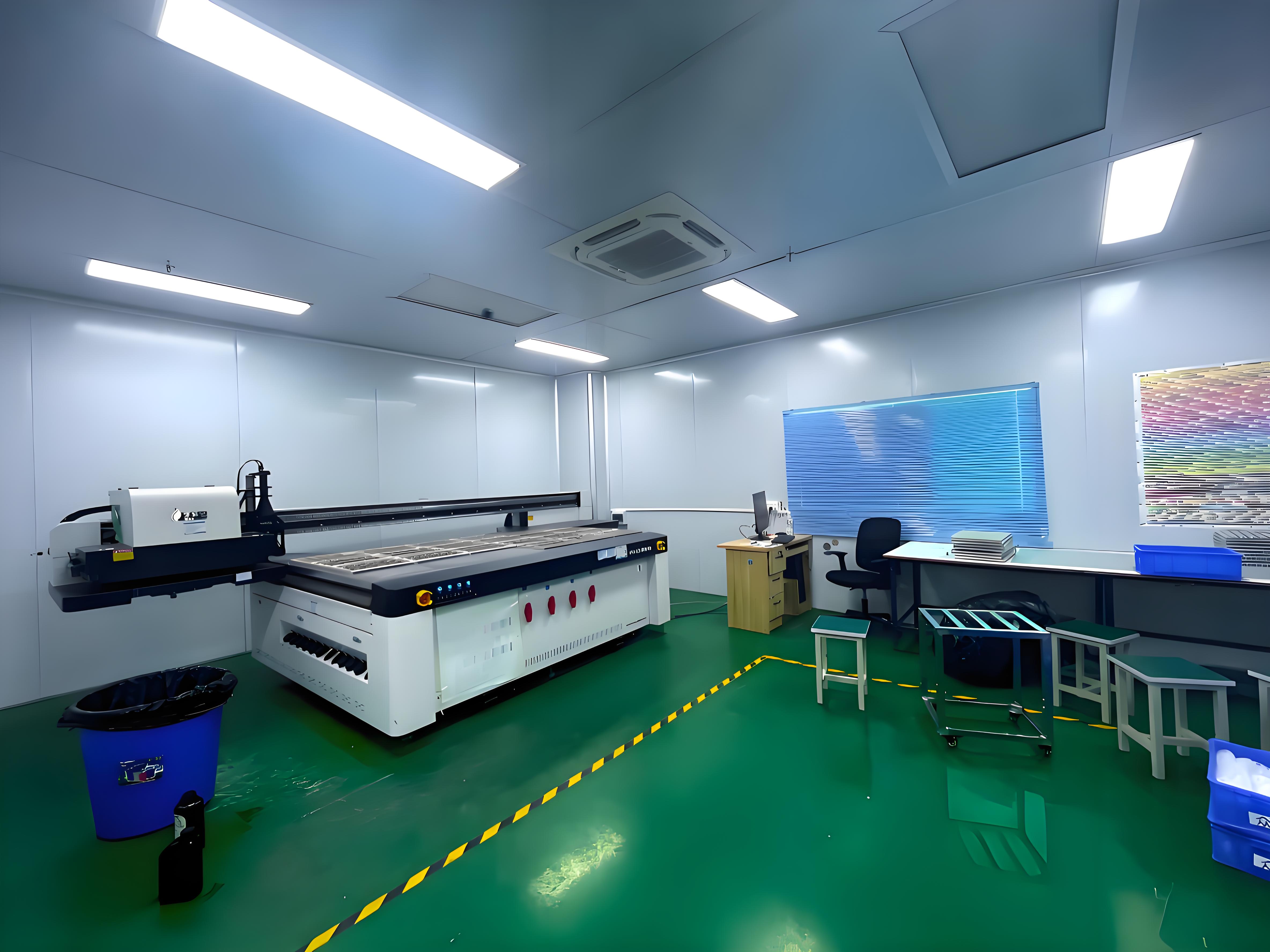
We have produced custom sports medals for gymnastics clubs, gymnastics schools and meet organisers from our own die-casting factory in Huizhou, Guangdong since 2010. This guide is the conversation we have with those buyers before a quote: how many medals a meet actually needs, how many designs are worth paying tooling for, what artwork will and will not cast, and how to work backwards from a date that cannot move.
Why Gymnastics Meets Order Differently
Three structural features separate a gymnastics order from almost any other sports medal order.
The award list multiplies twice. A football tournament has one event and a handful of age groups. A gymnastics meet has six men’s apparatus, four women’s apparatus, and five rhythmic apparatus, each contested separately, each with its own podium, and then an all-around title layered on top of all of it. Multiply that by age groups and levels, and the medal count climbs much faster than the entry count.
The titles are split, not stacked. A swimmer who wins three events gets three medals and the meet moves on. A gymnast who wins the all-around and two apparatus titles gets three medals in three different ceremonies, often on different days, sometimes in different sessions. The medal has to be identifiable at a glance from the side of the floor, because the person handing it out is working from a results sheet in a noisy hall.
The date is set by a calendar nobody at the club controls. A regional qualifier date is fixed months ahead by the sanctioning body, and the venue, the judges and the clubs travelling to it are all committed to it. There is no “we’ll push it a week”. Everything in the order — artwork approval, sampling, casting, plating, engraving, packing by session — has to be reverse-engineered from that one Saturday.
A fourth difference matters more than it sounds: the entry list is mostly children. A Level 3 medal is worn by an eight-year-old for a full day, sometimes over a leotard with no collar to protect the neck. Weight and edge finish are not cosmetic here — they are why a gymnastics medal cannot simply be a scaled-down marathon medal.
One Design or One per Apparatus
This is the first real decision, and it is where most of the tooling budget is decided.
The instinct for a first-time organiser is a design per apparatus — beam, bars, vault, floor — because it feels more considered. The instinct for a club that has run the same meet for a decade is usually the opposite: one design, differentiated by engraving or a colour insert.
Both are defensible. What is not defensible is ordering seven designs for a meet that awards 12 medals per category, because at that volume the mould cost per medal swamps everything else.
| Decision | One shared design | One design per apparatus |
|---|---|---|
| Tooling | One mould, one setup charge | One mould per apparatus, multiplied |
| Artwork | One proof, one approval cycle | Multiple proofs, multiple approval rounds |
| Differentiation | Engraved apparatus name, enamel colour, or ribbon colour | Built into the sculpture itself |
| Sorting and packing | Requires disciplined labelling by session | Self-sorting — the medal identifies itself |
| Reordering | Same mould works for every future meet | New apparatus means a new mould |
| Best fit | Club-level meets, multi-level invitationals, tight budgets | Championship finals, televised or sponsored events, large per-apparatus volume |
There is a middle path that most experienced organisers land on: one shared face, one variable element. The obverse carries the meet identity — club crest or host logo, meet name, year, and a gymnast or apparatus motif that reads generically. The reverse carries the specific title. That gives you a single mould, a single artwork approval, and still lets a beam champion’s medal say Balance Beam on the back in text that is legible from a metre away.
The variable element can be handled three ways, and the choice has real cost and timing consequences:
- Engraved text on the reverse. No extra tooling, no minimum beyond the medal order itself, and it happens after casting. This is the default for most meets.
- A colour-filled recess per apparatus. Each apparatus gets its own enamel colour in a shared recess. Still one mould, but the enamel work becomes a per-piece operation and colour changes need to be scheduled.
- A printed insert or label. Cheapest per unit and the fastest to change, but it looks like what it is. Fine for a club internal meet, weak for a championship.
If your meet awards deeply in one apparatus — a dedicated bars and vault invitational, for example — a dedicated design for that apparatus is worth the mould. If you are awarding three places across seven apparatus for four levels, it almost never is.
How Many Medals a Meet Actually Needs
The number that surprises first-time organisers is not the total. It is the ratio of medals to athletes.
A meet with 180 entrants can easily need 400 medals, because a gymnast who places on four apparatus and in the all-around takes five pieces home. The award count scales with placements available, not with headcount. So the calculation has to be built from the award structure first and the entry list second.
The formula we use when a club sends us their meet plan:
Apparatus medals = apparatus count × age groups × places awarded All-around medals = age groups × places awarded Team medals = team divisions × team size (if team awards are given)
A worked example makes it concrete. Take a women’s artistic meet with four apparatus, five age groups, three places, plus an all-around:
| Award category | Calculation | Pieces |
|---|---|---|
| Apparatus finals | 4 apparatus × 5 age groups × 3 places | 60 |
| All-around | 5 age groups × 3 places | 15 |
| Team | 3 divisions × 5 team members | 15 |
| Participation or improvement awards | Optional, 1 per entrant in selected groups | 20 |
| Subtotal | 110 | |
| Spoilage and breakage buffer (5%) | Rounded up | 6 |
| Order quantity | 116 |
Three things about that table are worth flagging.
The buffer is not padding. Medals get dropped, ribbons get stained, a club discovers at the last minute that two age groups were merged and needs six more of a title you did not plan for. A 5% buffer on a 100-plus order costs very little and prevents the worst outcome in meet administration: a champion standing on a podium with nothing to hang around her neck.
The multiplication is where budgets break. Adding a sixth age group does not add six medals. It adds 12 apparatus medals plus three all-around medals, and possibly a team set. Every level or age band you add to the schedule should be checked against the medal count before the schedule is published, not after.
Rhythmic meets need their own line. A rhythmic competition with hoop, ball, clubs, ribbon and rope, run across four levels, has five apparatus rather than four, and the all-around is often the headline award rather than an afterthought. If your meet combines artistic and rhythmic under one entry form, calculate them separately and add the totals — the two disciplines rarely share age groups cleanly.
That maths also settles the design question. MOQ is 100 pcs per design, so a meet landing at 116 pieces on a shared design clears it comfortably, while a separate design for a 12-medal apparatus category does not. That is a manufacturing constraint, not an aesthetic preference.
Designing Artwork That Casts Cleanly
Gymnastics artwork fails in predictable places. Knowing them before you brief a designer saves a proof round and, occasionally, a mould.
Our die-casting line works to three hard limits that every design has to respect:
- Minimum wall thickness: 2mm. Anything thinner will not fill reliably at production speed, and a short fill on a 45mm medal is a reject.
- Minimum relief height: 0.4mm. Below that, the detail disappears under plating. This is the number that kills most fine-line artwork.
- Minimum line width: 0.3mm. A stroke thinner than this is not a design element at production scale, it is a casting defect waiting to happen.
Now apply those to the motifs gymnastics designers love.
The rhythmic ribbon spiral is the single most common casualty. A ribbon drawn as a tapering spiral looks beautiful in vector and becomes a soft blob in metal, because the tail of the spiral drops below 0.3mm long before it visually ends. The fix is to thicken the spiral and let it terminate in a deliberate point rather than fading out, or to break it into three or four distinct ribbon segments with clear gaps.
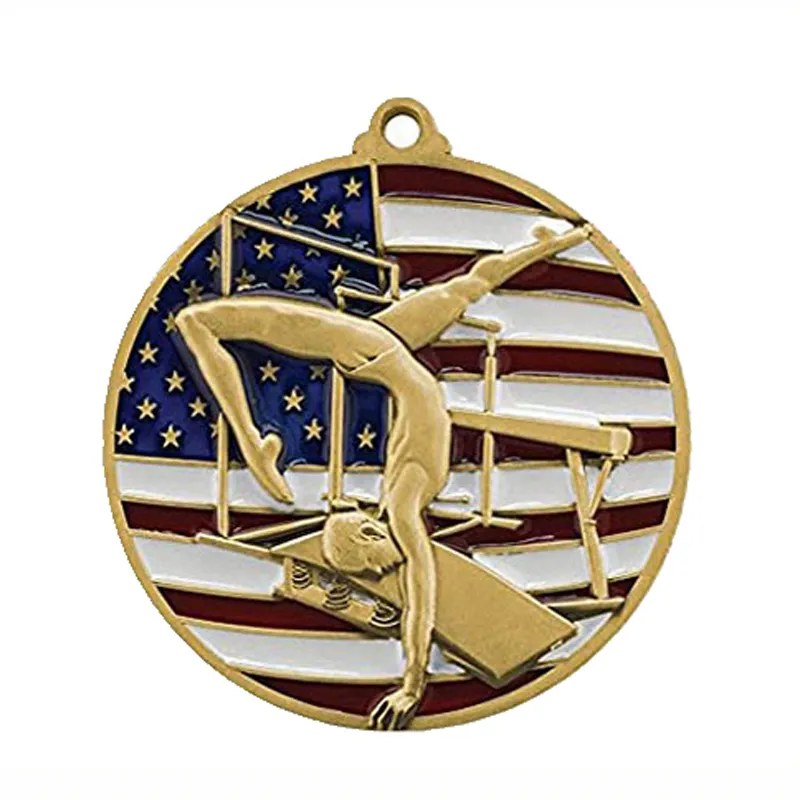
Apparatus pictograms — rings, parallel bars, a beam with a figure — work well if they are treated as silhouettes at 0.4mm relief or deeper. They fail when they are drawn as line icons with internal detail, because the internal lines vanish and the icon reads as a smudge at arm’s length.
Fine serif letterforms on a meet name are a recurring problem. Thin strokes and sharp serifs under 0.3mm will not hold. Condensed sans-serif at a decent weight is more reliable, and if the meet has an established brand font with thin strokes, plan for the logo to sit in a recessed panel rather than in relief.
Two-part dies cannot do undercuts. Any element that would need the mould to reach behind itself is not castable. In practice this means no deep hooks, no overhanging elements, and a draft angle on every vertical face so the piece releases cleanly.
Weight belongs in the artwork stage too. A 50mm medal at 3mm and one at 4.5mm are the same silhouette and very different objects on a child’s neck. For club gymnastics we steer toward a mid-weight piece in the 40–50mm range with a clean, deburred edge, and reserve heavier pieces for championship or commemorative awards. Our medal size and thickness guide covers the trade-offs.
We return artwork within 24 hours, and that first response is where we flag geometry problems rather than at proof approval.
Zinc alloy die-casting: what our line runs
Almost every medal we make is zinc alloy, and for gymnastics specifically that is the right call.
We cast Zamak 3, Zamak 5 and Zamak 7. Zamak 3 is the workhorse — good fluidity, stable dimensions, takes plating and enamel well, and it is what most medal work runs on. Zamak 5 is harder and slightly stronger, which suits thin or highly detailed pieces where rigidity matters. Zamak 7 is chosen when we need better flow into fine detail and a cleaner surface straight out of the die.
The alloy melts at 385°C, and we run it on 88-tonne die-casting machines. That tonnage is what lets us hold 0.4mm relief and 0.3mm line width across a full production run rather than only on the first few shots. The die is the expensive part of the process and the part that determines everything downstream: once the tool is cut, the relief depth, the wall thickness and the edge profile are fixed.
Why zinc rather than brass or aluminium for a gymnastics medal:
- Zinc casts fine detail better than aluminium. Aluminium is lighter and cheaper per kilo but does not reproduce 0.4mm relief with the same crispness.
- Zinc is more economical than brass at volume. Brass is beautiful and heavy and suits a small commemorative run; for 400 pieces across five titles, zinc gives the better result per unit.
- Zinc holds a sharp edge after deburring and polishing. For a medal going to a young gymnast, a finished edge is a safety characteristic, not a cosmetic one.
Our line produces 30,000+ pieces per day, so a 400-piece order is a normal run. The factory has been casting since 2010, and the geometry problems in this category — pictograms, ribbon spirals, small text, thin crests — are ones we have already solved in the tool room.
If you are weighing materials for a specific award, our sports medals range shows the same designs across zinc, brass and other substrates, which is usually the fastest way to make the decision.
Plating and Enamel for Club Colours
Plating is where a well-cast medal either looks expensive or looks like a giveaway — and the stage most buyers underestimate.
We run a 9-step plating process. The base is alkaline copper at roughly 500 seconds, followed by acid copper for 20 to 60 minutes depending on the piece and the finish required. The copper layers build a smooth, levelled surface over the cast grain, which is what allows the final nickel and top finish to read as a mirror rather than as a cast surface. After plating, pieces go through a drying tunnel at 100°C for 40 minutes.
The visible finish sits on top: gold, silver, bronze, antique gold or silver, black nickel, or a dual-plate combination. For gymnastics clubs the common choice is a straightforward gold-silver-bronze hierarchy, because the podium has to be readable across a gym floor. Antique finishes look richer in the hand but lose contrast at distance under sports-hall lighting, which matters when a volunteer is handing medals out at speed.
Enamel is the second half of the colour story, and there are two options that behave very differently:
| Soft enamel | Imitation hard enamel | |
|---|---|---|
| Recess depth | 0.3mm | 0.5mm |
| Surface | Colour sits below the metal lines; you can feel the ridges | Colour is polished flush with the metal |
| Look | More graphic, higher contrast between colour and metal | Smoother, more like vitreous enamel, closer to a coin |
| Feel | Textured, slightly ridged | Flat and solid |
| Best for | Club crests, multi-colour meet logos, bold apparatus colours | Premium championship awards, sponsor-facing pieces, pieces handled constantly |
| Wear | Colour protected by the metal ridges | Flush surface shows scratches more readily |
Soft enamel at a 0.3mm recess is the default for club-level work: it is more forgiving of a busy crest, it holds saturated colour well, and the metal ridges protect the paint. Imitation hard enamel at 0.5mm is the upgrade that makes a medal feel like an object rather than a giveaway, and it is worth it for an all-around title or a meet that a sponsor is putting their name on. Our enamel medals page covers the finishes side by side.
For club colours, we match to Pantone. Where a crest has a gradient, a photographic element or more than six or seven colours, enamel stops being the right process and we move to UV printing, pad printing or screen printing — UV for full colour and gradients, pad for one or two colours on a small area, screen for flat bold blocks. Laser engraving is the fourth marking route, used for text and fine line work rather than colour.
The practical advice: keep the medal to a small palette that matches the club’s existing kit, and let the plating carry the hierarchy. A gold medal with a two-colour crest reads better at 20 metres than a five-colour medal with a muddled field.
Ribbons, Clips and Medal Holders
The ribbon is the part of the award the athlete actually touches, and the part most often specified last.
Widths we run are 20mm, 25mm and 30mm. For gymnastics, 20mm is the usual choice for age-group and level medals because it sits comfortably on a child’s neck and does not twist; 25mm suits championship and all-around awards where the medal is heavier. Length matters as much as width — a ribbon cut for an adult marathon finisher hangs too low on an eight-year-old, and a shorter custom length is a cheap specification change that improves how the award photographs.
Printing options are sublimation for full-colour and photographic designs, and woven or screen-printed ribbon for simpler club colourways and repeated text. Sublimation is the right answer when the ribbon carries the meet logo in colour; a woven ribbon with the club name repeated along its length looks more considered and wears better through a season.
Attachment is worth deciding early:
- Ribbon clamp or crimp — the standard, neat, and the lowest-profile option.
- Bar pin and jump ring — allows the medal to be detached and worn as a pin, which some clubs prefer for younger age groups.
- Carabiner or lobster clip — quick to change, popular for multi-day meets where the same ribbon is reused across sessions.
- Safety breakaway — a release fitting that opens under load. For clubs with under-12 athletes, this is often a policy requirement rather than a preference, and it costs very little to specify.
On medal holders: a holder is a display rack, usually timber, acrylic or metal, that a gymnast hangs a season’s collection on. It is a popular club fundraiser and a common end-of-season gift, and it changes what you want from the ribbon, because a holder displays the ribbon flat and the medal face-on. Decide whether the holder is part of the award or sold separately, because it changes the packaging spec — and be clear on scope. Our production is metal medals, multi-material medals, trophies, ribbons, packaging and badges. Timber and acrylic holders sit outside our line, and we would rather say so at the quote stage than at packing.
Ribbon specification, attachment types and printing methods are set out in more detail on our medal ribbons page.
Engraving Level, Apparatus and Date
The text layer is what turns one physical design into a full meet’s worth of awards, and getting the split right between cast and engraved is the difference between a clean order and a sorting nightmare.
Cast into the mould: anything that appears on every medal. Host club or meet logo, meet name, the year, and any fixed element like a generic apparatus motif or a border pattern. Cast detail is permanent, does not wear, and costs nothing per piece after the tool is cut.
Engraved or printed afterwards: anything that varies. Apparatus name, level or age group, place (1st, 2nd, 3rd), date, and — if the budget allows — the athlete’s name.
| Method | What it handles | Where it sits |
|---|---|---|
| Laser engraving | Fine text, small type, high volume, consistent depth | Reverse face, or a designated panel on the front |
| Rotary engraving | Deeper, more traditional cut; good on curved surfaces | Reverse face |
| Pad printing | One or two colours, small text blocks | Reverse face or a recessed panel |
| UV printing | Full colour, gradients, small logos | Reverse face or front insert |
Two design decisions make engraving work at meet scale.
Reserve a flat panel for it. A reverse face that is fully sculpted gives the engraver nowhere clean to cut. A defined circular or rectangular panel — even a shallow one — keeps text legible and speeds up production.
Decide the variable text before the mould is cut. If the apparatus name is going to be engraved, the reverse needs room for the longest apparatus name in the schedule — Uneven Bars and Parallel Bars are longer than Vault, and a layout that fits Vault will not fit Balance Beam at the same size. We size the panel for the longest string in your award list, not the shortest.
For meets that hand out medals session by session, engraving also has a logistics dimension. If every apparatus medal is engraved after production, the pieces have to come back to the right session box. We bag and label by title and place as part of packing, which is the only way a volunteer can open one box at 9am on Saturday and find 15 beam medals without counting.
Our event medals programme is built around this pattern — one event identity, a variable title layer, and packing that matches the running order.
MOQ, Moulds and the Cost of Choice
MOQ is 100 pcs per design. That single number shapes the whole order, because it means every additional design has to justify 100 pieces of demand on its own.
A typical club meet sits in one of four bands:
| Order size | Designs that make sense | Tooling approach | Unit cost trend | Production window |
|---|---|---|---|---|
| 100–250 pcs | 1 design, variable text | One mould, shared across all titles | Highest per unit — tooling spread thin | 7–15 days after approval |
| 250–600 pcs | 1–2 designs | One shared design, optional second for a headline title | Falls sharply as volume absorbs the mould | 7–15 days after approval |
| 600–1,500 pcs | 2–3 designs | Shared design plus apparatus-specific pieces for the deepest categories | Stable, with the mould largely amortised | 7–15 days after approval |
| 1,500+ pcs | 3–5 designs | Full per-apparatus or per-discipline sets become viable | Lowest per unit; tooling is a small share | 7–15 days after approval, scheduled in advance |
Three rules of thumb follow from that table.
The mould is a one-time cost, and it is yours to reuse. If your club runs the same meet every season, a single mould amortised over three years is close to free by the third year. This is the strongest argument for a design that is generic enough to survive a change of meet name — a gymnast figure and a border will still work in five years; a specific date cast into the metal will not.
Consolidate before you customise. Adding a second design to a 400-piece order costs a second mould and splits the volume, which pushes unit cost up twice. Adding the same money to a single-design order as a better finish — imitation hard enamel instead of soft, a wider ribbon, a presentation box — usually produces a more impressive award for the same spend.
Multi-design orders are fine, they just need to be planned. A club ordering season-long awards across four levels, or a gymnastics school ordering a graduation set alongside meet medals, can run several designs on one purchase order. The moulds are separate; the production scheduling, the QC and the shipping are not, which is where the saving comes from.
Three-stage QC runs on every order — after casting, after plating, and after assembly — regardless of size. On a 120-piece club order that sounds excessive. On a meet order where a short count has no remedy, it is the only thing standing between a club administrator and an apology on the podium.
Working Backwards From Meet Day
The meet date is fixed. Everything else moves. So the order has to be built backwards from the date, with the non-compressible steps identified first.
| Step | Duration | Notes |
|---|---|---|
| Confirm award structure and headcount | Before anything else | Apparatus, levels, places, all-around, team |
| Artwork and proof | 24 hours for first artwork | Geometry issues flagged here, not at proof approval |
| Proof revisions | 1–3 days | Depends on how many stakeholders sign off |
| Sampling | 7–10 days | Physical sample for colour and weight sign-off |
| Bulk production | 7–15 days after approval | Includes casting, 9-step plating, enamelling, assembly |
| Engraving of variable text | After production | Apparatus, level, place, date, names |
| Packing by session | 1–3 days | Bagged and labelled to the running order |
| Freight | Varies by destination and mode | The step most often forgotten |
The critical path is not production. It is approval. A meet order that takes three weeks to approve artwork because four committee members have to sign off will miss its date no matter how fast the factory runs. Our part of the timeline — artwork in 24 hours, sample in 7–10 days, bulk in 7–15 days — is short and predictable. The variable is on the buyer’s side, and the fix is to nominate one person with authority to approve.
A realistic reverse calendar for a mid-season meet:
- 8–10 weeks out: confirm the award structure, level bands and places.
- 6–8 weeks out: brief artwork, approve the proof, order the sample.
- 5–6 weeks out: approve the sample. Check plating colour against the club kit in daylight, not office lighting.
- 4 weeks out: bulk production runs. Confirm the variable text list is final.
- 2–3 weeks out: engraving and packing by session. Ship to the venue or the club, not a home address.
- 1 week out: buffer. If something is going to go wrong, this is where you want to find out.
Two things compress the calendar. Ordering the sample before the award list is final is usually safe — the design does not change because an age group was added. And placing the bulk order with a provisional quantity keeps production in the schedule rather than waiting for a headcount that firms up in the last fortnight.
What cannot be compressed is the plating. The 9-step process, the copper build and the 100°C drying tunnel are sequential and time-bound. A factory that promises to halve plating time is promising to skip steps, and the failure mode is a finish that discolours within a season.
Frequently Asked Questions
How many medals does a gymnastics meet need?
Build it from the award structure, not the entry list. Multiply apparatus count by age groups by places awarded, then add all-around and team medals, then add a 5% buffer. A four-apparatus women’s meet with five age groups and three places needs around 116 pieces once the all-around, team awards and buffer are included.
Do we need a different medal design for each apparatus?
Usually not. One shared design with the apparatus name engraved or printed on the reverse covers a full meet on a single mould, and at MOQ 100 pcs per design that is the only economically sensible route for most club meets. Dedicated per-apparatus designs make sense when a single apparatus carries enough volume to justify its own tool.
Can a gymnastics medal be light enough for young children?
Yes, and it should be. A 40–45mm zinc alloy medal at a moderate thickness with a 20mm ribbon sits comfortably on a child’s neck. Confirm that the factory deburrs and polishes the cast edges before plating, and specify a safety breakaway attachment if your club’s policy requires one.
What artwork problems should we watch for?
Three, mostly: ribbon spirals that taper below the 0.3mm minimum line width, apparatus pictograms drawn as line icons instead of silhouettes, and thin serif lettering in a meet name. Minimum relief is 0.4mm and minimum wall thickness is 2mm, so anything finer than that will not survive production. We flag these within 24 hours of receiving artwork.
Soft enamel or imitation hard enamel for club medals?
Soft enamel at a 0.3mm recess is the default for club-level meets — more forgiving of a busy crest, more saturated colour, and the metal ridges protect the paint. Imitation hard enamel at a 0.5mm recess, polished flush, is the upgrade for all-around titles, championship awards and sponsor-facing pieces where the medal needs to feel substantial.
How far ahead should we order for a meet?
Eight to ten weeks before the meet date is comfortable. Artwork comes back in 24 hours, sampling takes 7–10 days, and bulk production runs 7–15 days after approval, with engraving, session packing and freight on top. The step that most often delays a meet order is internal artwork approval, not manufacturing.
Ordering Gymnastics Medals With Us
If you are planning a meet, send us the award structure rather than a finished design brief — apparatus list, levels or age groups, places awarded, whether there is an all-around and a team title, and the date. We will come back with a medal count, a design recommendation and a quote on one tooling budget.
Artwork is free and returned within 24 hours. MOQ is 100 pcs per design, which most meets clear on a single shared design. If you would rather hold the piece before committing, we can produce a physical sample in 7–10 days so you can check the weight, the plating colour against your club kit, and the ribbon length on an actual athlete.
We have been casting medals in our own factory since 2010, and a gymnastics meet — multiplied award list, fixed date, young athletes — is one of the orders we know best. Ribbon, packaging and presentation options are on our medal packaging page if you want to price the full award.
Related Reading
- Custom medal size and thickness guide
- Soft enamel vs hard enamel: which finish for your medals
- How to order custom medals in bulk
See also: medals with a moving inner disc — medals with a rotating centre, including 3D inner elements and custom plating.