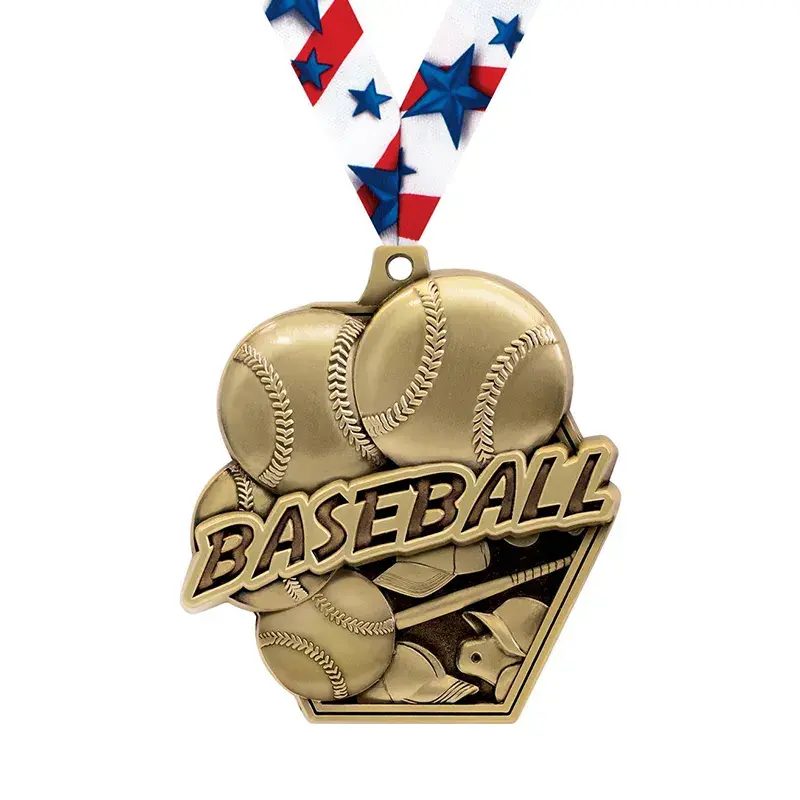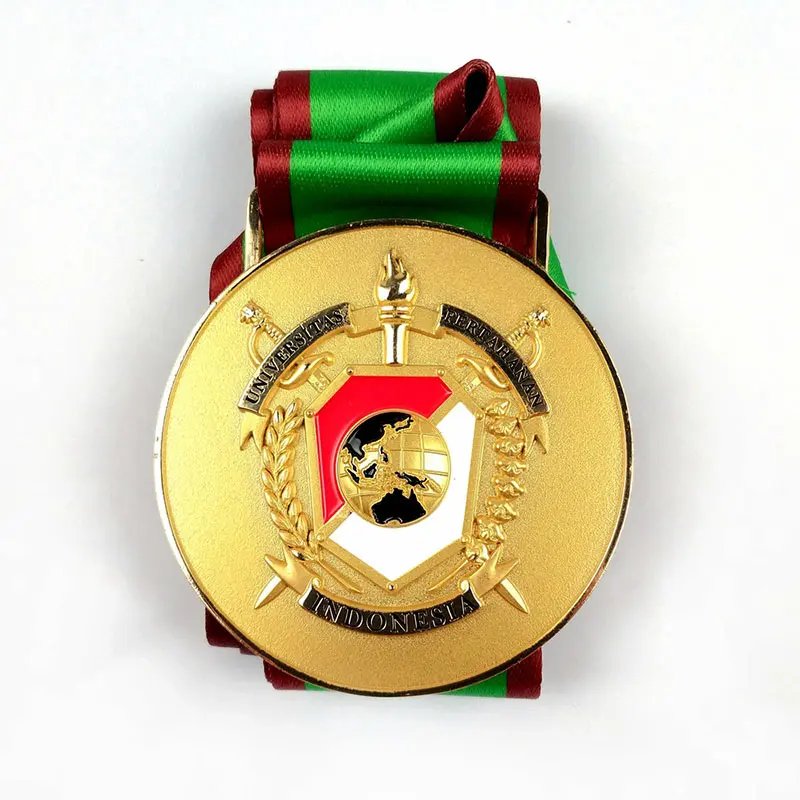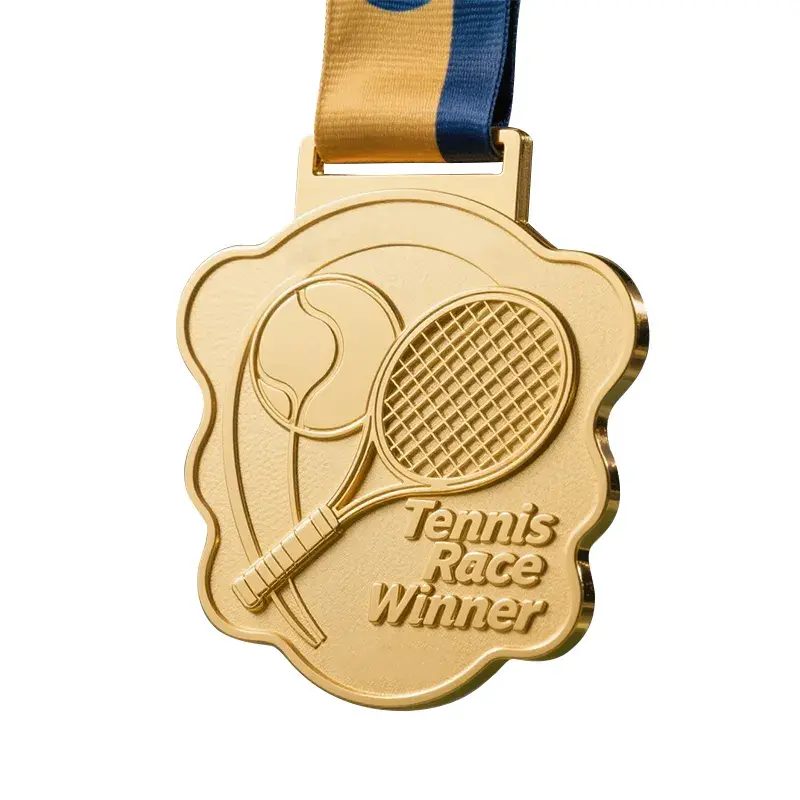
Nearly every marathon medal you’ve hung on a wall is zinc alloy, die-cast, electroplated, and filled with soft enamel. That’s the default recipe, and it’s the default for good reasons. But the four parts of that sentence each have alternatives, and the choice between them is where your budget goes. We produce custom race medals at volume in Huizhou, so here’s the material breakdown we give event directors.
What we’ll cover:
- The four materials that make up a standard finisher medal
- Why die-cast zinc alloy dominates marathon medals
- How plating and enamel change what a medal costs and feels like
- Which upgrades are worth paying for and which aren’t
[Image: race-medals.jpg — Custom marathon finisher medals with ribbon on a table]
The Four Parts of a Marathon Medal
A finished marathon medal is four components stacked: a metal body, a plating layer, an enamel fill, and a ribbon. Each one is a separate production step, and each one has options.
| Component | Common choice | Alternatives | Share of cost |
|---|---|---|---|
| Body | Die-cast zinc alloy | Brass, iron, aluminum, stainless steel | Largest single share |
| Plating | Imitation gold, nickel | Antique bronze, antique tin, dual-tone | Flat, predictable |
| Fill | Soft enamel | Imitation hard enamel, UV print, 3D relief | Scales with color count |
| Ribbon | Sublimated polyester | Woven, jacquard, custom-printed | Per-piece, low unit cost |
When a race director asks why two quotes for the same artwork differ by 40%, the answer almost always sits in one of these four rows. Body and finish explain most of the gap. Ribbons rarely do.
Notice the share-of-cost column. The body dominates. That’s why material is the first question we ask, and why it’s the first place to look when a quote comes in higher than expected.
[Image: process-03-die-casting.jpg — Die-casting press forming medal blanks from molten zinc alloy]
Why Die-Cast Zinc Alloy Dominates Marathon Medals
Zinc alloy wins on a technical property that matters more than any other: flow. Zamak 3, 5, and 7 melt at 385°C and move into a mold cavity easily, which lets an 88-ton die-casting machine capture fine 3D relief in a single shot. For a race medal — where you want your course map, your event logo, your date, and a sculpted figure all reading clearly — that’s the whole game.
The comparison tells the story:
| Zinc Alloy (Die-Cast) | Brass (Stamped) | Iron (Stamped) | |
|---|---|---|---|
| Right for | Marathon medals, 3D detail, cutouts | Heavyweight commemorative pieces | Simple flat shapes, tight budget |
| Density | 6.7 g/cm³ | 8.9 g/cm³ | 7.8 g/cm³ |
| Process | Die-casting, 88-ton press | Stamping | Stamping |
| 3D relief | Excellent | Low | Low |
| Relative cost | $$ | $$$ | $ |
Brass is heavier and reads more upscale, but it’s stamped rather than cast, so it can’t reproduce deep relief. If your design is a course map with elevation lines, brass will flatten it. Brass belongs on commemorative and military pieces where weight is the point.
Iron is the budget material. It’s the cheapest of the three and perfectly fine for flat, simple designs at high volume. But iron rusts if plating wears through, and a finisher medal gets worn against skin, pocketed, and handled. That’s a risk we flag before a race director commits.
Zinc alloy also handles geometry the other two can’t. Cutouts — a medal shaped around a route silhouette, with actual open negative space — require casting. Undercuts, thin bridges, and variable thickness all cast cleanly in zinc. Stamping can’t do any of them.
There’s one alternative worth mentioning for summer races: aluminum. At 2.7 g/cm³ it’s the lightest option, and it anodizes into bright colors. If your event is a hot-weather trail race where a heavy medal is a liability, aluminum is worth a conversation. Our medal materials guide covers all five metals in detail.
[Image: process-05-polishing.jpg — Raw medal castings being polished before plating]
Plating: The Layer Runners Actually See
Plating is what a runner sees first, and it’s the layer most buyers misjudge on cost. The intuition says antique finishes cost more. The chemistry says the opposite.
| Imitation Gold | Nickel (Silver) | Antique Bronze / Tin | |
|---|---|---|---|
| Right for | 1st place, classic marathon gold | 2nd place, silver tier | Heritage races, trail events |
| Look | Bright mirror gold | Bright silver | Dark, aged, matte |
| Application | Full electroplating | Full electroplating | Electrophoresis or barrel plating |
| Relative cost | $$ | $$ | $ |
A mirror finish is genuine electroplating, built in stages. We strip and degrease the casting, plate an alkaline copper base for about 500 seconds, run acid copper for 20 to 60 minutes to develop the shine, and then apply the final color. Then the medals go through a tunnel oven at 100°C for 40 minutes and get a protective oil coat to hold off oxidation. That’s a real metal layer over the whole surface.
Antique finishes skip the expensive part. Electrophoresis and barrel plating coat the recesses in one pass, which costs less. The aged surface forgives scratches and fingerprints too — a real advantage for a medal that lives in a drawer for eleven months between races.
For marathons specifically, we usually recommend imitation gold for the overall finisher medal and nickel for age-group places. A gold finisher medal photographs well against most race shirts, and the bright surface stays legible in a phone shot at the finish line — which is where most of your event’s social reach actually happens.
[Image: process-07-plating.jpg — Racks of medals moving through an electroplating line]
Enamel, Relief, and Print: Filling the Design
The fill is the colored part sitting inside the recessed areas. Three methods cover nearly all marathon medals, and they’re not interchangeable.
| Soft Enamel | Imitation Hard Enamel | UV Print | |
|---|---|---|---|
| Right for | Most finisher medals | Smooth ceramic-look awards | Full-color artwork, photos, gradients |
| Min. fill width | 0.3mm | 0.5mm | No recess needed |
| Surface | Recessed, raised metal lines | Ground flat and polished | Flat, printed on |
| Color limit | Per-color fill cycles | Per-color fill cycles | Four-color process |
| Relative cost | $ | $$ | $$ |
Soft enamel is the marathon standard. It fills recesses as narrow as 0.3mm and cures slightly below the metal line, so you feel the raised edges when you run a thumb across it. That tactile quality is why it’s still the default even though printing exists.
Imitation hard enamel needs a 0.5mm recess, goes on thicker, then gets ground flat and polished to a ceramic-like surface. That grinding step is the extra cost. It gives you a smooth top with no metal lines interrupting the color — the look most academic and corporate awards use.
UV print is the interesting option for races. It lays four-color process directly onto a flat or slightly 3D surface, so you’re no longer limited to discrete enamel colors. If your medal artwork has a gradient sunrise, a photographic landmark, or a sponsor logo with subtle shading, print is the only way to reproduce it. We can print onto surfaces with up to about 7mm of relief drop, which covers most sculpted designs.
Color count is the hidden cost driver. Every enamel color is its own fill-and-bake cycle — the low-temperature cure runs 60 to 70°C for 60 to 90 minutes for a half-set, and the full cure is 100°C for 60 minutes. A five-color medal means five passes. Designers who understand this consolidate colors, and it shows up on the quote.
[Image: process-09-color-filling.jpg — Technician filling enamel color into recessed medal areas]
What Marathon Medal Materials Actually Cost
Here’s where we land, and where we’d spend a race director’s budget.
The body is fixed. Zinc alloy, die-cast, is correct for nearly every marathon medal. It’s not a compromise — it’s the only material that delivers 3D relief at a workable price.
The plating is where you can save without anyone noticing. Antique bronze and tin cost less than mirror gold, and for a trail race or a heritage event, the aged look is arguably more appropriate. If your race has a modern, bright identity, keep the gold and accept the cost.
The enamel is where to be disciplined. Count your colors and ask what each one communicates. Colors that carry information — a course route, a distance marker, a charity color — earn their place. Background fills that just sit there don’t.
And the ribbon is the cheapest place to add perceived quality. A sublimated ribbon with your full-color event branding costs very little per piece and is the first thing a finisher touches. It’s the highest-return upgrade on the medal.
Our minimum is 100 pieces per design, and our floor runs over 30,000 pieces a day. Production takes 7 to 15 days after you approve a sample, and the sample takes 7 to 10 days. If you want to see the full flow, our manufacturing process page walks through all 12 steps, and you can request a quote and free design proof through our contact page.
[Image: factory-workshop-05.jpg — Medal factory floor with casting, finishing, and assembly stations]
FAQ: What Are Marathon Medals Made Of?
What metal are marathon medals made of? Most marathon medals are die-cast zinc alloy, typically Zamak 3, 5, or 7. These alloys melt at 385°C and flow easily into a mold cavity, so an 88-ton die-casting press can capture fine 3D relief — course maps, figures, cutouts — in a single shot. Brass and iron appear mainly on commemorative and budget pieces.
Are marathon medals solid gold or silver? No. The gold and silver appearance comes from electroplating over a base metal, usually zinc alloy. A bright finish is built in stages: an alkaline copper base plate of roughly 500 seconds, then 20 to 60 minutes of acid copper to develop shine, then the final color layer, followed by a 100°C bake for 40 minutes.
Why is my finisher medal so heavy? Weight comes from the metal and the size. Zinc alloy is 6.7 g/cm³, brass is 8.9 g/cm³, and aluminum is 2.7 g/cm³. A large medal in brass will feel substantially heavier than the same size in zinc. If weight is a concern for a summer race, aluminum is the lightest option and anodizes into bright colors.
What’s the difference between soft and hard enamel on a medal? Soft enamel fills recesses as narrow as 0.3mm and cures slightly sunken, so the metal lines remain raised and tactile. Imitation hard enamel requires a 0.5mm recess, goes on thicker, then gets ground flat and polished to a smooth, ceramic-like surface.
Can a marathon medal have a photo or gradient design? Yes, through UV printing. UV print lays four-color process directly onto a flat or slightly contoured surface, letting you reproduce gradients, photographs, and shaded sponsor logos — things discrete enamel colors can’t. We can print onto surfaces with up to about 7mm of relief drop.
How much does a custom marathon medal cost? Four factors set the price: body material, plating finish, enamel color count, and order quantity. Because mold and setup costs are largely fixed, per-piece price drops as quantity rises. Our minimum is 100 pieces per design, and quotes go out within 24 hours.
Recommended Reading
- Race Medal Cost: What Materials and Quantity Do to Price — the cost side of the same decision
- Custom Race Medals: The Complete Guide — designing and ordering race medals end to end
- Medal Plating & Finishes: Gold, Silver, Nickel, Antique — every finish option compared
Data to confirm: relative cost tiers ($$/$$$/$) indicate direction rather than a fixed price list. Actual per-piece pricing depends on artwork complexity, color count, and order quantity.
See also: hard enamel award medals — hard enamel medals built on the same Zamak die-cast base — specs, MOQ 100 and production schedule.