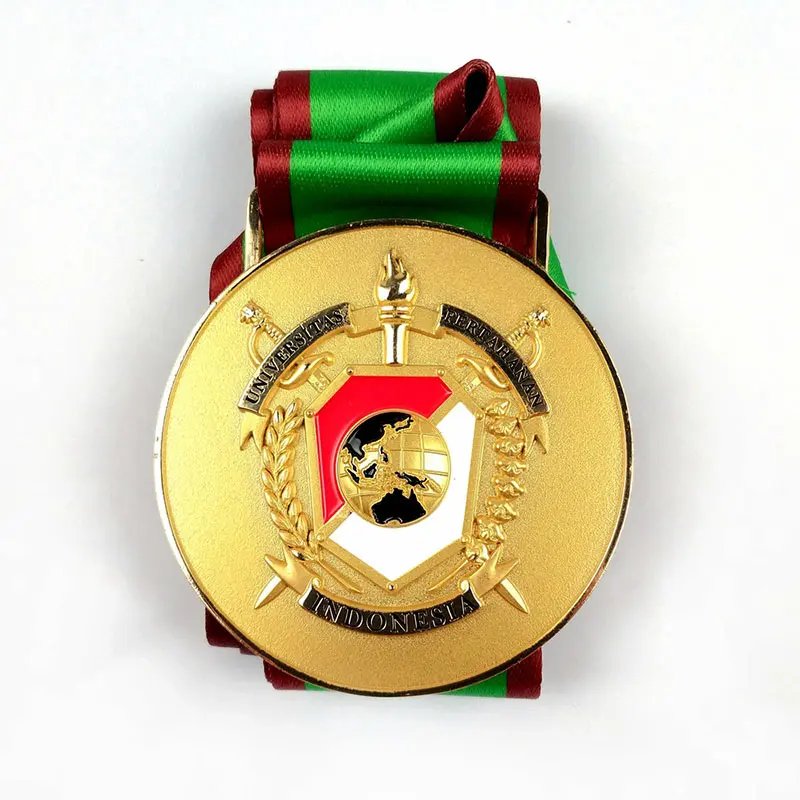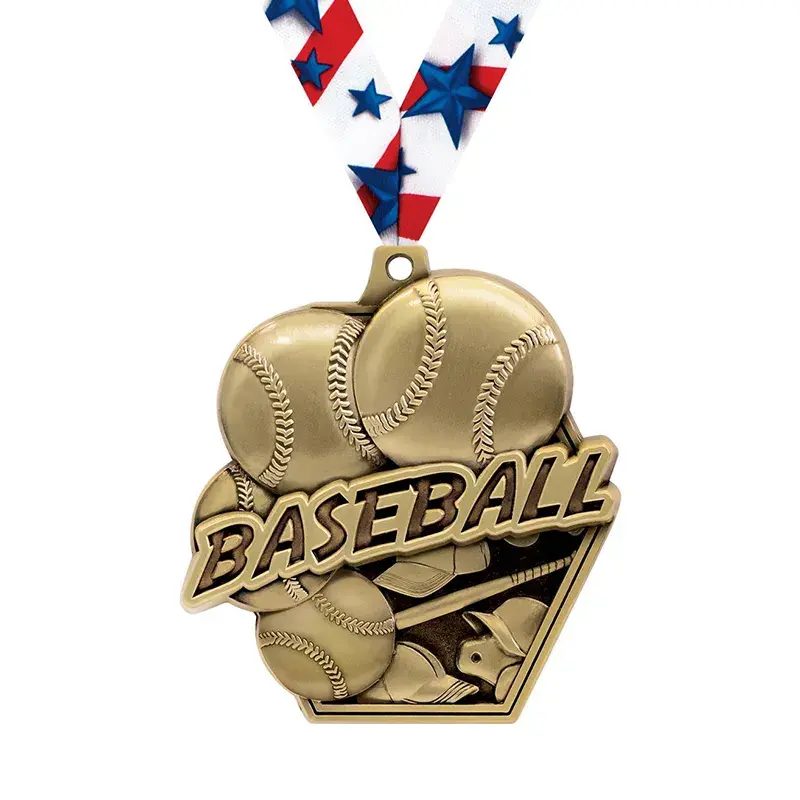
Most buyers arrive with one question and one assumption. The question is “what are custom medals made of,” and the assumption is that the answer is a metal. It is, but only partly. A finished medal is a five-layer assembly, and each layer is made by a different machine and fails in a different way. When a buyer tells us a previous order “looked cheap,” the cause is almost never the alloy — it is one of the four layers stacked on top of it. If you want the product view first, browse our custom medals range; if you want to know what you are paying for, read on.
A Medal Is a Stack, Not a Material
Think of a medal the way an engineer thinks of a coated component: a substrate, a corrosion and color system, a graphic layer, and two presentation parts. Nobody buys a substrate; they buy the whole stack, and the stack has to survive a ceremony, a backpack, a drawer, and three years of humidity.
| Layer | What it is | What it decides | How it fails |
|---|---|---|---|
| 1. Body | Die-cast zinc alloy, 3# / 5# / 7# | Silhouette, 3D relief, weight, openwork | Cracks, water marks, porosity, short shots at sharp corners |
| 2. Plating stack | Electroplated copper base plus a color metal | Metallic color, reflectivity, corrosion resistance | Blistering, flow lines, dulling, peeling at edges |
| 3. Color fill | Enamel or paint sitting in recessed areas | Graphic legibility and perceived quality | Bleeding, sinking, contamination, color shift |
| 4. Ribbon | Heat-transfer polyester lanyard, welded or sewn | How the medal hangs and reads at ten feet | Fraying, print cracking, wrong drape |
| 5. Hardware | Split ring, safety pin, chain, or magnet | Whether the medal survives being worn | Pull-out, corrosion, wrong attachment for the weight |
Layer 1: The Body Is Die-Cast Zinc Alloy
The substrate of nearly every custom medal we make is zinc alloy in grades 3#, 5#, and 7#. They are not three price tiers; they are one alloy family with slightly different balances of alloying elements, sharing the properties that make zinc the default medal metal: a density of 6.7 g/cm³, a melting point around 385°C, and excellent fluidity when molten.
That low melting point means less thermal shock to the steel mold, longer mold life, and a wider processing window on the press. Fluidity is the other half — zinc fills thin sections and fine lettering that would short-shot in a less forgiving alloy.
| Metal | Density | Forming route | Thickness limit | Why it is or is not used for medals |
|---|---|---|---|---|
| Zinc alloy 3# / 5# / 7# | 6.7 g/cm³ | Die-casting | 2 mm minimum wall | Best flow, best relief, takes plating and enamel |
| Brass | 8.9 g/cm³ | Stamping + cutting | Difficult above 3 mm | Heavy, dense, few pores, more expensive |
| Iron | 7.8 g/cm³ | Stamping + cutting | Difficult above 4 mm | Cheaper than brass, rusts easily |
| Aluminum | 2.7 g/cm³ | Stamping + cutting | Sheet-based | Light, takes anodizing, cannot hold deep relief |
We run medals on an 88-ton die-casting machine. Molten alloy is injected through a nozzle into a steel mold, and the mold is the real engineering work: frame, cavity insert, support pillars, slides, ejector pins, and a gate. On a round medal we cut four gates at even intervals around the circumference, so the metal reaches the far side of the cavity at the same moment it reaches the near side.
Surface texture is built into the mold, not sprayed on later. When a design calls for a matte field behind a polished figure, the mold shop burns that texture in by spark erosion — an electrode discharges into the steel and leaves a dense field of tiny craters that transfer to every casting, consistently.
The 2 mm minimum wall is not a commercial choice to sell more metal. Below it, the alloy cannot fill the cavity before it freezes, and the ejector pins have too little material to push against without deforming the piece. We treat 2 mm as a hard floor and 2.5–4 mm as the working range, covered in detail in our guide to medal thickness and weight.
Layer 2: The Plating Stack Is Nine Steps, Not One
This layer separates a medal that still looks good in year three from one that looks tired in month six. Plating is not “dip it in gold.” It is a sequence, and every step exists to make the next one adhere.
| # | Step | What happens | Typical parameter |
|---|---|---|---|
| 1 | Racking | Parts hung on jigs so current reaches every face | Manual, per-part fixture |
| 2 | Degreasing | Wax, oil, and release residue removed | Chemical bath |
| 3 | Ultrasonic cleaning | Residual polish compound lifted from recesses | Ultrasonic tank |
| 4 | Alkaline copper | Thin adhesion layer bonds to the zinc | About 500 seconds |
| 5 | Acid copper | Builds thickness and levels the surface for brightness | 20–60 minutes |
| 6 | Color plating | Gold, nickel, copper, rose gold, chrome, black nickel, platinum | Per finish |
| 7 | Tunnel oven dry | Fixes the deposit and drives off moisture | 100°C for 40 minutes |
| 8 | Seal coat | Clear lacquer over gold and copper tones to slow oxidation | Spray |
| 9 | Unracking | Parts come off the jig and go to inspection | Manual |
The alkaline copper step decides whether the finish stays put: a thin, tightly bonded layer that grips the zinc, while the acid copper that follows does the leveling and the brightness. Skip or shorten either and the color metal sits on a surface it does not really adhere to. That is the mechanism behind most “the plating peeled off” complaints, and why we do not offer a shortened plating cycle as a cost-down option. Step 8, the clear seal coat, matters too: gold and copper tones oxidize, and a seal coat slows that down and keeps fingerprints from etching the surface.
Layer 3: Color Fill Sits Inside the Metal
If the design has color in recessed areas, that is the third layer, and the choice of fill changes both the look and the manufacturing order.
Soft enamel is thin and flows well. Applied after plating and cured, it shrinks as it dries and sits below the metal lines. The result is the classic ridged feel: run a fingernail across the surface and you feel every line. Minimum color area is 0.3 mm.
Imitation hard enamel is thicker and denser. It is applied first, polished flat, and then the whole piece is plated — a reverse order most buyers do not expect. Because the color is polished level with the metal before plating, the finished surface is smooth and color and metal sit in the same plane. Minimum color area is 0.5 mm.
Glass enamel is also 0.5 mm minimum, applied after plating, and gives a glossier surface than soft enamel without the reverse process. Translucent versions need high-temperature tape on the back during curing.
| Fill type | Min. color width | Surface profile | Process order | Best for |
|---|---|---|---|---|
| Soft enamel | 0.3 mm | Recessed, tactile ridges | Plate → fill → cure | High-volume event medals, strong linework |
| Imitation hard enamel | 0.5 mm | Flat, polished, ceramic-like | Fill → polish → plate | Premium awards, corporate recognition |
| Glass enamel | 0.5 mm | Smooth, glossy, slightly domed | Plate → fill → cure | Bright color blocks, crests |
| Translucent enamel | 0.5 mm | Smooth, light-passing | Plate → fill (taped back) → cure | Jewel-tone effects |
| Glitter / glow | — | Textured or luminous | Glitter dusted while half-dry; glow coat after full cure | Kids’ events, novelty races |
| Epoxy dome | — | Glossy, glass-like | Same sequence as hard enamel, different fill | Protection plus shine at lower cost |
Curing is where color quality is won or lost. We run a two-stage bake: 60–70°C for 60–90 minutes for a partial cure, used when a part still needs wiping or a second color, then 100°C for 60 minutes for full cure. Rushing the second stage traps solvent, which shows up later as bubbles under the seal coat.
Layer 4: The Ribbon Carries the Weight
The ribbon is the only part of the medal that touches the recipient’s body, and it is usually specified last. Standard heat-transfer polyester ribbon runs 860–900 mm long and 20–30 mm wide, with a shorter 800 × 20 mm ribbon for kids’ events. Length is not arbitrary: it sets the medal at sternum height on an adult and keeps it from swinging into the face during a run.
Attachment is either ultrasonic welding or sewing. Ultrasonic welding fuses the folded ribbon to itself without thread, giving a clean edge and no stitch line to fray; it is what we use for high-volume event ribbons. Sewing — four-fold, three-fold, or angled single loop — is used where the material will not weld cleanly. Our medal ribbons range covers both.
Ribbon width interacts with body weight. A heavy 4 mm die-cast medal on a narrow 20 mm ribbon will twist; the same medal on a 30 mm ribbon hangs flat. Specify both together.
Layer 5: Hardware Decides Whether It Survives the Ceremony
The fifth layer is small, cheap, and the most common point of failure in the field. We stock split rings, dog clips, single loops, safety pins, screw posts, ball chains, and magnets from 2 mm to 20 mm in diameter.
A 4 mm, 60 mm-diameter medal weighs roughly twice what a 2.5 mm version of the same diameter does, and the attachment has to be chosen for that. Split rings and ribbons carry event medals; safety pins suit lightweight badges but not heavy die-cast bodies; screw posts need thread lock or they back out; ball chains are limited by chain tensile strength; magnets lose pull strength sharply on curved or textured backs. We match hardware to body weight at sampling, because discovering that a split ring opens under load after 5,000 pieces are packed is an expensive way to learn it.
Where Medals Actually Fail, and Why
Every defect below has a specific cause upstream, and none are fixed by “being more careful” at final inspection.
| Defect | Layer | Actual cause |
|---|---|---|
| Cracks | Body | Too few ejector pins, or pins distributed unevenly, so the part is pushed out under unbalanced load |
| Water marks | Body | Mold face not polished enough, insufficient injection pressure, or the press running too fast at start-up |
| Porosity (air holes) | Body | Poor venting — gas has nowhere to escape before the metal freezes |
| Sharp corners not filled | Body | Injection pressure too low for the section thickness |
| Plating blistering | Plating | Parts not cleaned thoroughly before plating, or blistering under the seal coat after baking |
| Flow lines in plating | Plating | Insufficient bath agitation or too much organic contamination in the solution |
| Contamination in enamel | Color fill | Dirty spray booth or unfiltered air over the fill station |
| Paint sagging | Color fill | Coating built too thick when spraying front and back in one pass |
Two are worth internalizing. Porosity is a venting problem, so it clusters in the same region of a design every time — if you see air holes in the same spot on multiple samples, the mold needs venting work, not more polishing. Blistering is a cleaning problem, so it appears in batches rather than randomly.
How the Layers Constrain Each Other
The five layers are not independent specifications you can each optimize. They push against each other in four predictable ways.
Deeper relief needs a thicker body. A 0.8 mm raised figure on a 2 mm plate leaves only 1.2 mm of material beneath it, which is the most common reason a design moves from 2.5 mm to 3 mm.
Plating throws into recesses unevenly. The color metal deposits faster on exposed high points than inside narrow channels, so 0.4 mm-wide recesses plate bright on top and thin at the bottom.
Enamel needs width, and hard enamel needs more of it. A 0.35 mm channel takes soft enamel but not imitation hard enamel, so hairline color separations must change before the mold is cut.
Weight has to be carried. A thicker body needs a wider ribbon and stronger hardware, and it costs more to ship.
If you want to see how these constraints are sequenced on the floor, our medal manufacturing process walks the full route from artwork to packing.
The Boundary of What We Make
We are a metal factory: we die-cast zinc alloy and stamp brass, iron, aluminum, and stainless steel. We do not produce textile, embroidery, apparel, paper, or silicone awards, and if your program needs a woven patch we will say so rather than subcontract it. Our medal materials guide covers the metals we work with, and our enamel medals page goes deeper on color fill.
FAQ
What metal are custom medals usually made of? Zinc alloy, in grades 3#, 5#, or 7#, is the default because it melts at about 385°C and flows well enough to fill fine 3D detail. Brass, iron, and aluminum are also used, but they are stamped from sheet rather than die-cast, so they cannot hold deep relief or openwork.
Is “zinc alloy” just a polite word for cheap metal? No. It is a specific engineering material with a density of 6.7 g/cm³, chosen because it casts detail no stamped metal can match. What makes a medal feel cheap is almost always a thin plating stack or a poorly finished mold, not the alloy.
How many plating steps does a medal actually need? Nine: racking, degreasing, ultrasonic cleaning, alkaline copper for about 500 seconds, acid copper for 20 to 60 minutes, color plating, tunnel-oven drying at 100°C for 40 minutes, seal coating, and unracking. The copper base is what the color layer adheres to, so it cannot be shortened without risking peeling.
Why do some plated medals bubble or peel? Almost always because the part was not clean enough before plating — polishing compound left in a recess, or oil not fully removed. The plating adheres to the contamination instead of the zinc and lifts later. Blistering can also come from moisture trapped under the seal coat during baking.
Can a custom medal be made without any plating? Yes, but the look changes completely. An unplated die-cast body shows raw zinc, a dull grey-white, and it will oxidize. Some designs use paint or electrophoresis instead, a different route with a different cost structure and a different set of achievable colors.
What is the minimum order for a custom die-cast medal? 100 pieces per design. Each design needs its own steel mold, so the mold cost drives the minimum rather than the casting itself. We quote by quantity tier, and the per-piece figure moves as tooling amortizes.
Start With the Layer You Cannot Change Later
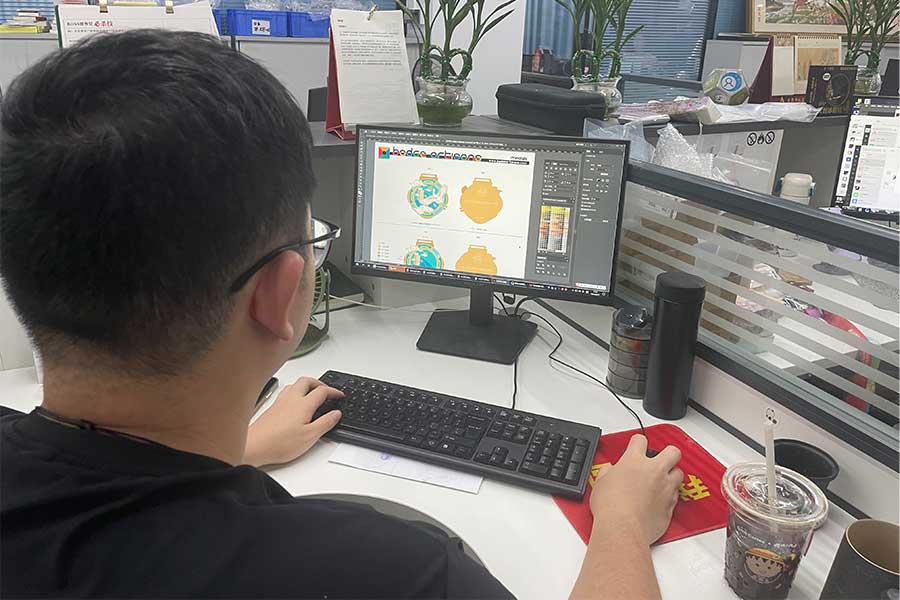
The body and the mold are fixed once the tool is cut; plating, color, ribbon, and hardware can all be revised on a reorder. That is why the useful conversation happens before tooling, with artwork in hand. Our design team turns artwork into a production-ready proof within 24 hours, with unlimited revisions, and flags where a design will not cast, plate, or fill cleanly.
We have been making metal medals since 2010, run 30,000+ pieces a day, ship to 50+ countries, and hold three-stage QC with 100% conforming delivery. Samples take 7–10 days and bulk runs 7–15 days. If you want a second opinion on a spec sheet, or a quote on a specific design, send us the artwork with the event, quantity, and look you are after. If the finish is the open question, go to plating and surface finishes.