A medal’s shape comes from the mold, but its look comes from how the colour gets onto the metal. That decision is made at step 9 of our 12-step line, and it is the one buyers most often leave until too late. UV printing and enamel are the two paths, and they are not interchangeable. We run both in our Huizhou factory, so this is the comparison we walk buyers through before they lock a design — starting from our full medal materials guide.
What we’ll cover:
- What UV printing actually is, and why it behaves differently from enamel
- Minimum line widths and colour limits for each method
- How each one wears over years, not weeks
- Cost per colour, and where the crossover sits
- Which method suits which event and design
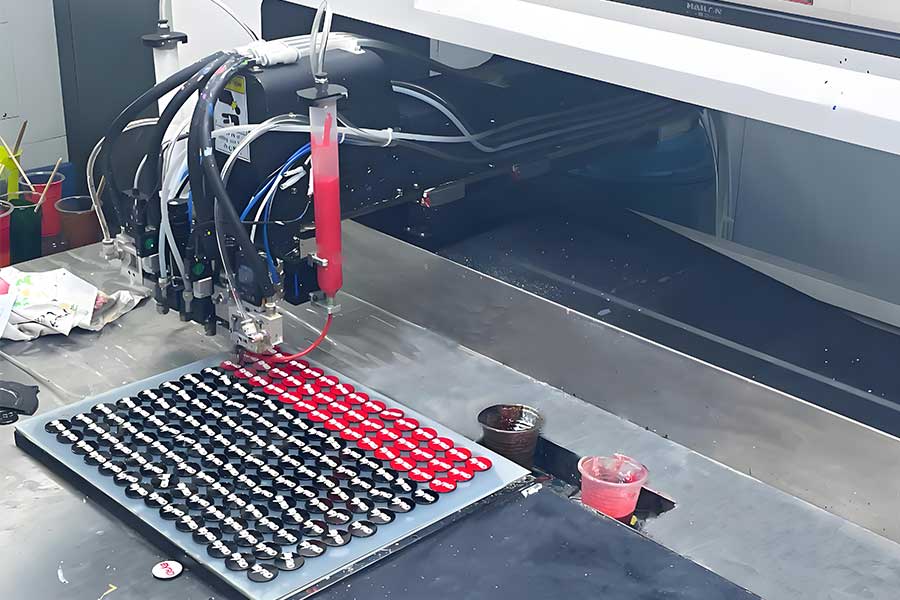
[Image: process-10-uv-printing.jpg — UV printer applying four-colour artwork directly onto a plated custom medal on the factory line]
Two Ways to Put Colour on Metal
Enamel fills recessed cavities in the metal with paint. UV printing lays ink on top of the surface. That single difference explains almost every trade-off that follows.
Soft enamel dispenses liquid paint into the recessed areas between raised metal lines. The paint cures, shrinks slightly, and settles below the metal ridges — so you feel the metal when you run a finger across it. Our line cures at a low-temperature bake of 60–70°C for 60–90 minutes as a semi-cure, then a full cure at 100°C. Minimum fill width is 0.3mm.
Imitation hard enamel uses a thicker paste instead, then polishes the entire face flat so paint and metal sit at the same level. That extra polishing stage pushes the minimum fill width out to 0.5mm and adds cost.
UV printing is a different animal. A print head deposits four-colour ink directly onto the medal surface and cures it instantly with ultraviolet light. There is no cavity to fill, so the ink sits on top of the plating rather than inside the metal. It handles gradients, photographic detail and blended colours that enamel cannot produce at all.
| Soft Enamel | Imitation Hard Enamel | UV Printing | |
|---|---|---|---|
| How colour is applied | Paint fills recessed cavities | Thick paste, then polished flat | Ink printed onto the surface |
| Surface feel | Textured — raised metal lines | Smooth, glass-like | Slightly grainy, flat |
| Minimum line width | 0.3mm | 0.5mm | No line minimum; detail limited by print resolution |
| Gradients & photos | No — flat colours only | No — flat colours only | Yes — full four-colour |
| Cure parameters | 60–70°C semi-cure → 100°C full cure | Baked, then machine-polished | Instant UV cure |
| Registration accuracy | Very precise (metal lines separate colours) | Very precise | Moderate — ink can drift on 3D relief |
| Best for | Race and sports medals, most events | Premium ceremony awards | Photographic art, logos with gradients, tight budgets |
The registration point is the one buyers miss. With enamel, the raised metal line is the colour boundary — the mould guarantees clean separation, so a 0.3mm line stays sharp across 10,000 pieces. With UV printing there is no metal wall between colours, so the printer has to hit the same position every time. On a flat medal it does that well. On a deeply relieved surface it does not, which is why UV works up to about a 7mm surface drop and starts to struggle beyond it.
Minimum Detail: What Your Artwork Can Actually Hold
This is where designs get approved and then come back wrong. The rule is different for each method.
| Design element | Soft enamel | Hard enamel | UV printing |
|---|---|---|---|
| Thinnest colour line | 0.3mm | 0.5mm | No minimum, but under ~0.3mm ink spreads |
| Smallest text | ~4pt | ~5pt | ~4pt |
| Colour count | Per colour, unlimited in theory | Per colour | One pass, effectively unlimited |
| Gradient or photo | Not possible | Not possible | Yes |
| Metal outline between colours | Required | Required | Not required |
| Works on 3D relief | Yes | Flat faces only | Up to ~7mm drop |
Enamel needs metal between every colour. That is a design constraint, not a defect — it is also what gives enamel medals their crisp, jewellery-like read. A ten-colour enamel design needs ten separations in the mold, which is why colour count drives both tooling and per-unit cost.
UV printing removes that constraint entirely. You can print a full-colour event poster onto a medal face and skip the multi-colour mold work. What you give up is the raised metal outline and the depth of a hand-filled enamel finish.
Our design guide walks through how to prepare artwork for each path, including the vector and Pantone requirements enamel needs.
[Image: process-09-color-filling.jpg — Technician hand-filling enamel colour into the recessed cavities of a plated die-cast medal]
Durability: How Each One Ages
Both finishes are durable when the metal underneath is prepared properly. The failure modes differ.
| Aspect | Soft enamel | Hard enamel | UV printing |
|---|---|---|---|
| Wear resistance | Excellent — paint protected by metal ridges | Excellent — flat polished surface | Good — ink sits exposed on the surface |
| Scratch risk | Low — ridges shield the colour | Moderate — flat face takes contact | Higher — the printed layer is the outermost surface |
| UV / sunlight fade | Minimal | Minimal | Can fade over years outdoors |
| Abrasion from handling | Low | Low | Moderate on high-touch areas |
| Expected life | Decades | Decades | Years, longer indoors |
The mechanism matters. Enamel colour is physically held inside the metal, so the raised lines take the wear instead of the paint. UV ink is the outermost layer on the medal, so it absorbs contact directly.
The foundation under both is the same, and it is where most quality problems actually start. Every medal on our line goes through ultrasonic degreasing, an alkaline copper base at about 500 seconds, then 20–60 minutes of acid copper before the final plating colour and a 100°C seal-coat bake. Skip that preparation and both enamel and UV ink will lift off a plated surface. Our plating guide breaks down that sequence.
One practical note: if the medal will live outdoors on a permanent monument or be handled daily for years, enamel is the safer choice. If it is a one-off event medal displayed indoors, UV printing’s fade risk is largely theoretical.
Cost: Where the Crossover Sits
Pricing runs in opposite directions for the two methods, and the crossover depends on colour count.
| Scenario | Soft enamel | UV printing |
|---|---|---|
| 1–3 colours, 500 pcs | Cheapest option | Comparable |
| 4–6 colours, 500 pcs | Rising per colour | Cheaper — one print pass |
| Full-colour artwork / gradient | Not possible | Only viable option |
| Mold / separation cost | One separation per colour | Body mould only |
| Tooling amortisation | Reused on reorders | Reused on reorders |
| Rush orders | Filling and curing take longer | Faster — instant cure |
Enamel is charged per colour because each one is a separate fill and cure step. UV printing is charged per print pass, so a twelve-colour design costs the same as a two-colour one. Past roughly four colours, UV printing usually wins on price.
Both methods share the body mould, and that is the cost that dominates a small order. Our MOQ is 100 pieces per design, and the mould is held on file — so a second run of the same design skips tooling entirely. Our pricing breakdown shows how the mould fee amortises across quantity, and the bulk custom medals page covers volume tiers.
[Image: process-07-plating.jpg — Plated medal blanks hanging on a rack, ready for colour filling or UV printing]
Which Method for Which Medal
| Medal type | Recommended method | Why |
|---|---|---|
| Marathon / race finisher | Soft enamel | Textured read, colour blocks, durable in volume |
| Championship / ceremony award | Hard enamel | Polished, jewellery-like perceived value |
| Event logo with gradient | UV printing | Only method that can hold a gradient |
| Photographic or illustrated art | UV printing | Four-colour detail enamel cannot reproduce |
| Tight budget, many colours | UV printing | One pass regardless of colour count |
| Outdoor permanent display | Enamel | No ink layer to fade |
| Military / challenge coin | Hard enamel | Crisp separations, formal finish |
| Kids’ event medals | Soft enamel | Durable, colourfast, cost-efficient |
The shortest version of the rule: if the design has gradients or photos, UV print. If it has flat colour blocks and needs a premium feel, use enamel. If it has flat colour blocks and needs durability at volume, use soft enamel.
Soft enamel remains the industry default for race and sports medals — roughly nine in ten custom medals we ship use it — because it balances durability, colour and cost better than anything else at event volumes.
If you are unsure which way to go, send us the artwork and your quantity. We will tell you which method holds your design and what each one costs, before you commit to a mould.
Data to confirm: Confirm current minimum line widths, colour counts and cure schedules with the factory before finalising artwork, as print and enamel consumables change.
FAQ
Is UV printing cheaper than enamel on medals? Not always, but it wins as colour count rises. Enamel is charged per colour because each one is a separate fill and cure step. UV printing is a single pass regardless of how many colours the artwork contains, so past roughly four colours it is usually the cheaper option.
Can UV printed medals have gradients? Yes — that is UV printing’s main advantage. Enamel can only produce flat, separated colour blocks because each colour needs its own recessed cavity in the metal. UV printing deposits four-colour ink on the surface, so gradients, blends and photographic detail are all possible.
How long does UV printing last on a medal? Indoors, years — long enough for any event medal. The ink is the outermost layer, so it takes surface contact directly, and prolonged direct sunlight can fade it over time. Enamel holds colour longer outdoors because the paint sits protected inside the metal.
What is the minimum line width for enamel medals? 0.3mm for soft enamel and 0.5mm for imitation hard enamel. Soft enamel allows finer detail because the paint sits recessed; hard enamel needs wider areas because the surface is polished flat after filling.
Does UV printing work on 3D medals? It works on flat surfaces and on relief up to about a 7mm drop. Beyond that, the print head cannot keep consistent contact with the surface, and registration drifts. For deep sculpted relief, enamel is the reliable choice.
Can I combine enamel and UV printing on one medal? Yes, and it is a common approach. Enamel fills the main colour blocks while UV printing adds a logo, fine text or a gradient detail on top. That combination keeps the premium enamel feel while avoiding extra mould separations for a complex element.
Which finish is better for a race medal? Soft enamel. It is textured, colourfast, durable at event volumes and the most cost-effective option once you are past a few colours. Hard enamel is the better pick when the medal is a formal championship award and perceived value matters more than unit cost.
Related reading: rotating-centre custom medals — custom spinning medals with a rotating centre — same Zamak die-cast base, MOQ 100 per design.