Race medal cost isn’t one number. It’s four numbers stacked together — material, plating, enamel fill, and quantity. Change any one and the per-piece price shifts. We build custom race medals in our Huizhou factory daily, so we can show you where the money actually goes, and how to pull cost out without the medal looking cheap.
What we’ll cover:
- The four cost drivers that move your per-piece price
- How zinc alloy, brass, and iron stack up on cost and feel
- Which plating and enamel finishes cost more — and why
- How mold fees and order quantity change the math
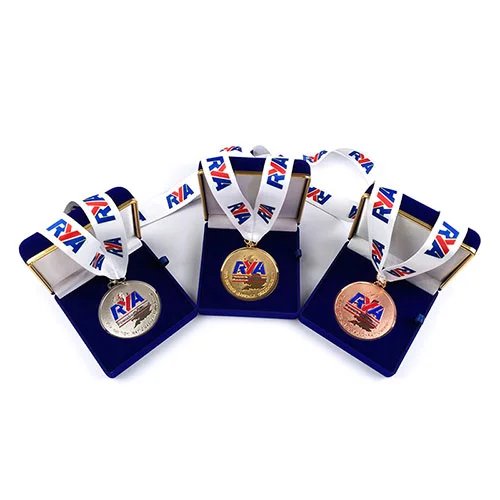
[Image: race-medals.jpg — Custom race medals in gold, silver, and bronze finishes arranged on a table]
The Four Cost Drivers That Move Your Price
When a buyer asks us “how much does a race medal cost,” we ask four questions right back. The answer lives in four drivers, and they don’t weigh the same.
In order of impact:
- Material — the single biggest lever on both price and feel
- Plating and finish — imitation gold, nickel, antique, and the rest
- Enamel fill — soft vs hard, and how many colors
- Mold fee and quantity — the one-time cost you spread across every piece
Get these four right and you’ll land a medal that looks expensive but isn’t.
Material: Zinc, Brass, or Iron
Material is the first question because it sets the floor for everything else. Zinc alloy, brass, and iron all make fine race medals, but they cost and feel nothing alike.
| Zinc Alloy (Die-Cast) | Brass (Stamped) | Iron (Stamped) | |
|---|---|---|---|
| Right for | 3D detail, complex shapes, most race medals | Heavyweight, upscale, heritage feel | Simple shapes, tight budget |
| Density | 6.7 g/cm³ | 8.9 g/cm³ | 7.8 g/cm³ |
| Process | Die-casting on an 88-ton press | Stamping | Stamping |
| 3D relief | Excellent | Low | Low |
| Relative cost | $$ | $$$ | $ |
Zinc alloy is our default for race medals, and for good reason. Zamak 3, 5, and 7 melt at 385°C and flow into a mold cavity easily, which is what lets a die-casting machine capture fine 3D detail in a single shot. It’s the cheapest way to get a raised, sculpted design — your event logo with real depth, cutouts, and text you can feel. The trade-off is lighter weight.
Brass is heavier (8.9 g/cm³ against zinc’s 6.7) and reads more upscale, but it’s stamped, not cast, so it can’t hold deep 3D relief. You pay more for that weight and warmth, which is why we usually steer brass toward military and commemorative pieces rather than a 5K finisher medal. Iron is the budget play — cheapest of the three, fine for flat or simple shapes, but it rusts if the plating wears, and it won’t give you sculpted detail.
So the rule is simple. Want 3D detail on a budget? Zinc. Want weight and prestige? Brass. Want the lowest possible price on a simple shape? Iron. The full breakdown of all five metals lives in our medal materials guide.
[Image: process-03-die-casting.jpg — 88-ton die-casting machine injecting molten zinc alloy into a medal mold]
Plating: Where the Visible Cost Lives
Plating is what the runner actually sees — the gold, silver, or antique surface. It’s a smaller cost than the metal underneath, but it changes how a medal photographs and how buyers judge it.
| Imitation Gold | Nickel (Silver) | Antique Bronze / Tin | |
|---|---|---|---|
| Right for | 1st place, classic gold | 2nd place, silver tier | Vintage, heritage, military races |
| Look | Bright mirror gold | Bright silver | Dark, aged, matte |
| How it’s applied | Electroplating | Electroplating | Electrophoresis or barrel plating |
| Relative cost | $$ | $$ | $ |
The surprise for most buyers is that the bright gold and silver are the pricier options, not the antique. A mirror finish is full electroplating: we strip and degrease, plate a base of alkaline copper for about 500 seconds, then acid copper for 20 to 60 minutes to build the shine, and only then lay the final color. That’s a real metal layer, built tank by tank.
Antique bronze and antique tin take a cheaper path. Electrophoresis and barrel plating coat the recesses in a single pass, which is why they cost less — and why a “vintage” medal can actually save you money on finishing. The aged look also hides scratches and handling far better than a bright mirror does.
But plating isn’t where cost runs away. It’s a flat, predictable add either way. Where buyers accidentally overspend is the enamel.
[Image: process-07-plating.jpg — Medals on a plating line being coated with a bright gold finish]
Enamel Fill: Soft vs Hard, and Color Count
Enamel is the colored paint that sits inside the recessed areas of your design. Two types dominate race medals: soft enamel and imitation hard enamel. The difference is thickness and finish — and it shows up on the invoice.
| Soft Enamel | Imitation Hard Enamel | |
|---|---|---|
| Right for | Colorful race medals, texture you can feel | Smooth, ceramic-like finish |
| Min. fill width | 0.3mm | 0.5mm |
| Surface | Recessed, metal lines you can feel | Flat, smooth, glassy |
| Relative cost | $ | $$ |
Soft enamel is the standard for race medals. It fills recessed areas as narrow as 0.3mm and cures to a slightly sunken finish, so you can feel the metal lines between colors. It’s the cheaper of the two. Imitation hard enamel needs a wider 0.5mm recess, goes on thicker, and is ground flat and polished to a smooth, ceramic-like top. You pay more for that surface — and for the extra labor.
Color count matters more than most buyers expect. Every color is a separate fill and cure cycle. A three-color medal means three passes through filling and baking. Add a fourth color and the per-piece price ticks up again, plus you’ve added handling time. The full picture on color options is in our enamel medals guide.
[Image: process-09-color-filling.jpg — Worker filling enamel color into the recessed areas of a medal]
Mold Fee and Order Quantity: The Real Lever
Here’s the part most first-time buyers don’t see coming: the mold. Every die-cast medal starts with a steel mold, and that mold is a one-time cost. It’s also the reason unit price falls as quantity rises.
We machine the mold from your 3D artwork, heat-treat it, and it becomes the tool that stamps out your medal on the 88-ton press. The mold fee is paid once, then spread across your total order. Order 100 medals and that fee sits heavily on each piece. Order 2,000 and it nearly disappears. That’s why our bulk custom medals page shows a sliding scale rather than a single number.
Quantity works the same way for the rest of the line. Our minimum is 100 pieces per design, and our floor runs over 30,000 pieces a day. Setup — loading the mold, mixing enamel colors, warming the plating tanks — costs about the same whether you run 100 pieces or 10,000. So the more you order, the less setup overhead each medal carries.
That’s the honest math. If you want a medal that looks like it cost more than it did, spend on zinc with a good plating and a clean two- or three-color soft enamel design, and push your quantity past the low hundreds. You’ll feel it in the per-piece price, and no one at the finish line will know the difference.
We’ve been running this line since 2010, and every order gets a three-stage QC check before it ships in 7 to 15 days. If you want to see the full flow before you commit, our manufacturing process page shows all 12 steps from design to packing.
[Image: factory-workshop-02.jpg — Factory floor running multiple medal production lines]
FAQ: Race Medal Cost
What’s the cheapest material for a race medal? Iron is the cheapest of the three common options, but it’s stamped and flat, so it only suits simple shapes. Zinc alloy is the cheapest way to get real 3D detail, which is why it’s our default for race medals.
How much does a race medal mold cost? The mold is a one-time steel tool machined from your 3D artwork and heat-treated before production. Because it’s spread across your order, its per-piece impact drops sharply as quantity rises — which is why we quote mold and unit cost together, not separately.
Why does my unit price drop when I order more? Setup is the reason. Loading the mold, mixing enamel colors, and warming the plating tanks costs about the same at 100 pieces or 10,000, so larger runs spread that overhead thinner. Our minimum is 100 pieces per design.
What’s the price difference between soft and hard enamel? Soft enamel fills recesses as narrow as 0.3mm and costs less. Imitation hard enamel needs a 0.5mm recess, goes on thicker, and is ground flat, so it costs more for the extra material and labor.
Does the plating color change the cost? Yes, but not the way most people guess. Bright imitation gold and nickel are full electroplating, so they run higher. Antique bronze and tin use electrophoresis or barrel plating, which is cheaper — so an antique look can actually lower your finishing cost.
How fast can I get a price and a sample? MedalOrigin sends a quote within 24 hours and a free design proof the same day. A sample takes 7 to 10 days, and full production ships in 7 to 15 days after you approve it.
Recommended Reading
- Custom Medal Pricing: Mold Fees, Quantity & Cost Drivers — a deeper look at how mold and quantity set your unit cost
- Medal Plating & Finishes: Gold, Silver, Nickel, Antique — every finish option and when to pick it
- Zinc Alloy vs Brass Medals: Which Material Is Right for Your Event? — the full material decision, side by side
Data to confirm: relative cost tiers ($$/$$$/$) reflect direction, not a fixed price list — actual per-piece pricing depends on artwork, color count, and quantity. The 10,000-piece example is illustrative, not a quoted tier break.