Plating is the single finish decision that changes how a custom medal looks in a photo, feels in the hand, and holds up after a season of handling. Yet it is usually the last thing buyers think about, and the first thing they regret.
We run plating in-house in Huizhou as part of our nine-step finishing line. This guide compares the three place finishes, the surface treatments on top of them, and how to keep a set looking like one set.
What we’ll cover:
- What plating actually is and why the base layer matters
- Shiny vs antique vs matte, and where each one wins
- How gold, silver, and bronze differ in look and wear
- Thickness, wear resistance, and what “durable” really means
- How to specify a consistent three-place set
Where this guide fits. This one is about the gold, silver, and bronze set specifically — how each of the three place colors is plated, what shiny, antique, and matte do to each one, and how to order all three so they read as one family. It is not a survey of every finish we run. If you are still deciding between a wider field of processes — black nickel, chrome, two-tone, electrophoresis — start with our medal plating finishes comparison.
What Plating Is, and Why the Base Layer Matters
Plating is a thin metal layer deposited onto the cast medal surface. It is not paint, and it is not the underlying material — the medal underneath is zinc alloy, brass, or iron.
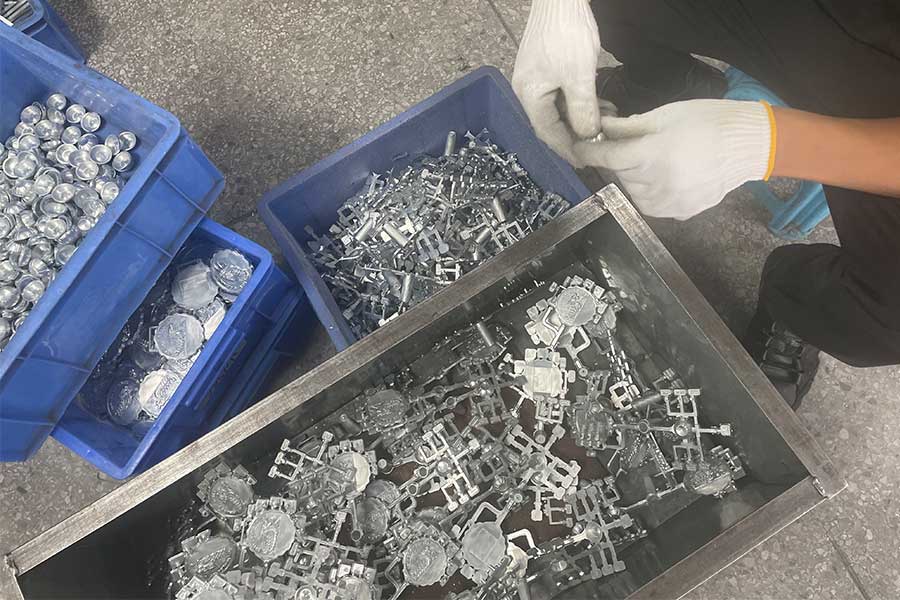
Our plating line runs nine steps: wax removal, ultrasonic cleaning, alkaline copper (about 500 seconds), acid copper (20-60 minutes), coloring, drying in a tunnel oven at 100°C for 40 minutes, oil sealing, and unhooking. The alkaline copper step is the one most buyers never hear about, and it is the one that decides whether your finish lasts.
Alkaline copper at roughly 500 seconds lays down the adhesion layer. Skip it, or rush it, and the bright decorative layer on top will lift, blister, or discolor under handling. This is the most common cause of “my medals looked fine at delivery and bad three months later.”
So when you compare finishes, remember you are comparing two things: the top color layer and the copper base holding it down.
Shiny vs Antique vs Matte
Three surface treatments dominate medal finishing. They sit on top of whichever color you pick.
| Treatment | Finish look | Handles scuffs | Photos as | Best for |
|---|---|---|---|---|
| Shiny | Mirror-bright, high reflect | Poorly — fine scratches show | Crisp, high contrast | Trophy-style awards, display pieces |
| Antique | Darkened recesses, aged depth | Very well | Rich, detailed relief | Race medals, military, heirloom feel |
| Matte | Soft, non-reflective | Very well | Even, modern | Corporate, minimalist branding |
Shiny is the default because it is the most immediately impressive. It is also the least forgiving. Every small handling mark reads against a mirror surface, and a mirror surface in a photo can blow out and lose all the relief detail you paid to cast.
Antique treatment darkens the recesses of the relief and leaves the raised areas polished. That contrast is what makes a detailed design legible. It is why most race and military medals use antique finishes: the design reads clearly and the surface hides a season of abuse.
Matte is the quiet option and the most underused. It photographs evenly, it does not glare, and it suits clean corporate or institutional branding. If your medal carries a logo rather than a scene, matte is often the better answer and clients rarely consider it. For a side-by-side of every finish we offer, see our plating and finishes comparison.
Gold, Silver, Bronze: What Actually Differs
The color choice is traditional and mostly fixed — but the finishes within each color are not.
| Place | Common finishes | Reads as | Notes |
|---|---|---|---|
| Gold | Shiny, antique, matte | First place, prestige | Antique gold avoids the “cheap bright” look |
| Silver | Shiny, antique | Second, clean | Shiny silver shows fingerprints and marks fastest |
| Bronze | Antique, matte | Third, warm | Almost always antiqued; shiny bronze reads oddly |
| Copper / Rose | Antique, shiny | Alternative third | Growing in popularity as a bronze alternative |
| Black nickel | Matte, shiny | Modern, technical | Popular for corporate and tech events |
Two practical notes. First, shiny silver is the finish that ages worst in the hand — fingerprints, fine scratches, and any handling oil all show immediately. If your medals will be passed around, get silver in antique.
Second, gold has a real risk of looking cheap when it is too bright and too uniform. Antique gold gives the color depth and instantly reads as a more considered piece, at essentially the same cost.
Thickness, Wear, and the Word “Durable”
Buyers often ask for “thick plating.” It is the right instinct but the wrong lever on its own. Wear resistance comes from the base layer plus the top layer plus the seal, not from thickness alone.
| Factor | What it does | Practical effect |
|---|---|---|
| Alkaline copper base (~500s) | Adhesion layer | Without it, finish lifts over time |
| Acid copper (20-60 min) | Builds brightness and smoothness | Affects color depth |
| Top color layer | Sets the look | Determines final appearance |
| Oil sealing | Protective coat | Slows oxidation and handling wear |
Our line finishes with an oil seal after the 100°C, 40-minute oven dry. The seal is what keeps a finish looking new through shipping and early handling. The full medal materials guide covers how plating sits alongside alloy choice, and our manufacturing process walks through each of the twelve steps.
The honest summary: a properly based and sealed finish outlasts a thicker finish with a rushed base, every time. If a supplier cannot tell you what their base layer is, that is the question to press.
Specifying a Consistent Three-Place Set
The most common finishing complaint we hear is not about any single medal — it is that gold, silver, and bronze did not look like a family.
Four rules keep a set coherent:
- One surface treatment across all three. Shiny gold with antique bronze is the classic mismatch. Antique gold, antique silver, antique bronze is a set.
- Order all three in one batch. Plating color drifts slightly between runs. Split orders produce split sets.
- Keep the ribbon consistent in construction, even if you vary the color.
- Approve one physical sample of each place, not just a digital proof. Screens do not show metallic finish.
If you only have budget to sample one, sample the silver. It is the one that most visibly reveals whether your base layer and sealing are right. For how finishes affect per-piece cost, our pricing breakdown covers the cost drivers.
Where Plating Fits in the Timeline
Plating sits roughly in the middle of our twelve-step process, after die-casting and polishing and before color filling, UV printing, and assembly.
| Stage | Typical timing |
|---|---|
| Design proof | Within 24 hours of artwork |
| Sampling | 7-10 days |
| Production after approval | 7-15 days |
| Plating within production | Mid-sequence, after polishing |
Because plating comes before color filling and printing, any change to your plating choice after sampling means the sample is no longer valid. Lock the finish before you approve, not after.
We run three-stage QC — after casting, after plating, and after assembly — so a plating fault is caught before it reaches the assembly line rather than after it ships.
If you are choosing a finish and want to see the difference on your own design, send us your artwork and we will quote a physical sample in the two or three finishes you are considering.
Data to confirm: Confirm current plating line specs and sample charges with the factory before quoting, as bath chemistry and vendor supply can shift parameters seasonally.
FAQ
What is the difference between shiny, antique, and matte plating? Shiny is mirror-bright and shows scratches easily. Antique darkens the recesses so relief reads clearly and hides handling marks. Matte is soft and non-reflective, photographs evenly, and suits clean logo-based designs.
Which plating finish lasts longest? Wear resistance comes from the base layer and the seal more than the top color. Our line uses an alkaline copper base of about 500 seconds plus an oil seal after a 100°C, 40-minute oven dry. A well-based and sealed finish outlasts a thicker finish over a rushed base.
Should bronze medals be shiny or antique? Antique. Shiny bronze tends to read as an odd color rather than a deliberate third place. Antique bronze is warm, dark in the recesses, and is what most buyers expect.
Why do gold, silver, and bronze sometimes look mismatched? Usually because the three places were ordered in different batches or with different surface treatments. Order all three in one run, in the same treatment family, and approve a physical sample of each.
How long does plating take within production? Plating sits mid-sequence in the twelve-step process, after die-casting and polishing and before color filling and printing. Overall production runs 7-15 days after sample approval.
Does plating affect the cost much? The major cost drivers on a medal are material, quantity, and enamel color count. Surface treatment choice within gold, silver, or bronze sits inside roughly the same cost band — antique or matte is not a meaningful upcharge over shiny.
Related: custom hard enamel medals — custom hard enamel medals — the finish most buyers compare against soft enamel.