Most buyers who ask us for a medal and pin set assume they are ordering two products. They are not. They are ordering one design system that happens to be produced at two scales, on two tools, through the same plating line — and the moment those two pieces sit next to each other in a presentation box, every small inconsistency becomes visible. We have been casting metal awards at our Huizhou factory since 2010, running custom medals and lapel pins off the same die-casting floor, and the set orders that go wrong almost never fail in production. They fail at the artwork stage, when a 60 mm layout is shrunk to 20 mm and nobody checks whether the linework survives.
This guide is about the purchasing decision, not the design mood board. It covers why events, schools and companies put medals and pins on one purchase order, what “matching” means in manufacturing terms, how tooling is actually charged, how many pins you need per medal, and how the two pieces should be packed so they arrive as a set rather than as two boxes that happen to share a tracking number.
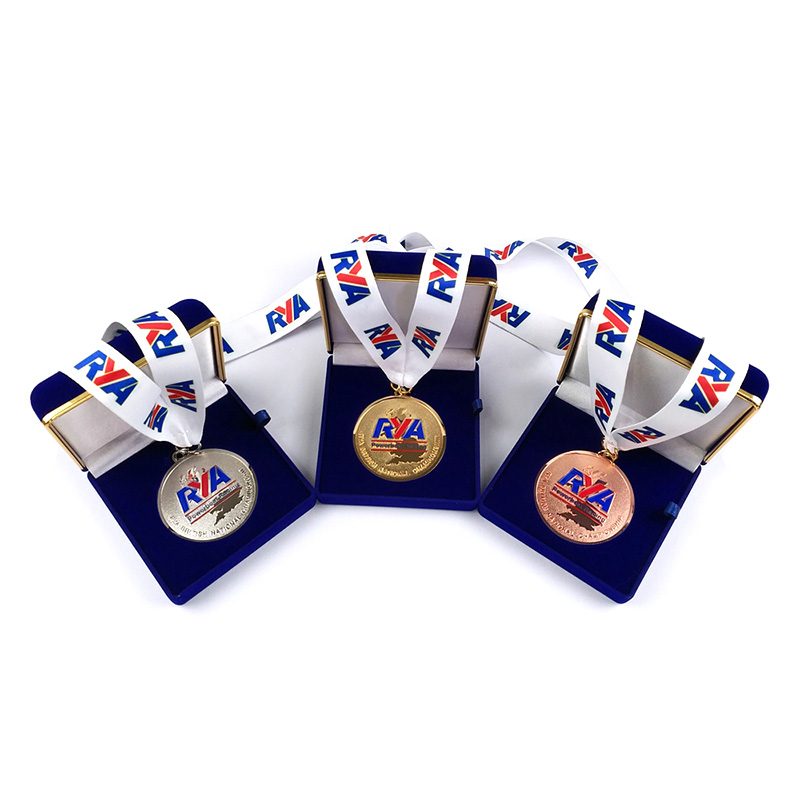
[Image: medal-and-pin-sets-guide.jpg — A matched gold, silver and bronze medal set in presentation boxes, plated in one run so the tones stay consistent]
Why buyers put medals and pins on the same order
The commercial argument for a set is not that it looks nicer. It is that six separate things get done once instead of twice.
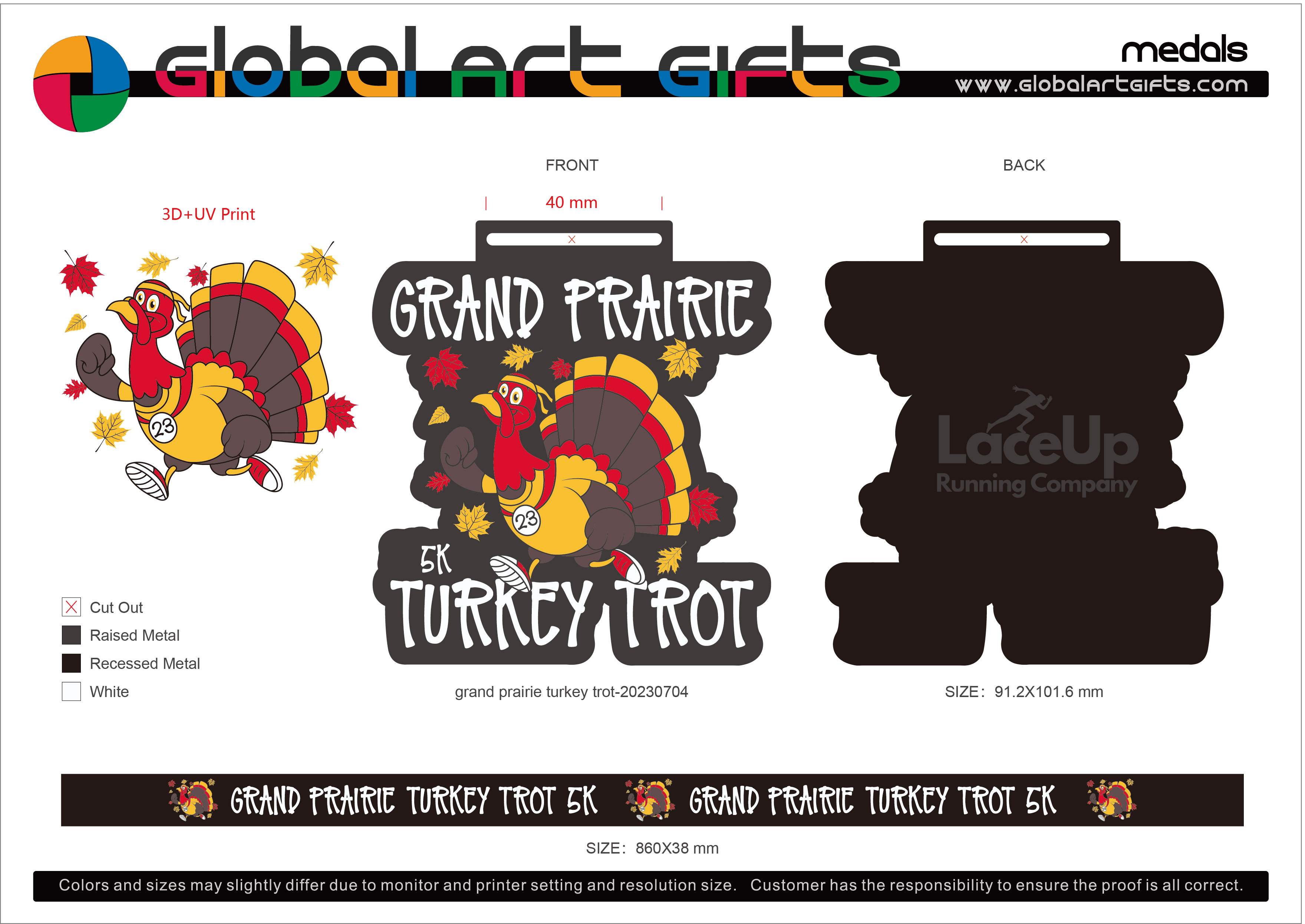
One artwork approval. The pin is derived from the medal master file, not redrawn from a logo. When both pieces come off one approved layout, the typography, the rim treatment and the colour callouts are identical by construction. When they come off two separate orders placed weeks apart, they are identical only by luck.
One tooling window. Two tools, cut in the same week, from the same approved file. This matters more than it sounds: if the medal tool is cut in March and the pin tool in June, the second tool is cut by a different operator reading a file that may have been re-exported in between.
One colour standard. A Pantone reference approved once, applied to both. Enamel colour is mixed by weight against a reference, and a second mixing session is a second chance to drift — usually by a shade that nobody notices alone and everybody notices side by side.
One plating lot. This is the one buyers underestimate most. Gold that looks correct on its own can look bronze next to gold from another bath. Plating tone is a chemistry and timing problem, not a colour number, and we cover the process in detail below.
One shipment and one document set. A single commercial invoice, a single packing list, one set of carton marks. For a school district or a government buyer, this is often the difference between a clean procurement file and a reconciliation problem.
One delivery date. At a race, pins go to the registration desk and medals go to the finish line. They are used by different volunteers at different times on the same morning. Two shipments with two arrival dates is an operational risk that has nothing to do with manufacturing quality.
What “matching” actually means on a metal award
A matched set is not the same artwork at two sizes. Scaling a medal layout down to pin size is the single most common cause of a set that looks unrelated — the elements keep their relative positions but lose their relative weight, and the pin ends up reading as a shrunken medal rather than as a companion piece.
In practice we build a set around five shared decisions and one deliberate difference.
The shared decisions are the silhouette family (a round medal usually wants a round or shield pin, not a square one), the palette (same Pantone references, same enamel type), the plating (same finish, same tone), the typeface (often only the initials or the year survive at pin scale), and the edge treatment (a beaded rim on the medal needs a simplified version on the pin, not an absent one).
The deliberate difference is hierarchy. The medal is the object of the moment: it carries the event name, the date, the placement, sometimes the distance. The pin is a keepsake and an identifier: it carries the mark, and usually nothing else. Trying to put the full medal inscription on a 20 mm pin is how sets end up with unreadable text on the small piece and empty space on the large one.
The scale problem: where artwork breaks
This is where a manufacturer’s constraints matter more than a designer’s opinion. Our die-cast tooling has hard floors, and they apply to both pieces equally — which is exactly why the same artwork cannot simply be scaled.
| Constraint | Limit | What it means for a 20 mm pin | What it means for a 60 mm medal |
|---|---|---|---|
| Minimum line width | 0.3 mm | 0.3 mm is 1.5% of the diameter — a visible line | 0.3 mm is 0.5% of the diameter — reads as a hairline, often lost after plating |
| Minimum relief height | 0.4 mm | 0.4 mm is a strong, legible raise | 0.4 mm is nearly flat at arm’s length |
| Minimum wall thickness | 2 mm | A 2 mm border on a 20 mm pin leaves a 16 mm field | Not usually the binding constraint at medal scale |
| Enamel recess depth | 0.3 mm soft / 0.5 mm hard | Colour sits below the metal line, readable | Deep recesses catch light differently across a large face |
Read that table as a warning about direction. Linework that is comfortable on the medal is usually too fine for the pin, and linework that is comfortable on the pin is usually too heavy for the medal — a 1.2 mm stroke that looks correct at 60 mm becomes a slab at 20 mm, closing the counters in letters like “a” and “e” and filling the gap between two adjacent elements.
The practical fix is to redraw the small piece rather than scale it: hold the 0.3 mm floor as an absolute minimum and treat it as a floor, not a target; simplify the rim; drop secondary text; and let the pin carry fewer elements at a heavier weight. We do this in the artwork stage, which is why our design turnaround is 24 hours — most of that time on a set order is spent on the small piece, not the large one.
Relief works the same way in reverse. The 0.4 mm minimum is a floor for the pin, where it reads as a confident raise. On a 60 mm medal the same 0.4 mm is visually flat, so relief has to be built proportionally to the diameter rather than copied across. If you hand a factory one 3D file and ask for both sizes, expect the medal to look under-modelled.
Enamel type: the mismatch nobody specifies
Soft enamel and hard enamel are not two finishes of the same thing. Soft enamel fills a recess of about 0.3 mm and leaves the metal line standing proud, so you can feel the ridges. Hard enamel is polished back to a flat surface with a recess of about 0.5 mm, so the metal and colour sit in one plane.
Put a soft-enamel medal next to a hard-enamel pin in the same box and the difference is obvious under any raking light: one has texture, the other has a mirror-flat face. Neither is wrong, but a set should choose one and apply it to both pieces. We usually recommend hard enamel for pins that will be worn on a lapel or a lanyard, because the polished face resists abrasion and does not hold lint, and soft enamel for larger medals where the raised line adds definition at a distance. When a client wants both, we match the recess depth across the two tools so the lighting behaviour is at least consistent. The full comparison is in our soft enamel vs hard enamel guide.
Tooling: what is actually shared and what is not
A medal tool cannot produce a pin, and a pin tool cannot produce a medal. Different diameters, different tonnage requirements, different ejection geometry. Any supplier who tells you a set shares one mold is describing something that does not exist in die-casting.
So a set means two tools. What you save is everything around them:
- Artwork and engraving preparation is done once against one approved file, instead of twice with a re-export in between.
- Sampling is one round instead of two. At 7–10 days per round, plus one courier movement, that is the difference between a comfortable schedule and a rushed one.
- Approval is one sign-off. Two sign-offs mean two people can approve two slightly different interpretations of the same brief.
- Tooling is quoted as a one-time line against the design, not a per-unit charge, so the second tool is priced inside an existing commercial relationship rather than as a standalone project.
There is one number that catches first-time set buyers: our MOQ is 100 pcs per design, per size. A set is therefore two lines, not one — 100 medals and 100 pins, 200 pieces total, across two tools. If you need 60 medals and 60 pins, the order is still priced at the 100-piece floor on each line, and it is usually better to raise the quantity than to split the design. Buyers who want the underlying logic of how those lines are priced should read how custom medal pricing is calculated.
Zinc alloy is the default for both pieces: Zamak 3, 5 or 7, melted at 385 °C and cast on our 88-tonne press, which is the workhorse for medal production. The alloys differ in copper and magnesium content, which affects fluidity and how crisp a fine line comes out of the tool — for a pin with 0.3 mm linework, that difference is visible. Density matters for the feel of the finished piece: zinc at 6.7 g/cm³ against aluminium at 2.7 g/cm³ means the same disc in zinc weighs roughly two and a half times what it does in aluminium, which is why a zinc pin feels substantial in the hand and an aluminium one does not.
The cost comparison: two orders versus one
We are not going to pretend a set order halves your unit price. Die-casting, enamelling and plating are charged per piece and they do not care how the order was placed. What changes is the cost that sits around the unit price.
| Cost line | Two separate orders | One set order |
|---|---|---|
| Artwork and engraving prep | Prepared twice, two approval loops | Prepared once from one master file |
| Tooling | Two tools, two quotes, two approvals | Two tools, one quote, one approval cycle |
| Sampling | Two rounds at 7–10 days each, two couriers | One round, one courier |
| Colour matching | Pantone approved twice, drift risk | One approval applied to both pieces |
| Plating | Separate baths, tone can differ | Same lot where volume allows |
| Freight and documents | Two shipments, two invoice sets | Consolidated shipment and paperwork |
| QC | Two protocols, two inspection reports | One 3-stage protocol across both lines |
| Admin | Two POs, two deposits, two payment runs | One PO, T/T 30% deposit and 70% balance once |
The honest summary: a set order saves setup, sampling, freight and administrative cost, and it removes a class of quality risk. It does not change the per-piece manufacturing cost, and any supplier who quotes a dramatic discount for bundling is likely recovering it somewhere else in the specification.
How many pins per medal
This is the question we get asked most often after price, and there is no universal ratio — it depends on who receives what. The useful way to plan it is to count recipients, not to guess a percentage.
| Scenario | Medals | Pins | Ratio | Why this split |
|---|---|---|---|---|
| School graduation | 300 | 300 | 1:1 | Every graduate receives both; the pin is worn at future alumni events |
| Corporate anniversary | 200 | 600 | 1:3 | Staff receive the set; guests, board members and long-service recipients receive pins only |
| Marathon or race | 1,000 | 300 | 1:0.3 | Medals for all finishers; pins for volunteers, pace teams and podium |
| Conference or summit | 150 | 500 | 1:3 | Speaker and delegate medals; pins for staff, press and booth visitors |
| Sports club season | 120 | 400 | 1:3 | End-of-season medals; pins sold or gifted through the season |
| Dealer or partner programme | 100 | 1,000 | 1:10 | Medals for top performers; pins as a low-cost identifier for the wider network |
Two practical notes. First, pins are the cheaper piece per unit, so the ratio is usually driven by how many people you want to identify rather than how many you want to honour. Second, because MOQ applies per design per size, a 1:10 ratio is easy to hit on the pin line and hard to justify on the medal line — which is exactly why the two lines are quoted separately even inside one order.
Packaging: making two pieces arrive as one set
A matched set that ships as a medal in one carton and pins in another is not a set at the receiving end. It becomes one at the packing table, and that is a decision you make at quotation time, not a week before the ceremony.
The default we recommend for set orders is a presentation card: the pin mounted on a printed backing card, the medal in a protective sleeve, both inside one box, with the ribbon either attached or folded alongside depending on box depth. The backing card is where the set reads as a set — same stock, same print, event name and date, and a die-cut hole that holds the pin without a butterfly clutch pressing against the medal face.
Three packing rules that prevent most damage claims:
- Never let two plated faces touch. Medals in a bulk carton should each sit in a sleeve or a bag; pins should be carded, not loose. Face-to-face contact in transit produces the fine scratches that are invisible in a photo and very visible under ceremony lighting.
- Keep set components in the same carton sequence. If the boxes are packed 50 per carton, pack them as complete sets rather than 50 medals in one carton and 50 pins in another. Venue unpacking is done by volunteers under time pressure.
- Specify the ribbon decision early. An attached ribbon makes the piece ceremony-ready but adds depth to the box; a detached ribbon needs its own compartment or it will crease. Our medal packaging guide covers box styles and insert options, and the ribbon and accessories procurement guide covers the attachment hardware.
Plating and QC: why tone matching is a process problem
Plating is where a set either looks intentional or looks assembled from two suppliers. Our line runs nine stages, and the ones that decide tone are the ones with time attached: alkaline copper at roughly 500 seconds, acid copper for 20 to 60 minutes, colour plating, then tunnel drying at 100 °C for 40 minutes before lacquering and unhooking. The copper layers build the base that the colour plate sits on; if the acid copper time differs between two runs, the final gold or nickel will differ with it.
That is the technical reason we prefer to plate set components in the same run when volume allows. It is also why a reorder placed six months later may not perfectly match the original — same specification, different bath. Buyers who care about continuity across years should keep the plating specification on file and reorder both pieces together, not one at a time.
Quality control runs in three stages: incoming material, in-process inspection, and final inspection before packing. On a set order, both lines go through the same protocol, which means one inspection report covering both pieces rather than two reports that use different sampling language. Our capacity is 30,000+ pieces per day, and the certifications that licensed and public-sector buyers usually ask for are in place: BSCI, Disney, ISO9001, Reach, RoHS, TUV and Sedex.
Timeline: why a set does not double the calendar
The single strongest operational argument for one order is that the two tools are cut in parallel. A set does not take twice as long as a medal.
| Stage | Time | Notes |
|---|---|---|
| Quotation | 24 hours | Both lines quoted together, tooling shown separately |
| Artwork and 3D proof | 24 hours | Redrawn for both scales, not scaled |
| Sampling | 7–10 days | One round covering both pieces |
| Bulk production | 7–15 days | Both lines scheduled together after sample approval |
| QC and packing | Within the production window | 3-stage protocol, set packing at the end |
For a ceremony with a fixed date, work backwards from the date rather than forwards from the order. Sample approval, bulk production, packing and international freight all sit between the PO and the venue, and the freight leg is the one you do not control. A set ordered in one window is easier to protect than two orders that can slip independently.
FAQ
Can a medal and a pin share the same mold? No. Different diameters need different tools, and a pin tool cannot be run on a medal press. What is shared is the artwork file, the colour standard and the plating specification — not the tool.
What is the minimum order for a set? 100 pieces per design, per size. That means 100 medals plus 100 pins as the smallest viable set, quoted as two lines. Below that, the tooling cost dominates the unit price and the order stops making economic sense.
Can the medal be soft enamel while the pin is hard enamel? Yes, and it is a legitimate choice when the two pieces are never displayed together. If they ship in the same box, match the enamel type — the difference between a textured face and a polished one is obvious at arm’s length.
Will one order reduce my unit price? Not directly. Casting, enamelling and plating are charged per piece regardless of how the order is structured. You save on setup, sampling, freight and administration, and a combined volume may cross a price band — but the process cost per piece is unchanged.
How long does a matched set take? 24 hours for the quote and the artwork, 7–10 days for the sample, 7–15 days for bulk production after approval. The two tools run in parallel, so the set does not take twice as long as a single medal.
What happens if the pin artwork has fine detail? It gets redrawn. The floor is 0.3 mm line width and 0.4 mm relief height, and anything below that will not survive tooling and plating. We flag it at the proof stage rather than at the sample stage, which is the cheaper place to find out.
Send us the event brief and the mark, and we will come back within 24 hours with a quote covering both lines and a design proposal drawn at both scales — the medal layout and a pin layout that is redrawn rather than shrunk. If you already have artwork, send it as vector and we will tell you honestly which elements will not survive the small piece.
We would rather have that conversation before the tool is cut. It is a 24-hour exchange at the start, and it is the difference between a set that looks designed and two awards that happen to share a colour.
You can see the pin side of our work at custom pins, or start from the medal range at custom medals.
See also: enamel-filled die-cast medals — custom hard enamel medals — the finish most buyers compare against soft enamel.