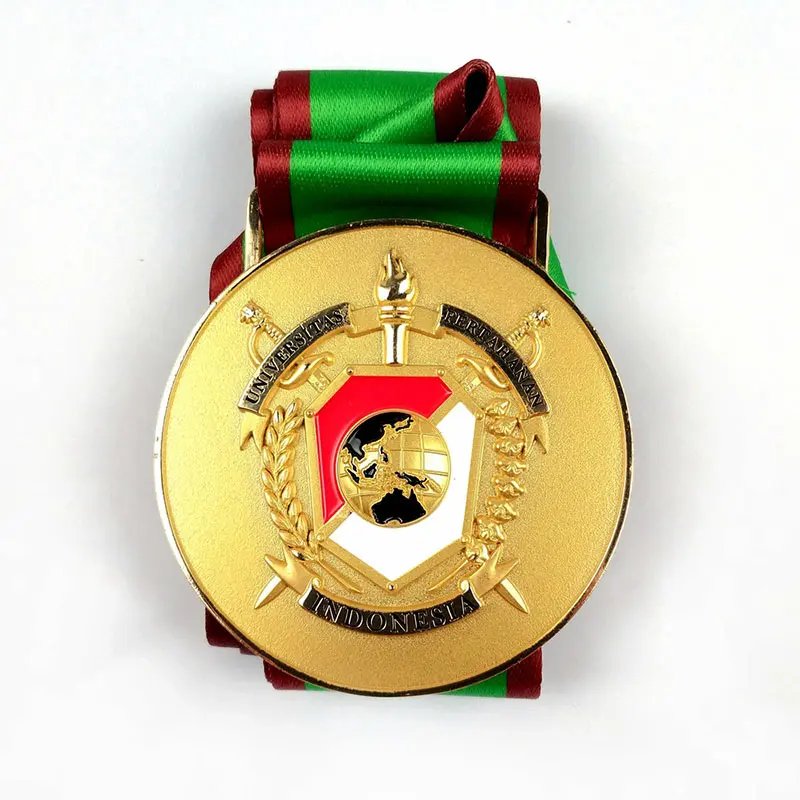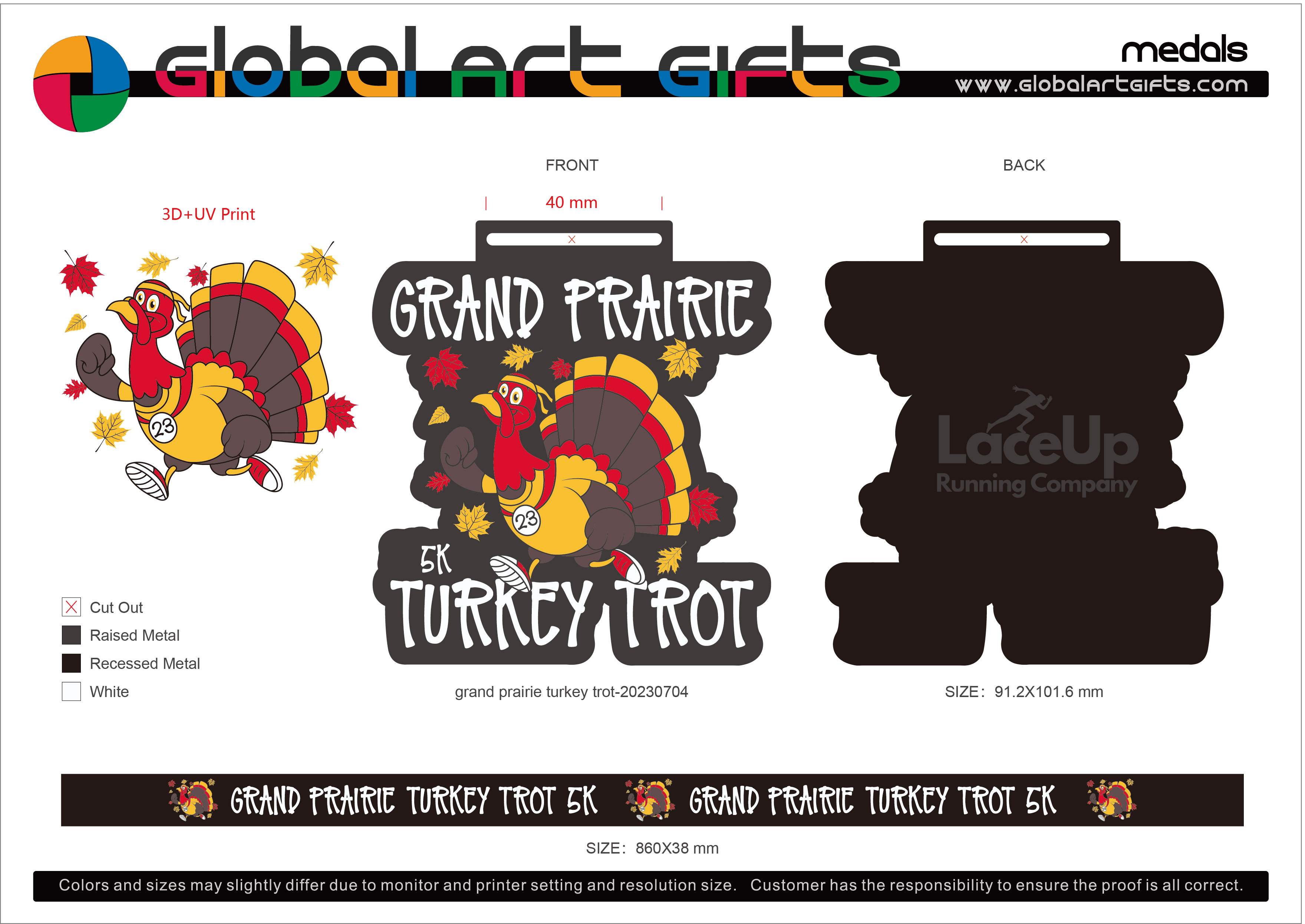
Two buyers sent us artwork on the same morning. The first wanted a 60 mm medal with a sculpted runner breaking out of a laurel wreath, the wreath cut as true openwork so daylight passes through it. The second wanted a 60 mm disc with a flat club crest, one enamel color, 400 pieces. Both called the job a custom medal. Only one could be die cast, and only one should be.
That gap — between what a design is and what a process can do — is what this comparison is about. We run both routes out of our Huizhou factory, and most published “die cast vs die struck” articles stop one step too early: they say die casting is more three-dimensional, die striking is flatter, and hand you a verdict. They never say where the physical wall sits, or at what order size the two routes swap places on cost. Those are the two things that decide the job. For the wider map, start at our custom medals overview.
The Question Behind the Question
“Which process is better” is really two questions. The first is geometry: can this shape exist in this process at all? Deep relief, undercuts, and openwork exist in one route and not the other, and no budget moves that line. The second is economics: at my quantity, which route costs less per piece? Answer geometry first. It usually eliminates one route outright, and then the economics become trivial. Buyers who reverse the order spend weeks negotiating a price for a medal that cannot be made the way they imagined.
How Die Casting Actually Forms a Medal
Die casting is a liquid process. Zinc alloy — we run 3#, 5#, and 7# grades, which cast complex shapes cleanly and take plating well — melts at about 385°C and is injected under pressure into a steel mold on an 88-ton press. The metal travels through a nozzle, fills the cavity as a liquid, and freezes against the steel. Because it arrives liquid, it takes whatever shape the cavity has: a raised figure, a recessed field, a hole through the body, a lip that curls under itself.
The mold is the expensive part, and it is not one block with a shape carved in it. It is an assembly:
| Mold component | What it does | Why it matters to your design |
|---|---|---|
| Mold base | Frame that holds everything and mounts to the press | Fixed cost; sets maximum medal size |
| Cavity insert | The cut geometry of your medal, in tool steel | Where relief depth and line width live |
| Support pillars | Carry clamping force so the insert does not deflect | Thin, wide medals need more |
| Slides | Retracting blocks that form undercuts and side holes | Every slide adds tooling cost and cycle time |
| Ejector pins | Push the frozen part off the core | Too few, or uneven, and the part cracks |
| Gates | Where molten metal enters the cavity | On a round medal we cut four, evenly spaced |
That last row matters more than it looks. On a circular medal we open four gates at even intervals around the rim, so the melt arrives from four directions at once and meets in the middle of the face. Feed a round medal from one side and the flow front cools as it travels; by the far rim it is slushy, and you get flow lines or a corner that never fills.
Surface texture is cut into the steel, not sprayed on afterward. We cut molds on milling machines, lathes, drills, and tapping machines, then finish specific areas with spark discharge (EDM) — an electrode discharges into the steel and leaves a dense field of tiny pits, which transfers to the casting as a matte surface. That is how a die-cast medal gets a frosted background with polished raised lettering in one casting. The mold is then heat-treated for hardness and wear resistance. Our manufacturing process page shows where casting sits in the line.
How Die Striking Actually Forms a Medal
Die striking is a solid-state process. You start with flat sheet or a blank, clamp it between an upper and a lower die, and press. The metal flows within the die but never becomes liquid, so the outline is punched clean and the face takes whatever shallow impression the die carries. There are no slides, no gates, no ejector pins in the die-casting sense — the part is flat and it leaves the die flat.
Material choice is narrower than people expect, and thickness decides it:
- Brass at 8.9 g/cm³ is the premium struck metal: dense, few pinholes, takes a mirror polish beautifully. Above roughly 3 mm it becomes difficult to strike, because the press has to move too much solid metal.
- Iron at 7.8 g/cm³ is cheaper and strikes well, but it rusts, so the plating has to be sound. Above about 4 mm it becomes difficult to strike.
- Aluminum at 2.7 g/cm³ strikes easily and anodizes, which is why it dominates lightweight finisher medals.
The trade is straightforward: die striking gives crisp flat graphics, precise outlines, tight dimensional control, and excellent surfaces for plating or anodizing. It does not give depth — no undercut, no hollow frame, no figure standing 3 mm proud of the field. A shallow embossed line or stepped field is the limit; the medal stays a flat object with a graphic on it.
The Physical Boundary, Stated Plainly
This is the table we would draw for you on a quote call.
| Capability | Die cast (zinc alloy) | Die struck (brass / iron / aluminum) |
|---|---|---|
| Deep 3D relief | Yes — sculpted figures, layered fields | No — shallow impression only |
| Undercuts | Yes, formed by slides | No |
| True openwork | Yes — metal flows around a core | Not practical |
| Flat graphic detail | Good, limited by casting resolution | Excellent — crisp edges, fine outlines |
| Minimum wall thickness | 2 mm | Set by sheet gauge |
| Maximum practical thickness | Relief-limited, not thickness-limited | Brass >3 mm hard, iron >4 mm hard |
| Two-sided design | Yes, both faces in one mold | Yes, two dies or a double-sided strike |
| Domed or curved face | Yes, molded in | Limited |
| Enamel color fields | Yes — recessed cells cast into the part | Yes, but struck cells are shallower |
Read the two thickness rows together and you get the rule that resolves most arguments. Die casting is limited by how thin you can go — 2 mm is the floor, because below that the melt freezes before it fills. Die striking is limited by how thick you can go — 3 mm in brass, 4 mm in iron, because the press has to deform solid metal. The two processes fail at opposite ends of the same axis, which is why they do not overlap much.
That floor is not a suggestion. We have been asked for 1.5 mm walls to save weight and we decline: the metal short-shots, the wall arrives porous, and the part breaks at the ejector pins. If a design needs to be lighter, the lever is diameter, not wall thickness.
Where the Cost Crossover Sits
We will not give you a price here. Medal pricing depends on size, weight, plating, color count, and quantity, and any number printed in an article would be wrong for your job within a month. What we can give you is the structure, which is stable.
| Cost element | Die cast | Die struck | Behaviour as quantity rises |
|---|---|---|---|
| Tooling | High — mold with inserts, slides, ejectors, gates | Lower — simpler die, no slides | One-time; does not scale |
| Material | Zinc alloy by weight, 6.7 g/cm³ | Sheet by weight; brass 8.9, iron 7.8 | Scales linearly |
| Forming labor | Press cycle, trimming, de-gating | Per stroke, faster cycle | Scales linearly |
| Finishing | Polishing, plating, enamel | Polishing, plating, enamel | Scales linearly, dominates at high color counts |
| Assembly and packaging | Ribbon welding, rings, bagging | Same | Scales linearly |
The crossover is a division problem. Take the difference in tooling between the two routes, divide it by the difference in per-piece cost, and you get the quantity at which the cheaper-per-piece route has repaid its more expensive mold. Inputs that raise tooling — more slides, deeper relief, a larger medal — push the crossover to a higher quantity. Inputs that raise per-piece cost on the struck side — a thicker brass blank, more plating steps, more enamel colors — pull it lower.
That gives four levers, and they are the ones we actually discuss with buyers:
- Relief complexity. Deep relief and slides are mold cost. If the design can be flattened, the struck route’s tooling advantage gets real.
- Color count. Enamel is hand work per piece, per color, on both routes. A five-color design raises per-piece cost enough that a higher tooling bill stops mattering sooner.
- Annual versus one-off. Tooling is charged once. If the event repeats and we hold the mold on file, year two carries none — which is why recurring programs almost always end up die cast.
- Weight and freight. Zinc at 6.7 g/cm³ is heavier than aluminum at 2.7 g/cm³. On a large air shipment the freight difference can outweigh a per-piece difference, and it is invisible in a unit-price comparison.
Notice what is not on that list: company size, event prestige, or how much you like the look. Those do not move the crossover. Geometry and volume do.
The Decision Rules We Give Buyers
These are the rules our sales team applies before a job reaches the mold shop.
Die cast is the only option when:
- The design has an undercut — any feature that would lock the part into a straight-pulling die.
- The design has true openwork, where metal is absent through the full thickness.
- The relief is deep and sculpted — a mascot, a landmark, a figure, a layered crest.
- The medal needs a domed face, a curved edge, or a 3D border that wraps.
- The part needs internal features — a recess for a spinning insert, a pocket for a magnet.
Die struck is the better option when:
- The design is flat and graphic — a logo, a silhouette, a ring of type.
- The medal is thin and large, where casting would add weight you do not want.
- You want brass, and the density and polish only wrought brass gives.
- The run is small and one-off, where a die-cast mold cannot amortize.
- The finish is anodized aluminum, which is a struck-only route.
Either works, so choose on economics when the design is a flat crest with shallow relief, 2 to 3 mm thick, one or two enamel colors. That is the genuine overlap zone, and the answer is purely the crossover arithmetic. A quick test: measure the thickest point and the height of the highest relief. Relief under about a millimeter on a flat plate is struck territory. Relief measured in millimeters, with any hollow space, is die casting.
Failure Modes You Can See in a Sample
Process choice also determines what goes wrong, and the signature tells you how to judge a sample.
On a die casting, defects cluster around fill and ejection. Cracks across a thin web mean too few ejector pins, or pins placed unevenly, so the part is pushed off the core while still hot. Flow lines mean the mold was polished too coarsely, pressure was low, or the shot was fired too fast. Porosity means the mold vents poorly and air stays in the metal, which reappears later as blisters under plating. Sharp corners that never fill mean pressure was insufficient, which is why we ask for radii on internal corners.
On a die striking, the defects are mechanical: burrs on the punched edge from die wear or insufficient clearance, wear lines as the die passes its service life, and distortion on thin sheet where the strike pulls the blank out of flat.
We run three-stage QC on both routes, and its value is catching these before plating rather than after — a plated part hides a crack until the recipient opens the box.
Where Each Route Sits in a Real Program
A race or league needs a finisher medal for every entrant — thousands of pieces, one design, flat artwork, minimal color — so that job is usually struck, or die-cast zinc at volume, and the deciding factor is weight and freight rather than prestige. A championship needs a podium piece for three people, with a sculpted figure and deep relief, and that job is die cast without a second thought. The mistake is applying podium logic to a mass-participation order, paying for relief nobody inspects at the finish line, or applying mass-production logic to a trophy-level award and ending up with a flat disc that feels like a token.
Our sports medals range is built around that split, and the medal design guide covers artwork that survives either process. If the real question is budget, how custom medal pricing is structured explains the same cost elements from the quoting side.
FAQ
Is die casting always more expensive than die striking? No. It costs more at low volume, because the mold is a one-time cost carried by fewer pieces. At high volume the mold amortizes and the per-piece gap narrows or reverses, especially with relief or several enamel colors. The crossover depends on your tooling delta and per-piece delta, which is why we quote both when a design allows it.
What is the minimum wall thickness for a die-cast medal? 2 mm. Below that the zinc alloy freezes before it fills the cavity, and the wall arrives short or porous. If you need a lighter medal, reduce the diameter rather than the wall. Struck medals have no floor, but they have ceilings: brass above 3 mm and iron above 4 mm get difficult.
Can a die-struck medal have 3D relief? Only shallow relief. Striking presses solid metal between dies, so you get a crisp graphic, a stepped field, or a low embossed line — not a sculpted figure, an undercut, or openwork. Depth requires die casting, where metal at 385°C fills a steel cavity on an 88-ton press.
Why does a round medal get four gates instead of one? A single gate makes the melt travel the whole circumference, and the leading edge cools on the way. Four gates at even intervals let metal arrive from all sides at once, which balances fill and reduces flow lines.
Can I reuse the mold for a reorder? Yes, and it is the biggest cost lever in a recurring program. We hold molds on file, so a second or third year of the same design carries no tooling. That is why annual events and recognition programs usually end up die cast.
How long does each route take? The same at each stage: artwork proof in 24 hours, sample in 7 to 10 days, bulk production in 7 to 15 days after approval. We do not quote faster, because the schedule is set by the mold.
Next Step
Send us the artwork and the quantity, and we will tell you which route your design can actually be made in — including when the answer is that your relief will not strike. Where both processes are viable, we quote both, so you can see the crossover on your own numbers instead of ours.
Our factory has been producing die-cast and die-struck medals since 2010, with capacity of 30,000+ pieces per day, an MOQ of 100 pieces per design, and export to 50+ countries. Proofs in 24 hours, samples in 7 to 10 days, bulk in 7 to 15 days, three-stage QC, and 100% conforming delivery.
Contact us with your design file and event date, and we will come back with a process recommendation and a quantity-tiered quote.