A race director sent us a spreadsheet last spring. Four legs, one city, one season, 3,000 runners on the start list at every leg. Four legs times 3,000 starts is 12,000 finisher medals, before volunteers, age-group podiums or the sponsor’s own allocation. She had a ribbon supplier and a bib printer. What she did not have was an answer to the only question that mattered: if the four medals are supposed to lock together at the end of the season, who is responsible when they don’t fit?
That question is the reason for this article. Most of what is published about custom medals treats the series medal as a design exercise — pick a shape, a color, a ribbon. It isn’t. An interlocking series is a tolerance problem that happens to look like art: the joint is an interface between two separately cast, separately plated pieces of zinc alloy, and everything that can go wrong with it goes wrong in the tooling, months before anyone sees a medal.
Twelve thousand pieces is not a large order for us. Our floor in Huizhou turns out more than 30,000 medals a day, so the full series is 0.4 of a production day — a Tuesday morning. The number that decides your budget is not 12,000. It is four. Four legs means four molds, one assembly gauge, and four plating lots that have to come out the same color. That is the cost structure nobody in this category publishes.
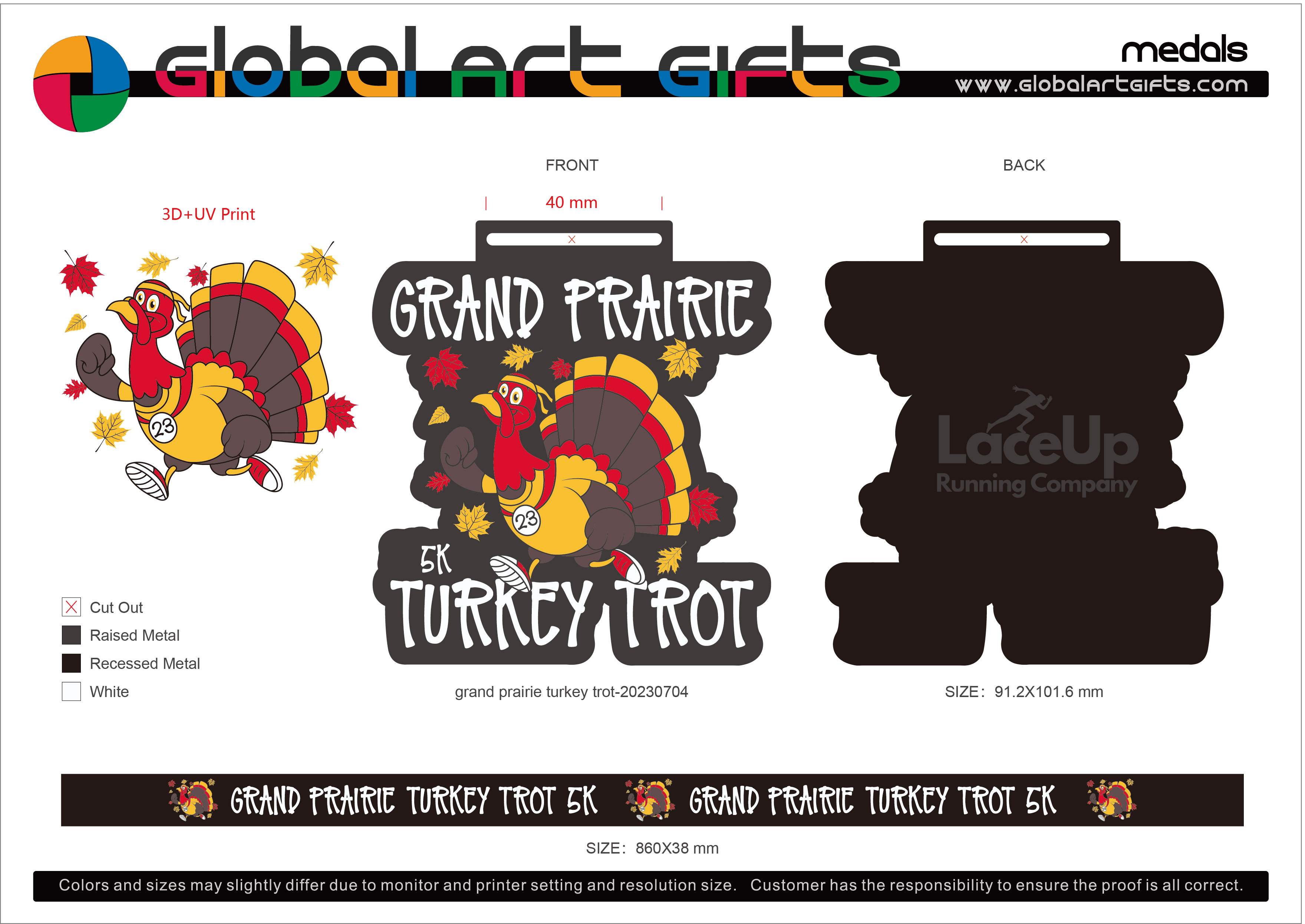
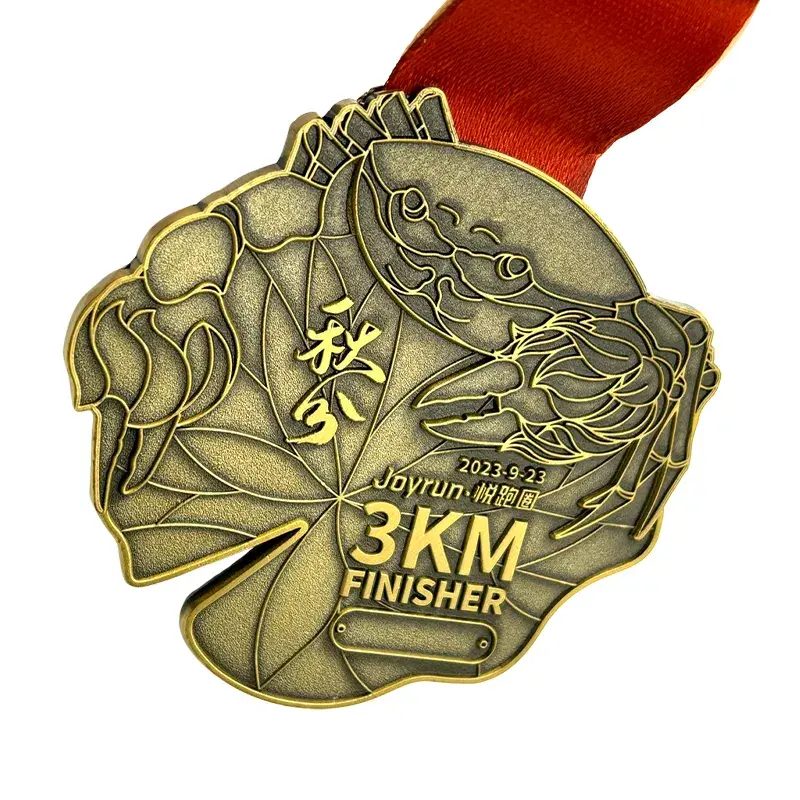
[Image: interlocking-series-medals-guide.jpg — Four die-cast race series medals laid out separately and then assembled into a single circular piece, showing the toothed interlocking edges and matching enamel colors]
Why a Series Bothers With Medals That Connect
Four different medals already differentiate four races. Nobody needs a joint to tell leg one from leg four. So the joint has to earn its tooling cost, and it earns it three ways.
The medal becomes the reason to enter the next leg. A runner who finishes leg one and takes home a medal with a toothed edge and an obvious gap has an unfinished object on the wall. That is a different proposition from a medal that is complete on its own. The effect is clearest at the early legs, where the field is thinnest: the assembled-so-far photo is the marketing asset, not the individual medal.
It creates a finisher category that didn’t exist. The series title is decided at the last race, but the set is decided by attendance. A runner who did three of four legs has three quarters of a medal, which gives you a reason to sell a season pass rather than four separate entries.
It gives the series a photograph. Four medals assembled on a table is one image that reads at thumbnail size. Four medals in a row is not. For a city series fighting for entries against a bigger branded event, that image is worth more than the incremental tooling.
The honest counter-argument, because we talk a fair number of directors out of this: if your four races are unrelated events sharing an organizer, an interlocking set adds tooling, a failure mode and a QA burden for no return. The joint pays when the series is a product — a season pass, a points table, a title — not when it is a calendar. Decide that before you approve artwork, because the joint shape is designed into leg one, and leg one usually has the least lead time.
If you are still choosing the format itself, our race medals page covers where a series brief usually starts.
Where Interlocking Gets Hard in a Die Shop
An interlocking medal is two castings that must mate. Every tolerance in the process stacks up at that interface, and the stack is longer than buyers expect.
Shrinkage is not uniform. Zamak 3 leaves the shot at 385°C and contracts as it solidifies. A flat plate with even section contracts evenly; a medal with a thick sculpted center and a 2mm rim does not — the thick section is still shrinking while the thin rim has already locked. The joint sits at the edge, exactly where that uneven contraction shows up, which is why we apply the shrinkage allowance to the assembled outline rather than to each leg in isolation.
Thin teeth freeze before they fill. Teeth are the farthest point from the sprue and the thinnest section in the cavity. On our 88-ton machines, a tooth narrower than the minimum line width of 0.3mm will not fill — the zinc solidifies at the tip and you get a rounded stub that looks like a casting defect but is really a design instruction. Every tooth needs 2mm of wall behind it to act as a heat reservoir, and the root needs a radius. A square-rooted tooth chips in the tumbler, not in the runner’s hand.
Draft turns a rectangle into a trapezoid. Every face that releases from the mold needs draft, including the joint faces. A tooth is never a rectangle — it is wider at the base than the tip, and the mating socket has to be the inverse trapezoid drafted in the opposite direction relative to its own mold. Get this wrong and the two legs fit perfectly in the CAD file and not at all in the gauge.
Plating grows the part. Electroplating deposits metal on every exposed surface, including the joint faces. Two legs designed to touch will interfere after plating, and two legs designed with a visible gap will end up with a gap wide enough to read as a crack. Our rule: the joint gap must be narrower than a 0.3mm enamel line, because that is the finest detail the eye is already reading on the face. To hold it, we mask the joint faces during plating or cut the clearance for the plated condition — a decision made at the tooling stage, and not afterwards.
Flatness compounds. A single medal sitting slightly off flat is invisible. Four assembled, each with its own flatness error, produce a piece that rocks — and the first thing a runner does is put it down. We hold assembled flatness in a steel gauge, not on the bench.
Relief has to survive the joint. The minimum relief we can cast is 0.4mm. A joint detail modeled below that disappears into the plating and the seam looks accidental. If the joint is a design feature — a keyway, a chevron, a numeric index — model it at 0.4mm or deeper so it reads as intentional.
Practically: we need the assembled outline before we divide it. The division line is a tooling decision, and the earlier it is made, the cheaper it is.
Four Ways to Join, and What Each One Costs You
There is no single correct joint. There are four we tool regularly, and they fail differently. The choice depends on how the medal is handled, whether the set is permanent, and how much budget you want sitting in steel.
| Edge teeth (jigsaw) | Center boss and socket | Magnetic | Snap-fit clip | |
|---|---|---|---|---|
| How it works | Toothed profile cut into the medal edge; neighboring leg carries the inverse | One leg has a raised boss on the reverse, the next a matching recess | Cast-in magnet pockets on the reverse of both legs | Undercut hook on one leg, matching catch on the other |
| Casting difficulty | High — thin teeth at the cavity edge, draft on every face | Medium — boss is a simple core, recess needs a clean floor | Medium — pockets cast to depth, magnet glued after plating | High — undercut needs a sliding core or a second operation |
| Assembled look | Seam follows a visible toothed line; reads as one object | Seam hidden behind the boss; face stays continuous | Straight butt joint; no mechanical lock | Tight seam, but the clip is visible from the side |
| Holding strength | Excellent once seated — teeth key in both directions | Good in shear, weak in peel | Weak — holds alignment, not load | Good, but depends on the undercut surviving plating |
| Typical failure | Chipped tooth tip if the root is square | Boss cracking if the wall behind it is under 2mm | Magnet pulled out, or glue failing after a season | Catch wears and the joint goes slack |
| Best for | Series where the assembled piece is the trophy | Series with a strong central emblem on every leg | Display sets, collector editions, lightweight pieces | Prototypes and short runs with tight tooling budget |
Edge teeth are what most people picture, and the most expensive to get right. The profile is the design: too fine and the teeth don’t fill, too coarse and the seam looks like a broken plate. We aim for a tooth pitch that lets the seam read as a deliberate graphic device — a chevron, a wave, a skyline silhouette — so the joint does narrative work instead of apologizing for itself.
Center boss and socket is the quiet option. Because the lock is on the reverse, the front of the assembled piece stays almost continuous and the seam hides behind the neighboring medal’s body. It is also the most forgiving on plating, since the mating surfaces sit inside the recess where build-up doesn’t show. If your series repeats a central emblem across all four legs, this is usually the cheapest route to a clean front.
Magnetic is the one buyers ask for and the one we push back on. A magnet aligns; it does not hold. For a set that lives in a frame, fine. For a medal that goes home in a kit bag and gets handled by a nine-year-old, the magnet separates and the runner concludes the medal is broken. We tool it, but we say what it is.
Snap-fit needs an undercut, which in die casting means a sliding core or a secondary machining step. Both add cost and a failure point. It earns that when the set is meant to come apart repeatedly — legs worn separately through the season and assembled at the finale.
Whatever you choose, the joint is decided alongside the ribbon attachment. A ring at twelve o’clock and a joint at three o’clock is a clean layout. A joint at twelve o’clock is a joint the ribbon covers, and you find that out at sample stage, the most expensive possible moment. Attachment points are geometry, not an afterthought.
Molds and the Cost Structure Nobody Publishes
Nothing else in this category publishes this, and it decides whether your series is affordable.
| One medal, one race | Four legs, interlocking | |
|---|---|---|
| Tooling | 1 mold | 4 molds + 1 assembly gauge |
| MOQ | 100 pcs | 100 pcs per leg — 400 for the set |
| Lead time | 7–10 days sampling, 7–15 days bulk | same per leg, but all four tooled up front |
| Design freedom | no interface constraints | joint profile shared across every leg |
| Cost driver | unit quantity | the fixed tooling block |
| Main risk | none at the joint | fit, and plating drift between lots |
A four-leg interlocking series needs four molds and one assembly gauge. The molds are obvious; the gauge is the one nobody quotes, and it is not optional. It is a steel plate with four pockets cut to the assembled outline, and every leg is dropped into it before plating. A leg that does not seat does not get plated, because plated metal cannot be corrected. The gauge is also the only way to prove on the bench that leg four, made in month six, still mates with leg one, made in month one.
Three ways to structure it, differing in ways that only show up later.
| One mold per leg | Shared base mold + inserts | One mold, four cavities | |
|---|---|---|---|
| Tooling count | 4 molds + 1 gauge | 1 base mold + 4 inserts + 1 gauge | 1 four-cavity mold + 1 gauge |
| Design freedom per leg | Full — each leg can be a different shape | Outline fixed; only face artwork changes | None — one outline, one shot weight |
| Plating consistency | Depends on lot discipline | Depends on lot discipline | Best — all four legs off the same rack |
| Cost of a late design change | One new mold | One new insert | A new four-cavity mold |
| Production risk | Isolated per leg | Isolated per insert | One cavity down stops all four legs |
| Best fit | Series where each leg is a distinct place or distance | Series where the four legs share a silhouette | High-volume series with a fixed format, ordered in one window |
The trade-off: the cheapest tooling gives you the least design freedom, and the most design freedom gives you four separate plating lots. Most four-leg city series land on one mold per leg, because the legs are genuinely different races and the artwork has to say so. A trail series where all four legs share a mountain silhouette can use a shared base and four inserts and save real money. A national series running five figures per leg with a fixed format should be looking at a four-cavity mold.
The MOQ arithmetic is where small legs hurt: our minimum is 100 pieces per design, so a four-leg series has a floor of 400 pieces, not 100. Fine when every leg draws a few thousand; a line item when leg one is a small night race and leg four is the finale, because you still pay for 100 of leg one at the same mold cost. If a leg is genuinely small, the honest answer is a non-interlocking medal in the same visual family.
Cost splits into fixed and variable. Fixed: molds, gauge, artwork separation, sample iterations — plus storage, since we hold your molds between seasons so the series can be reordered for years. Variable: casting, finishing, plating, ribbon, packaging, freight. Interlocking moves cost from variable to fixed — per-piece casting is barely different from a standard medal, but the fixed block is four times larger. That is why series economics improve sharply with volume. Our bulk custom medals page covers how that curve behaves.
Keeping Four Legs the Same Color
A four-leg series is four plating lots unless you force it to be one. Color drift between lots is the most common complaint we get on series work, and it is almost never a plating defect — it is a scheduling decision made months earlier.
Our plating line runs the sequence in this order: degreasing, ultrasonic cleaning, alkaline copper at roughly 500 seconds, acid copper for 20 to 60 minutes, color plating, drying in a tunnel at 100°C for 40 minutes, lacquer sealing, and unhanging. The acid copper dwell is the thickness lever. A rack that spends 20 minutes in the bath and one that spends 60 will not come out the same color after the color plate goes on, even with identical chemistry. That is why the 20-to-60-minute window is a process range, not a menu.
The rule for a series is blunt: one plating lot, one day, one rack load. All four legs go through together. If volume makes that impossible, they go through in consecutive loads on the same day in the same bath, and the first and last leg are compared side by side under the same light before packing. Antique and two-tone finishes drift more than bright finishes, so they get the strictest version of the rule.
Enamel depth matters at the joint too. Soft enamel fills to 0.3mm; imitation hard enamel fills to 0.5mm and is then ground and polished flat. If leg one is soft and leg four is imitation hard, the surfaces sit at different heights and the seam steps by 0.2mm — visible, and impossible to fix afterwards. Pick one enamel depth for the series and put it in the purchase order so a reorder can’t quietly change it. Our enamel medals page covers where that 0.2mm actually shows.
There is also a racking problem specific to interlocking medals. Every medal hangs from a contact point that receives no plating, normally the top edge, where the ribbon hides it. On an interlocking medal that edge may be a joint face, so the contact has to move to a hidden surface — under the ring, or inside the socket. Tooling note, not plating note.
Ribbons and the Box That Makes It a Set
A series has a ribbon problem a single race does not: four legs, four identities, one family. The pattern that works is one base color with one accent per leg, so the medals read as a set on a table and as four distinct races on a neck. Four different ribbons destroy the set; four identical ribbons destroy the differentiation.
The ring must not foul the neighboring medal when the set is assembled. On an edge-tooth series the ring sits at the top of the assembled circle, so only one leg carries it at twelve o’clock — the other three have rings at the sides, positioned so they don’t collide. We model the assembled piece with all four ribbons attached before we cut steel. Our medal ribbons range covers widths and attachments if you are still choosing.
Packaging is where a series becomes a product. A four-slot collector box, foam cut to the assembled outline, with the empty slot visible until the runner completes the set, is the cheapest retention device in the project. It also creates a constraint: a box sized for the assembled piece cannot ship flat, so it is designed with the medals rather than ordered afterwards. We have seen a finished 12,000-medal series wait on a box that arrived sized for a single medal. Our medal packaging page covers insert geometry that matches the assembled outline.
Working Backwards From Race Four
Series work fails on calendar, not on quality. Leg four’s medals have to be in a warehouse before leg one starts, because you cannot tool, sample, plate and ship a leg between two race dates four weeks apart.
| When | What happens | What we need from you |
|---|---|---|
| 14 weeks before leg one | Assembled outline agreed, joint type chosen, division lines set | Final artwork, leg count, expected finishers per leg |
| Within 48 hours of the brief | Quotation and design drawings — 24 hours for the quote, 24 hours for the drawing | Confirmation of quantities and finishes |
| 12 weeks | Four molds and the assembly gauge cut | Approved drawing, deposit |
| 11 weeks | Samples cast and finished — 7 to 10 days | Nothing; this is our clock |
| 10 weeks | Samples in your hands; joint tested assembled; plating color signed off against a physical standard | Written approval, one color standard retained by both sides |
| 9 weeks | Bulk production of leg one — 7 to 15 days | Purchase order for the full series, not leg by leg |
| 7 weeks | Leg one plated, gauged, packed | Ribbon and box artwork locked |
| 6 weeks | Leg one shipped | — |
| Each later leg | Plating slot booked against that leg’s race date; no new tooling | Final quantity, six weeks out |
Two points matter more than the rest. First, the whole series is tooled at once: tooling leg four later means the gauge was built without it, and the verification method collapses. Second, later legs are a plating scheduling problem — the molds exist, so the constraint is line time booked against race dates.
The 24-hour quote and 24-hour drawing are what make this calendar start at 14 weeks rather than 20.
Six Mistakes We See Every Season
1. The runner picks up the wrong leg’s medal. Four medals differing only in face artwork, handed out at four finish lines by four volunteer teams, will be mixed. Fix it on the reverse: leg number, date and distance cast in, plus a distinct ribbon color per leg. The reverse costs nothing to tool if it is decided with the front.
2. The joint is assembled backwards. A symmetric jigsaw edge can mate in the wrong orientation, and the result looks subtly wrong in a way nobody can name. Fix it with an asymmetric keying feature — one tooth a different size, a chevron pointing one way, a numeral that only reads correctly in one direction. Mirror-image artwork is the classic version: the leg looks right alone and wrong in the set.
3. Teeth chip at the edge. Usually a square root, or under 2mm of wall behind the tooth. The chip happens in the tumbler or in transit, not in the runner’s hand, so it surfaces as a broken medal at the finish line. Radius every root and keep 2mm minimum behind the joint.
4. Four legs, four plating lots, four slightly different colors. The most expensive mistake to fix, because the only remedy is stripping and replating. Book one lot.
5. The ribbon ring sits on the joint. Found at sample stage, which means a mold change or an ugly workaround. Model the assembled piece with ribbons on before cutting steel.
6. Only three legs were tooled. This happens when a series adds a leg after the season starts, or when procurement splits the order to spread payment. The gauge is built for four, the fourth mold doesn’t exist, and the season ends with three quarters of a medal. Tool all four even if the fourth leg’s artwork is still in review — cut the mold to the outline and finalize the face later.
Frequently Asked Questions
What exactly is an interlocking race series medal?
A set of medals, one per race, where the edges or reverses are shaped so the medals lock into a single larger piece. Each is complete and wearable on its own; the joint only becomes meaningful when the runner has more than one. It is cast in rather than added afterwards, which is why the series is designed as a whole even though it is manufactured leg by leg.
Can each leg be a different shape and still connect?
Yes, within limits. With one mold per leg, each leg can have a completely different outline and the joint is cut where the outlines meet. What cannot change is the interface: tooth profile, tooth pitch and draft must be identical across all four legs, because they come from the same geometry. Four different rooms, one doorway.
How does the tooling cost compare with four ordinary medals?
Four ordinary medals need four molds. Four interlocking medals need four molds plus an assembly gauge, so the fixed block is larger by one tool — and the joint geometry makes each mold costlier to cut than a plain outline. Volume changes the total: at 12,000 pieces the extra tooling spreads thin, at 400 it dominates.
Do the medals still fit after plating?
They do, because the joint is designed for the plated condition rather than the bare casting. Either the joint faces are masked during plating, or the clearance is cut to allow for build-up. A supplier who designs the joint on the bare casting and plates afterwards will deliver a set that doesn’t close.
What is the minimum order for a series?
100 pieces per design, so a four-leg series has a floor of 400. A much smaller leg still carries a 100-piece minimum and its own mold, which is why we sometimes recommend a standard medal in the same visual family for that leg.
How long does a four-leg series take from artwork to first delivery?
Quote in 24 hours, drawings in 24 hours, samples in 7 to 10 days, bulk in 7 to 15 days after approval. We ask for 14 weeks before leg one, because the full series is tooled at once and the gauge has to exist before any leg is plated.
Send Us the Calendar
If you are planning a series, the useful thing to send is not artwork. It is the race calendar and the leg count: the four dates, the expected field at each, and which leg is the finale. From that we can tell you whether the joint is worth tooling, which mold structure fits your quantities, and what the fixed block looks like before you commit to a design direction. You will have a quote in 24 hours and a drawing in another 24, with the assembled outline drawn before anything is divided.
We cast in Zamak 3, 5 and 7 on 88-ton machines, plate in-house across the nine-step line, and hold BSCI, ISO 9001 and Sedex certification. We ship to more than 50 countries and run three-stage QC on every order, which is how we hold a 100% pass rate on delivery — including the gauge check that decides whether a leg gets plated at all.
Send the calendar. We will send back the drawing and a per-leg breakdown.
Related Reading
- Custom Race Medals: The Complete Guide for Event Organizers
- Custom Medal Size and Thickness: What Actually Works in Production
- Custom Shaped Medals: Designing Beyond the Circle
Related product page: custom spin medals for events — custom spinning medals with a rotating centre — same Zamak die-cast base, MOQ 100 per design.