Some medals leave the factory flawless. Others shouldn’t leave at all. The difference isn’t luck — it’s a defect that slipped past a QC step, and you can usually catch it before it ships. We’ve been running custom medal manufacturing in our Huizhou factory since 2010, and we’ve seen every failure mode a die-cast medal can throw at a buyer — cracks, water marks, porosity, plating blisters, all of them. This guide shows you how to spot the same faults on your own desk, before you approve a sample or accept a bulk delivery.
What we’ll cover: the six defects that show up most in die-cast medals and what actually causes them, how a three-stage QC process is supposed to work, what to check the moment a sample lands on your desk, and a simple checklist to run when a bulk order arrives.
[Image: medal-qc-inspection.jpg — QC inspector examining a custom medal surface under angled light at an inspection bench]
The Six Defects That Show Up Most in Die-Cast Medals
Before you can inspect a medal, you need to know what you’re looking for. These six faults account for nearly every quality complaint we hear — and each one traces back to a specific step in production.
| Defect | What it looks like on the finished medal | What causes it |
|---|---|---|
| Cracks | Hairline fractures near the edge or around the hardware | Ejector pins too few or unevenly spread — the casting sticks and tears on ejection |
| Water marks | Wavy streaks that show through plating like ripples | Mold cavity not polished smooth, or the press didn’t build enough pressure |
| Porosity | Tiny pits that appear after plating, like pinpricks | Trapped air — the mold’s venting channels are blocked or insufficient |
| Plating blisters | Bubbles under the finish that lift and peel | Parts went into the line dirty, or moisture got trapped under the seal coat |
| Enamel impurities | Specks or fibers embedded in the color fill | The painting room isn’t clean enough |
| Paint pinholes | Small holes in painted areas | Compressed air carried water, or the thinner was wrong |
Two of these — cracks and porosity — are casting faults. The other four are surface faults, and they usually trace back to the plating line, the paint booth, or the drying oven. Knowing which bucket a defect falls into tells you where the real problem is.
Why Die-Cast Medals Pick Up These Defects
You don’t need to run a foundry to understand the root causes. They come back to three things: the mold, the machine, and the people running it.
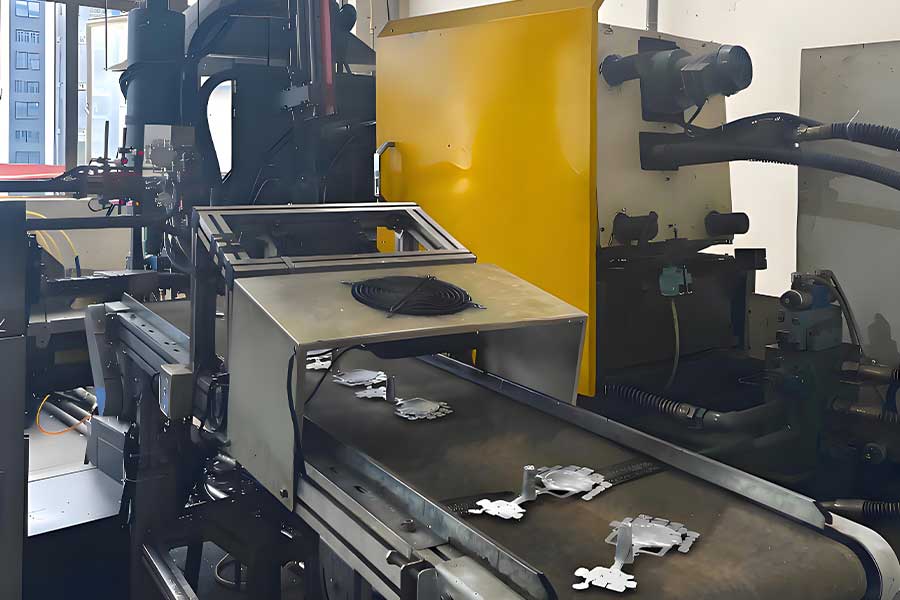
Zinc alloy melts at 385°C and gets shot into a steel mold on an 88-ton press. The whole cycle runs about 15-30 seconds per shot. When the mold opens, ejector pins push the casting out. If a design has deep relief and only a couple of pins hold it, the part can stick and crack — that’s your crack defect. Water marks start the same way: a mold cavity that isn’t polished to a mirror finish transfers its texture straight to the metal, and plating makes that texture look worse, not better.
Porosity is the one buyers blame on the plating line when it isn’t. As molten zinc rushes into the cavity in under a second, air has to escape through vent channels cut into the parting surface. Clog those vents and air gets trapped, then shows up as pits after plating. The quiet fix is mold maintenance — we pull dies for vent cleaning on a schedule, which is the kind of thing you never see on a certificate but you can see in a finished medal.
Plating blisters are a different story. Every medal on our line runs through ultrasonic degreasing, then an alkaline copper strike of about 500 seconds that bonds the finish to the zinc, then 20-60 minutes in an acid copper bath for gloss, then the finish metal, then a seal coat cured in a tunnel oven at 100°C for 40 minutes. Skip the cleaning step or rush the drying and the finish lifts. A blister you see today is a failure a rushed factory planted a month ago.
[Image: casting-defect-macro.jpg — Close-up of water marks and porosity defects on a polished die-cast medal surface]
How a Three-Stage QC Process Is Supposed to Work
Real quality control isn’t one final inspection. It’s three gates, and each one catches a different kind of problem.
- Post-casting — every part checked for fill defects: cracks, short shots, porosity. Rejects go straight back into the furnace, because zinc alloy is 100% recyclable.
- Post-plating — the surface checked under 5000K lighting for plating uniformity, color consistency, and adhesion. This is where a scratch or blister gets caught before it’s hidden under a seal coat.
- Final pre-packing — every medal inspected by hand. Color fill complete, ribbon attachment pull-tested, engraving verified against the order manifest.
Our MedalOrigin line runs 30,000+ medals through those three gates every day, and that’s why we can hold a 100% qualified delivery rate. Here’s what matters to you: a factory with only a final check is a factory that will ship defects. The gates have to sit before and after the plating line, not just at the end.
What to Check When Your Sample Arrives
The sample is your one free chance to catch a problem before it’s multiplied by 500. Don’t just hold it up and smile — run through these checks.
- Look at the surface under strong, angled light. Plating magnifies scratches — if you see them on the sample, they’ll be on every bulk piece.
- Run a fingernail across the enamel. If color chips or flakes, the curing was rushed. Properly cured enamel survives the fingernail test.
- Check the plating at the edges and in the recesses for blisters or thin spots.
- Inspect the edges and the hardware mount with a magnifying glass for hairline cracks.
- Test the ribbon attachment — give it a firm pull. A weak mount will show up here, not later.
- Measure thickness and weight against what you ordered. The sample is the baseline every bulk piece should match.
If anything fails these checks, raise it now. The design and plating are locked once bulk production starts — the sample stage is your only window.
[Image: service-certifications.jpg — Quality certification documents framed on a factory wall beside finished medal samples]
What to Check When the Bulk Order Arrives
The sample shows the factory’s finest work. The bulk order shows its average — which is why you check differently here.
- Pull a random sample from several cartons, not just the top box. Pick from the first, middle, and last cartons in the shipment.
- Look for batch drift. Lay a piece from early production next to one from late production. Color or plating that shifts between them is a plating-line discipline problem.
- Re-run the six-defect check on your sampled pieces. Cracks and porosity are one-offs; blisters and impurities are a pattern.
- Verify the count and confirm any engraving — names, numbers, dates — matches your order manifest.
- If you find a problem, photograph it and raise it within your claims window. A photo of the defect plus the carton batch helps us (or any supplier) trace it to the right production day.
This is the point where the bulk custom medals page becomes useful reading — it walks through how volume production is scheduled and what you should expect from a large run.
[Image: bulk-medal-cartons.jpg — Opened cartons of bulk medals laid out on a table for random inspection checks]
Inspection Options: Factory QC, Third-Party, or Your Own
You’ve got three routes to confidence, and they aren’t equal. Most buyers use a combination.
| Factory 3-Stage QC | Third-Party Inspection | Your Own Sample Check | |
|---|---|---|---|
| When to use | Every order, no exceptions | Large orders or a new supplier | Before you approve anything |
| What it catches | Casting, plating, and finish defects at the source | An independent view of the packed order | Design and finish problems up front |
| Cost | Included in the price | Per-order or per-diem fee | Your time |
| Right fit | Baseline protection on every run | 1,000+ piece orders, first-time suppliers | Sample and first-bulk stages |
Here’s the honest take: a good factory QC system beats a third-party inspection that shows up after the medals are packed. But a third-party inspector is a useful check when you’re working with a supplier for the first time and want an independent set of eyes.
FAQ: Custom Medal Quality Questions
What are the most common defects in custom medals? Cracks, water marks, porosity, plating blisters, enamel impurities, and paint pinholes. The first two are casting faults that start in the mold or the press; the last four are surface faults that start in the plating line, paint booth, or drying oven.
Why was my sample perfect but my bulk order wasn’t? Samples get maximum attention and often extra hand finishing. Bulk production runs at line speed, which is where defects from rushed steps actually show up. That’s why you check bulk orders for batch drift — compare an early piece against a late piece and look for plating or color shifts.
How do I tell a real crack from a normal mold line? A mold parting line is a thin, consistent line running all the way around the medal’s edge. A crack is jagged, runs across a face or toward the hardware, and usually doesn’t follow the outline. If you’re unsure, magnify it — cracks are sharp-edged, parting lines are smooth.
Can a plating blister be fixed, or is the medal scrap? A blister can’t be touched up — the finish has to be stripped and the part re-plated from scratch. But a properly cleaned part won’t blister in the first place. The failure starts in the degreasing step before the alkaline copper strike, so a blistered medal tells you the plating line skipped a step.
What QC should I request from a supplier? Ask for three-stage QC: post-casting, post-plating, and final pre-pack. Also ask for ribbon pull testing, plating thickness verification, and photos of the packed order before shipment. A supplier that can’t explain its QC gates is a supplier that probably doesn’t have them.
What’s a normal defect rate for die-cast medals? For complex multi-color designs, about 0.3-0.5% of pieces are caught and reworked at the final stage before packing. That rate is normal. What matters isn’t that defects happen — it’s that they’re caught before they ship to you.
Recommended Reading
- How Custom Medals Are Made: Inside Our Die-Casting Factory — the full 12-step process that every defect above plugs into
- Custom Die Cast Medals: The Zinc Alloy Detail Advantage — why die casting is the default process and what its weak points are
- How to Order Custom Medals in Bulk: MOQ, Pricing, Timeline & What to Expect — the procurement timeline around the QC gates
If you’re holding a medal and aren’t sure whether it’s a defect, send photos to MedalOrigin’s contact page — we’ll tell you exactly what you’re looking at and whether it’s worth flagging.