Custom medal pricing isn’t a list. It’s four levers — material, plating, enamel colors, and quantity — and moving any one of them shifts your per-piece number. We quote custom medals out of our Huizhou factory daily, and the buyers who get the sharpest prices aren’t the ones who push hardest. They’re the ones who understand which lever actually moves.
What we’ll cover:
- The four levers and how much each one really moves price
- Why the same artwork draws quotes that differ by 40%
- How the mold fee works and why quantity is your biggest lever
- Where to cut cost without the medal looking cheap
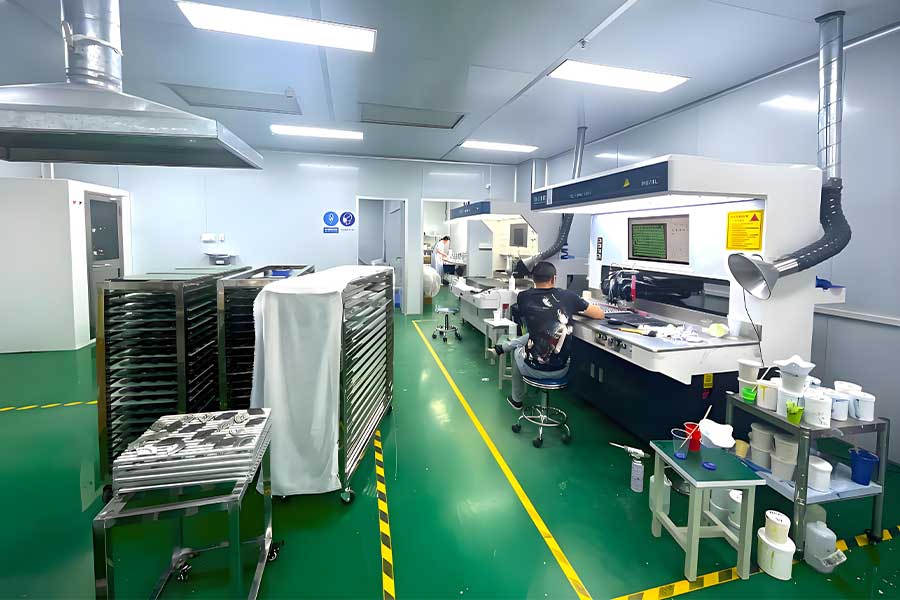
[Image: factory-workshop-02.jpg — Medal production floor running multiple casting and finishing lines]
The Four Levers That Set Your Per-Piece Price
When a buyer asks for a price, we ask four questions back. The answers determine the number, and the levers aren’t equally powerful.
| Lever | What it controls | Impact on price | Easy to change? |
|---|---|---|---|
| Material | Body metal and forming process | Largest single factor | Yes, before tooling |
| Plating | Surface finish and color | Moderate, predictable | Yes, any time |
| Enamel colors | Fill type and color count | Scales per color | Yes, before artwork |
| Quantity | How setup cost is spread | Largest lever at low volumes | Yes, up to your budget |
Most buyers focus on the first row and ignore the last. That’s backwards. Material sets a floor, but quantity is what decides whether your per-piece price lands at the bottom of its range or the top.
Here’s the part that catches people: material and enamel color count are cheapest to change before tooling is made. Once the mold exists, changing the body’s shape means paying for a new mold. Changing plating color doesn’t. So decide your design and your material first, in that order, and treat plating as a late-stage dial.
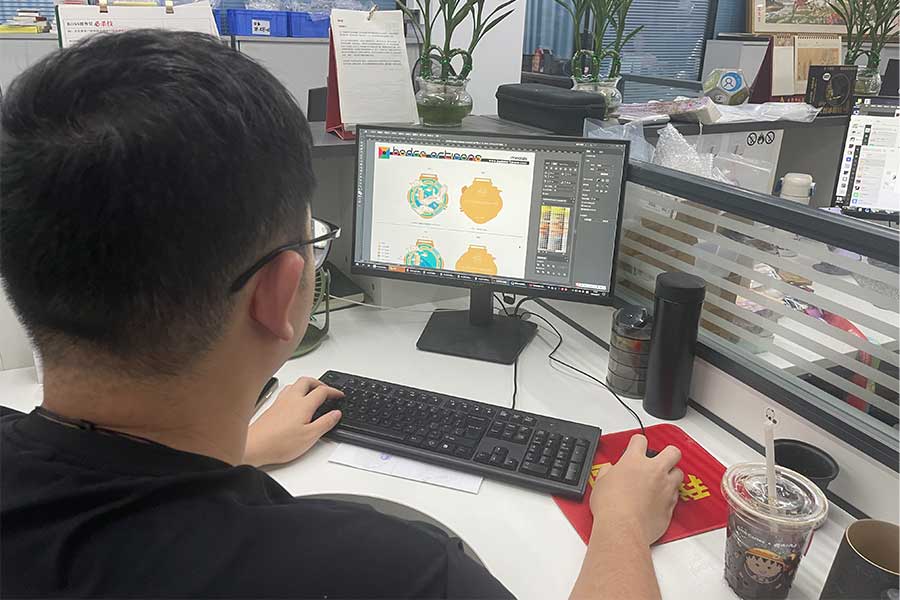
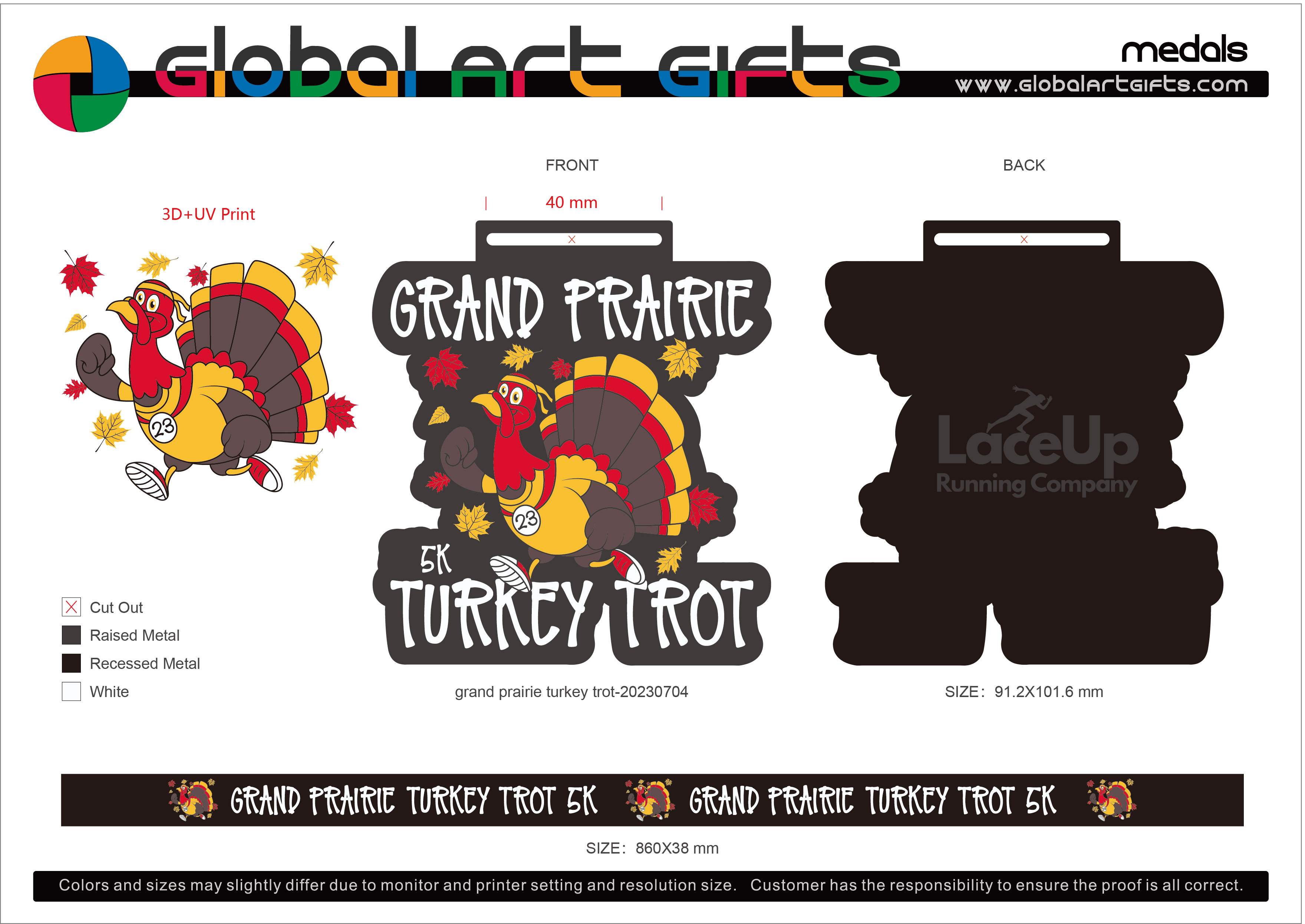
[Image: process-01-design.jpg — Design team preparing medal artwork for production]
Lever 1: Material — Where the Floor Is Set
Material is the biggest single factor because it determines both the metal cost and the forming process. We work in five metals, but three carry nearly all our award medal volume.
| Zinc Alloy (Die-Cast) | Brass (Stamped) | Iron (Stamped) | |
|---|---|---|---|
| Right for | 3D detail, cutouts, most medals | Weight and heritage feel | Flat shapes, high volume |
| Density | 6.7 g/cm³ | 8.9 g/cm³ | 7.8 g/cm³ |
| Process | Die-casting, 88-ton press | Stamping | Stamping |
| 3D relief | Excellent | Low | Low |
| Relative cost | $$ | $$$ | $ |
Zinc alloy is our default, and the reason is flow. Zamak 3, 5, and 7 melt at 385°C and fill a mold cavity easily, so an 88-ton die-casting machine captures fine 3D relief in a single shot. That’s the cheapest route to a sculpted design — your logo with real depth, cutouts, lettering you can feel. For the full anatomy of what goes into a medal, see our breakdown of what custom medals are made of.
Brass costs more at 8.9 g/cm³, and it’s stamped rather than cast, so it can’t hold deep relief. You’re buying weight and warmth, not detail. It earns its place on military and commemorative pieces.
Iron is the cheapest option and works fine for flat designs at volume. The catch is corrosion — if plating wears through, iron rusts. For a display piece that’s fine. For something handled weekly, we flag it.
There’s also aluminum at 2.7 g/cm³, the lightest option, which anodizes into bright colors. Worth considering for summer races where a heavy medal works against you. Full details are in our medal materials guide.
Lever 2: Plating — Predictable, and Often Cheaper Than Buyers Expect
Plating is a flat, predictable cost, and it’s the lever buyers most often misjudge in the wrong direction.
| Imitation Gold | Nickel (Silver) | Antique Bronze / Tin | |
|---|---|---|---|
| Right for | 1st place, classic gold | 2nd place, silver tier | Vintage, heritage, military |
| Look | Bright mirror gold | Bright silver | Dark, aged, matte |
| Application | Full electroplating | Full electroplating | Electrophoresis or barrel plating |
| Relative cost | $$ | $$ | $ |
The surprise is that bright gold costs more than antique. A mirror finish is genuine electroplating built in stages: degrease and strip the casting, plate an alkaline copper base for roughly 500 seconds, run acid copper for 20 to 60 minutes to build shine, then apply the final color. After that the medals bake in a tunnel oven at 100°C for 40 minutes and receive a protective oil coat against oxidation.
Antique finishes take the cheap path. Electrophoresis and barrel plating coat the recesses in a single pass. So a “vintage” finish can lower your finishing cost and hide scratches better than a mirror does.
The practical takeaway: if you’re looking to trim a quote, switching from mirror gold to antique bronze saves real money and gives you a deliberate design direction instead of looking like a downgrade. Dual-tone plating — we do imitation gold combined with nickel most often — costs more because it adds a masking step, but it’s a strong visual upgrade for a small extra cost. We cover the full finish menu and the cost ordering of electroplating versus spray versus electrophoresis in our medal plating guide.
[Image: process-07-plating.jpg — Medals on a plating line receiving a bright gold finish]
Lever 3: Enamel Colors — Small per Unit, Compounds Fast
Enamel is the colored fill inside your design’s recessed areas. Two types dominate, and color count matters more than most buyers expect.
| Soft Enamel | Imitation Hard Enamel | |
|---|---|---|
| Right for | Colorful medals, tactile surface | Smooth, ceramic-like awards |
| Min. fill width | 0.3mm | 0.5mm |
| Surface | Recessed, raised metal lines | Ground flat and polished |
| Relative cost | $ | $$ |
Soft enamel fills recesses as narrow as 0.3mm and cures slightly sunken, leaving the metal lines raised. Imitation hard enamel needs a 0.5mm recess, goes on thicker, and then gets ground flat and polished smooth — that extra grinding is the cost.
Here’s the compounding problem: every color is a separate fill-and-bake cycle. The low-temperature cure runs 60 to 70°C for 60 to 90 minutes for a half-set; the full cure is 100°C for 60 minutes. A four-color medal means four passes with handling in between. Designers who consolidate colors produce quotes that come in noticeably lower for a medal that looks the same.
If your artwork has gradients, photographs, or finely shaded sponsor logos, enamel can’t hold it. UV print lays four-color process directly onto flat or slightly contoured surfaces, up to about 7mm of relief drop. It’s a different cost structure again, and for complex artwork it’s often the only option.
[Image: process-09-color-filling.jpg — Worker filling enamel color into recessed areas of a medal]
Lever 4: Quantity — Your Biggest Lever
This is the lever that decides where in your range the price lands, and it’s the one buyers underuse.
Every die-cast medal starts with a steel mold machined from your artwork and heat-treated. That’s a one-time cost. It’s also why unit price falls as quantity rises. Order 100 medals and the mold fee sits heavily on every piece. Order 2,000 and it nearly vanishes.
The same logic applies to labor. Loading the mold, mixing enamel colors, and warming the plating tanks costs roughly the same at 100 pieces or 10,000. Our minimum is 100 pieces per design, and our floor runs over 30,000 pieces a day. So the setup overhead per medal drops sharply as your order grows.
That’s why we quote on a sliding scale rather than a single number, and why our bulk custom medals page exists. It’s also why we sometimes tell a buyer to hold their order and place one larger run later rather than pay two setup costs. More often than not, the math favors waiting.
Putting the Levers Together
Here’s the sequence we’d suggest to any buyer building a budget.
Decide the design and material first, before tooling. That’s the expensive thing to change later. Lock the design, accept the mold cost as a one-time expense, and then treat plating and enamel as your adjustable dials.
Then look for savings in this order. Bright to antique plating saves real money if you like the look. Trimming one non-essential enamel color compounds across the whole run. And quantity beats everything else — pushing from a minimum order into the low hundreds usually moves your per-piece price more than every finish decision combined.
Spend the savings where recipients notice. A full-color custom ribbon is one of the cheapest upgrades available and it’s the first thing anyone touches. A clean, well-plated zinc medal photographs better than a heavier brass one with flat detail.
Our quotes go out within 24 hours with a free design proof the same day and unlimited revisions. Samples take 7 to 10 days and production ships in 7 to 15 days after approval. If you’d rather not guess at your starting point, send us your artwork through our contact page and we’ll quote it properly against all four levers.
[Image: factory-workshop-06.jpg — Finished medal orders in packing and QC before shipment]
FAQ: Custom Medal Cost
What’s the average cost of a custom medal? There’s no single average, because four levers move the number: body material, plating finish, enamel color count, and order quantity. Material sets the floor and quantity is the strongest lever, since mold and setup costs are largely fixed and spread across your run. Our minimum is 100 pieces per design.
Why do I get such different quotes for the same artwork? Usually because the quotes aren’t for the same specification. One may be die-cast zinc with soft enamel, another stamped iron with print. Plating choice and color count also differ. Ask each supplier to break out material, plating, fill type, color count, and quantity so you’re comparing like with like.
Is a mold fee always required? Yes for die-cast medals. Every die-cast piece starts with a steel mold machined from your artwork and heat-treated. It’s a one-time cost, which is exactly why per-piece price drops as quantity rises — the fee gets spread across more units.
How much does plating add to the price? Plating is a moderate, predictable add, and antique finishes cost less than bright ones. Mirror imitation gold and nickel require full electroplating with roughly 500 seconds of alkaline copper base and 20 to 60 minutes of acid copper. Antique bronze and tin use single-pass electrophoresis or barrel plating.
Do more colors mean a higher price? Yes. Each enamel color is its own fill-and-bake cycle — the low-temperature cure runs 60 to 70°C for 60 to 90 minutes, and the full cure is 100°C for 60 minutes. Four colors means four passes. Consolidating colors is one of the most effective ways to lower per-piece cost.
How do I get the lowest price per medal? Order in the largest quantity your budget allows, choose zinc alloy rather than a heavier metal, keep enamel colors to those that carry meaning, and pick a finish based on look rather than assumed cost — antique is often cheaper than mirror. Then request a quote and free proof; we turn those around within 24 hours.
Recommended Reading
- Race Medal Cost: What Materials and Quantity Do to Price — the same levers applied to race medals
- How to Order Custom Medals in Bulk: A Buyer’s Workflow — the ordering process step by step
- Custom Medal Pricing: Mold Fees, Quantity & Cost Drivers — a deeper dive into mold and quantity math
Data to confirm: relative cost tiers ($$/$$$/$) indicate direction rather than a fixed price list. Actual per-piece pricing depends on artwork complexity, color count, and order quantity.
Related reading: spinning medals for sports programmes — custom spinning medals with a rotating centre — same Zamak die-cast base, MOQ 100 per design.