Honor guard units order insignia and pins for reasons custom medals do not cover. A medal recognizes an individual and is worn on dress occasions. Insignia identifies a unit, marks a qualification, or honors service over time, and it is often worn on a uniform rather than a ribbon.
That difference drives the specification. We produce custom military medals and associated insignia, and this is how units typically approach an order.
What we’ll cover:
- The three reasons honor guard units order insignia
- Pin versus medal versus badge — when each applies
- Materials and finishes that suit formal wear
- Attachment types for uniform use
- Specifying a coordinated unit set
Three Reasons Units Order Insignia
| Purpose | What it is | Typical form |
|---|---|---|
| Unit identification | Marks which unit the wearer belongs to | Distinctive pin or crest |
| Qualification | Marks a completed course or standard | Qualification pin, often metal |
| Recognition / service | Honors a period of service or event | Commemorative pin or medal |
| Ceremonial presentation | Awards given at formal events | Medal with ribbon |
The first three are worn on uniform and need to be small, durable, and reproducible. The fourth follows medal conventions and is worn on dress occasions.
Knowing which of these you are ordering determines almost every other decision, including size, attachment, and whether you need a mold. Units that order a “pin” when they actually need a uniformity-grade insignia often end up with something too heavy or too fragile for daily wear.
Pin, Medal, or Badge
The three forms are not interchangeable, and units sometimes specify the wrong one.
| Form | Typical size | Attachment | Best for |
|---|---|---|---|
| Lapel pin | 15-25mm | Butterfly or magnetic clasp | Unit ID, qualifications |
| Insignia pin | 20-35mm | Double post or screw back | Uniform wear, formal |
| Challenge coin | 40-45mm | None (carried) | Recognition, exchange |
| Medal | 40-70mm | Ribbon | Ceremonial presentation |
| Badge | Varies | Pin or sew-on | Identification, larger format |
The main practical division is between something worn on a uniform and something presented ceremonially. Uniform wear favors a smaller, heavier-duty piece with a secure attachment; presentation favors a larger piece with a ribbon.
If your unit needs both, order them as one coordinated set rather than two separate orders. A unit crest executed as both a pin and a medal keeps the visual identity consistent, and it costs less in tooling than commissioning two unrelated designs.
Materials and Finishes
Material choice for insignia is narrower than for medals because the piece is smaller and often handled more.
| Material | Weight | Detail | Best for | Cost |
|---|---|---|---|---|
| Die-cast zinc | Light to mid | Good relief | Most insignia | Low |
| Brass | Heavier | Excellent, sharp | Higher-end unit crests | Higher |
| Iron / stamped | Light | Flat, shallow | High-volume simple pins | Lowest |
| Stainless | Mid | Laser-cut, flat | Modern, technical units | Mid |
| Enamel on metal | Varies by base | Full color in recess | Colored crests | Adds cost per color |
For most honor guard insignia, die-cast zinc with enamel fill gives a solid balance: real relief, accurate crest detail, and a manageable unit cost. Brass is worth the step up for a unit crest that will be used for years and presented to visitors.
The finish deserves particular attention on insignia because it is small. Antique finishes darken the recesses, which is what makes a detailed crest legible at 25mm. A bright shiny finish on a small, intricate piece turns into an unreadable glare at any distance. Finishes are compared in our plating guide.
Our nine-step plating line uses an alkaline copper base of about 500 seconds plus acid copper for 20-60 minutes before color, with a 100°C, 40-minute oven dry and an oil seal. That base layer is what prevents the finish from lifting on a piece that gets worn and cleaned regularly. Our manufacturing process covers the full sequence.
Attachments for Uniform Wear
The attachment decides whether a piece survives daily wear. This is the part units most often under-specify.
| Attachment | Security | Best for | Notes |
|---|---|---|---|
| Butterfly (clutch) clasp | Moderate | Lapel pins, occasional wear | Standard, replaceable |
| Double post | High | Uniform insignia | Prevents rotation, more secure |
| Screw back | Highest | Heavy or valuable insignia | Slower to attach |
| Magnetic | Moderate | No-hole uniforms | Convenient, can shift |
| Safety pin | Low | Temporary or light use | Not for daily uniform wear |
| Ribbon (medals) | N/A | Ceremonial medals | Standard 860-900mm |
For honor guard use, a double post or screw back is the right default. A single butterfly clasp rotates on the uniform and can work loose, which matters when presentation standards are strict.
For any pin intended for young or minor recipients, or for use where snagging is a concern, a safety-release option is worth specifying. Our medal ribbon guide covers the attachment options for ribboned pieces.
Specifying a Coordinated Set
Honor guard units usually need more than one item, and specifying them together saves tooling and produces a coherent look.
| Item | Typical spec | Shared with the set |
|---|---|---|
| Unit crest pin | 25-35mm, zinc or brass, antique finish | Same crest artwork |
| Qualification pin | 20-25mm, zinc, single finish | Same outer shape |
| Commemorative medal | 45-55mm, zinc, antique | Same crest, ribbon added |
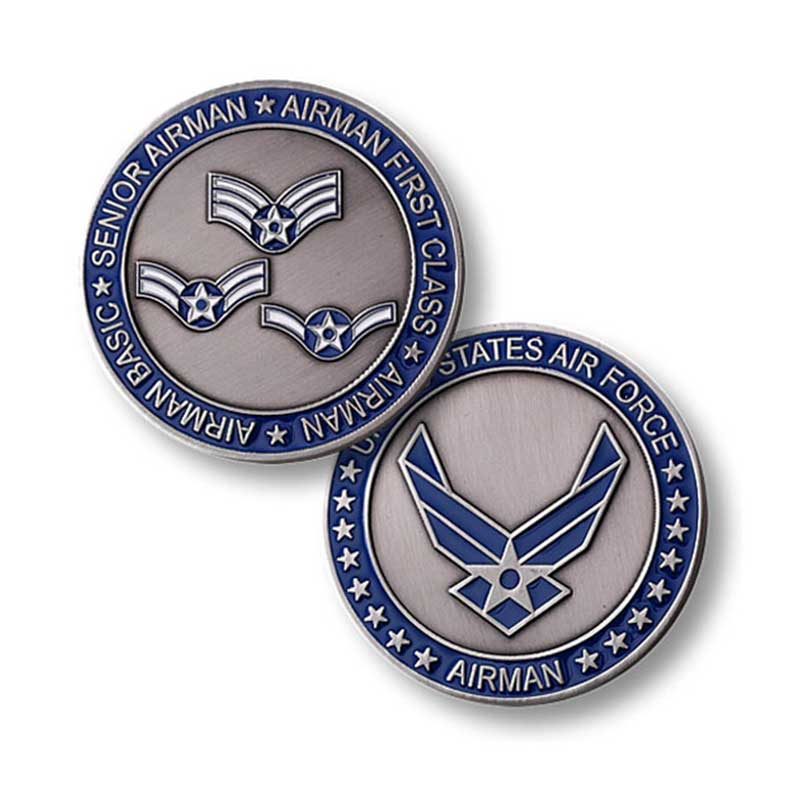
| Challenge coin | 40-45mm, zinc or brass | Same crest, double-sided |
| Presentation box | Optional | Consistent branding |
The efficiency comes from the crest artwork. Once you have a unit crest cut into a mold, adapting it to a pin, medal, and coin is a matter of scale and attachment rather than new artwork — and often a shared tooling setup rather than separate molds.
That same logic covers the case where a unit needs the pin on its own — a qualification pin for each new class, a crest pin issued to a visiting detachment, a commemorative pin for an anniversary year. Those run from the same crest artwork on our custom pins and badges line, in soft enamel, hard enamel or die-struck metal, so a reorder two years later still matches the set already in wear.
The other coordination point is finish. Use one finish family across the set so the pin, medal, and coin look like they belong together. Antique finishes work best across a set that mixes sizes, because the darkened recesses give detail at small scale and depth at large scale.
Our minimum is 100 pcs per design, and we hold tooling on file — which matters for units that reorder qualification pins as new members complete training. See our military medals page for the wider range.
Production timing is standard: design proof within 24 hours of artwork, sampling 7-10 days, production 7-15 days after approval. We run three-stage QC after casting, after plating, and after assembly.
If your unit is specifying an insignia set, send us your crest artwork and item list and we will quote the set together.
Data to confirm: Confirm current MOQ, tooling charges, and attachment options with the factory before finalizing a unit order, as some attachment hardware has longer lead times.
FAQ
What is the difference between an insignia and a medal? Insignia identifies a unit or qualification and is typically worn on a uniform. A medal recognizes an individual and is presented ceremonially on a ribbon. They follow different sizing and attachment conventions.
Should honor guard insignia be zinc or brass? Die-cast zinc with enamel fill suits most insignia and gives real relief at a manageable cost. Brass is worth the step up for a unit crest intended for long-term use and presentation to visitors.
What attachment is best for uniform wear? A double post or screw back. A single butterfly clasp can rotate and work loose on a uniform, which matters when presentation standards are strict. Magnetic clasps are convenient but can shift.
Which finish is best for small, detailed insignia? Antique finishes. They darken the recesses, which is what makes a detailed crest legible at 25mm. Bright shiny finishes on small intricate pieces glare and lose readability.
Can we use the same design for a pin, medal, and coin? Yes, and it saves money. Once the unit crest is cut into a mold, adapting it to a pin, medal, or coin is a matter of scale and attachment rather than new artwork. Use one finish family across the set.
How far ahead should a unit order insignia? Allow 6-8 weeks. Design proofs come back within 24 hours of artwork, sampling runs 7-10 days, and production runs 7-15 days after approval. Some attachment hardware can extend the timeline.
Related product page: custom spin medals for events — our spinning medal range: a moving inner disc on a die-cast body, 100-piece minimum.