The medal is finished. Then most buyers realize the last thing their athlete touches is the box, not the metal. Packaging is the handshake at the finish line — what people hold, photograph, and keep. We make custom medal packaging at step 11 of our 12-step line, right before the crate goes out. And it’s where a lot of procurement plans go quiet. So here’s the guide we wish every buyer read before they said “just box them up.”
What we’ll cover: the six packaging types and the cost ladder between them, which box survives a freight journey and which is purely cosmetic, how logos land on different box surfaces, and the moisture math that decides whether your medals arrive bright or tarnished.
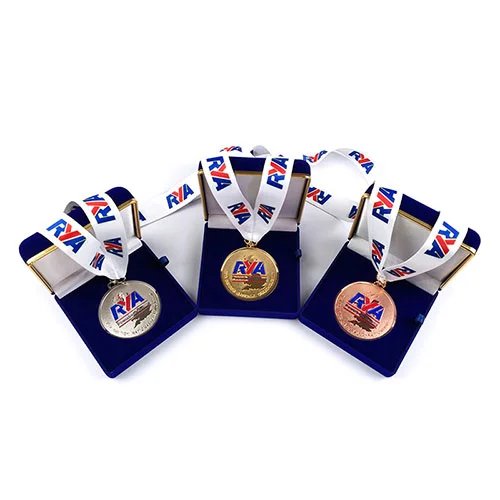
[Image: medal-packaging.jpg — Custom medal packaging options including velvet boxes, hinged lid cases and display boxes]
Packaging Types: Velvet Box, Hinged Lid, Display Box & the Rest
Six options cover almost every order we ship. Match the box to how the medal is given, not just how it looks on a shelf.
| Velvet Box | Hinged Lid Box | Display Box | Paper Card | Cloth Bag | Acrylic Case | |
|---|---|---|---|---|---|---|
| Scene | Formal ceremony | Presentation | Retail, trophy shelf | Budget events | Outdoor, casual | Retail, showpiece |
| Feel | Plush, ceremonial | Structured | See-through | Lightweight | Casual, portable | Clear, keepsake |
| Protection | Medium | High | Medium | Low | Low | High |
| Relative cost | $$$ | $$ | $$ | $ | $ | $$$$ |
| Best for | Awards dinners, galas | Corporate, academic | Medal collections | High-volume events | Marathons, fun runs | Retail display |
Velvet boxes are the awards-dinner standard — plush lining, a real presentation moment. Hinged lid boxes add structure and genuine protection, so they’re our default for corporate and academic orders that actually ship somewhere. Display boxes leave the medal visible on a shelf. Paper cards and cloth bags are the cost play for high-volume events where the medal does the talking. Acrylic cases read as retail showpieces, and they’re the priciest per unit.
The Cost Ladder: From Paper Card to Acrylic Case
Packaging prices span about a 6:1 range from the cheapest card to a full acrylic case. Here’s the gradient in practice.
| Packaging option | Per-unit range (approx.) | When it earns its cost |
|---|---|---|
| Paper card (board + backing) | $0.10–$0.25 | 5,000+ pieces, medals handed out fast |
| Cloth bag (drawstring) | $0.15–$0.30 | Outdoor events, portable giveaways |
| Display box (clear lid) | $0.40–$0.80 | Retail or trophy-shelf collections |
| Hinged lid box (rigid) | $0.60–$1.20 | Corporate, academic, anything shipped |
| Velvet box (plush lined) | $0.70–$1.40 | Awards dinners, galas, ceremony |
| Acrylic case | $1.50–$3.00+ | Retail showpiece, keepsake orders |
These are ballpark factory-direct figures, and they shift with quantity, box size, and print. Ask for per-unit pricing at your actual volume — the ladder’s shape is what matters, not the exact rungs.
The ladder’s logic is simple: what protects and presents costs more than what carries. At 5,000 medals for a city-wide race, a paper card keeps per-unit cost low and medals leave the table in minutes. A 400-person gala needs a velvet moment. Both are right at their own volume.
Packaging Spec Sheet: Protection, Moisture, Lead Time & Neutral Packing
Cost is only one axis. Here’s the same six options read as a procurement spec — what protects, what keeps humidity out, what costs you calendar days, and what can ship without our name on it.
| Packaging | Protection level | Moisture protection | Best for | Lead-time impact | Neutral packing (no factory name) |
|---|---|---|---|---|---|
| Standard PP/OPP self-seal bag | Basic — scratch protection only | Yes — the only option here that actually seals the medal away from air | Bulk handouts, and as the base layer under every other option | None — stocked item | Yes |
| Velvet pouch (drawstring) | Low–medium | No — fabric breathes and holds humidity; use it over a bagged medal | Races, outdoor events, portable giveaways | None | Yes |
| Paper display card | Low | No — open face, and board absorbs moisture | 5,000+ pcs events handed out within hours | Add 1–3 days for printing | Yes |
| Rigid gift / paper box | High | Partial — the board is a buffer, not a seal; bag the medal first | Corporate and academic orders that ship | Add 1–3 days | Yes |
| Acrylic display case | High | Good — the tightest seal of the six | Retail display, keepsake and collector orders | Add 2–3 days | Yes |
| Velvet box (plush lined) | Medium–high | Partial — plush lining holds humidity against the medal face unless the medal is bagged first | Awards dinners, galas, formal ceremony | Add 1–3 days | Yes |
Neutral packing means no factory name, no factory logo, and no origin marking on the box or the export carton — resellers, gift companies, and agencies re-branding a run usually want it. Ask for it at the quote stage, not at packing, because it changes what gets printed or stamped.
The pattern in that table is worth stating plainly: every soft, breathable option works on top of a self-seal bag, not instead of one. The bag is the moisture barrier. The pouch, box, or case is the presentation layer above it.
Moisture Protection: Sea Freight, Humid Climates and Storage After Arrival
Why a plated medal oxidizes in transit. The finish on a medal is a very thin electroplated layer over a zinc alloy body. What protects it is a chain: the alkaline copper strike of roughly 500 seconds as the base coat, the finish layer above it, and the anti-oxidation oil applied after the 100°C tunnel oven. That chain is designed for handling, not for a month inside a shipping container. On a sea crossing through tropical or coastal humidity, the container interior swings between day heat and night cool, and water condenses on whatever surface is coldest — which is the metal. Port air carries salt. Add temperature cycling week after week and a bright nickel finish that left the line flawless can arrive clouded. That is a moisture failure, not a plating failure, and it’s solved at the packing bench.
How we defend against it in packing. Each medal goes into a PP/OPP self-seal bag with the air pressed out, straight off the line while the seal oil is still intact — we don’t wipe or polish that coat off. Desiccant sachets go into the inner cartons, sized to the carton volume and the route length. A velvet pouch or rigid box then becomes a second isolation layer, so the medal never rests directly against a lining that can hold damp. Finally, the export carton is sealed and pallet-wrapped, because the carton is what stands between your medals and a humid warehouse floor. The packing step sits after three stages of QC for exactly this reason: a medal that gets bagged while still warm from plating traps its own moisture.
What to do when the cartons land. Don’t break the seal the hour the truck arrives. If cartons have travelled through cold or damp conditions, let them come up to room temperature first — opening a cold carton in a warm room condenses water directly onto cold metal, which is the single most common way a perfect shipment gets tarnished after delivery. Then store cartons in a dry interior room, ideally below about 60% relative humidity; not a garage, not a basement, not next to a kitchen or a washroom. Keep medals in their bags until the day you hand them out. For long-term display, a frame or a medal display hanger keeps the surface away from the damp that collects inside closed cases.
If a medal does dull in storage, wipe it with a dry soft cloth. Skip abrasive polishes and metal cleaners on a plated surface — they remove the seal oil along with the tarnish, and the medal is then bare metal in the same humid room. For ocean routes and long lead times, read the shipping and lead time guide before you pick a freight mode; the packing spec and the freight mode have to be decided together.
Branding on Packaging: UV Print, Offset and Foil
The box is real estate. Put your mark on it with the method that fits the surface and the quantity.
UV printing handles full color on flat box surfaces and on low-relief up to about 7mm — it’s our default for logos and photo elements on rigid boxes, and it’s instant-dry. Offset printing gives the sharpest result on flat card and paper stocks, but it needs a plate, so it only pays off at volume. Gold foil stamping is the ceremony move — a foil logo on a velvet box reads as an event brand, not a promo item. Whichever you pick, send vector artwork (.ai, .eps, .pdf) and we’ll proof it on the actual box stock before the run.
[Image: medal-box-branding.jpg — Custom printed presentation box with a foil-stamped event logo]
Transport Protection and the Moisture Problem
Packaging’s second job is surviving freight. The enemy is humidity, not impact.
Impact is easy to fix — foam inserts, dividers, and tight packing. Moisture is the one nobody budgets for. Plated medals tarnish in humid air, and a sealed box ships with whatever air is inside it. We pack medals straight off the line, surface already sealed with the anti-oxidation oil coat that follows the tunnel oven at 100°C for 40 minutes. For longer routes — ocean freight especially, weeks in humid air — we add desiccant sachets to the cartons. A bright nickel finish that left our line flawless can cloud on a humid crossing if the packing math is wrong. That’s a packaging spec, not a plating failure.
The seal only holds if the layers under it hold. Every medal takes an alkaline copper strike of roughly 500 seconds as its base coat, and that strike is what decides whether the nickel and gold above it grip through years of handling. The oil coat is the last line against oxidation; the copper strike is the first — and a packaging spec is only ever as good as both.
How Packaging Fits the QC and Packing Step
Packing is the final step of our 12-step line, and we treat it like one — not an afterthought.
Every medal reaches the packing bench only after three stages of QC: the casting and dimension check, the plating and enamel check, and a final inspection before anything goes in a box. At step 11 the detail work happens. Each medal gets a protective layer so it doesn’t sit directly against the box lining. Ribbons are folded so they don’t crease against the medal face — standard neck ribbons run 860–900mm by 20–30mm, so folding one down to fit a box or a cloth bag without setting a crease across the print is a bench skill, not a guess. The box closes with the ribbon loop tucked clear of the plating. Get that wrong and a flawless medal arrives scratched. Get it right and the box opens to the same finish that passed inspection. That’s the packing bar on a MedalOrigin order.
[Image: process-11-packing.jpg — Factory worker placing ribboned medals into presentation boxes at the packing station]
If you’re speccing a bulk custom medal order and want packaging quoted together, send us the count, the box style, and your logo and we’ll price the whole bundle — medals, ribbons, and packaging as one line. Get a quote.
FAQ: Medal Packaging Decisions
What’s the cheapest packaging option? Paper card backing and drawstring cloth bags, roughly $0.10–$0.30 per unit. They’re right for high-volume events where medals are handed out fast and the packaging is a carrier, not a stage.
Does packaging protect medals during shipping? Hinged lid and velvet boxes with foam or card inserts do. Open paper cards and cloth bags only loosely protect the face — they’re for events where the medal goes on the neck, not in the mail. For anything that ships, we pack with dividers and add desiccant on longer routes.
Can I put our logo on the box? Yes. UV printing handles full-color art on flat and low-relief surfaces, offset is the sharpest at volume, and gold foil stamping is the formal option. Send vector artwork and we’ll proof it on the actual box stock first.
How do I stop medals tarnishing inside a sealed box? The medals leave our line sealed with anti-oxidation oil, and we add desiccant sachets for freight and longer storage. Store the cartons in a dry room — over about 60% humidity, tarnish can start even inside a sealed box.
What’s the minimum order for custom packaging? MOQ is 100 pieces per design, same as our medals, and packaging usually rides along on a medal order. Ordering boxes with the medals keeps the ribbon spec and the box cut matched to the same run.
Can I add packaging to an existing medal order? Yes. We bundle medals, ribbons, and packaging as one line on the bulk order flow, so you get one QC pass, one packing bench, and one shipment instead of three vendors.
Recommended Reading
- Custom Medal Ribbons & Accessories: Procurement Guide — the accessories that pair with your box
- How to Order Custom Medals in Bulk: MOQ, Pricing & Timeline — the full procurement workflow from quote to crate
See also: enamel-filled die-cast medals — hard enamel medals built on the same Zamak die-cast base — specs, MOQ 100 and production schedule.