Ordering custom sports medals for a track meet is different from ordering for almost any other sport. You are not buying one design for one podium — you are buying a set that has to make sense across throwers, sprinters, distance runners, and jumpers, often on the same day, often in the same order. Get the set wrong and you either overpay for events nobody medals, or you run short on the one event that filled up.
We cast track and field medals year-round in Huizhou. This guide is what we tell meet directors before they lock a design.
What we’ll cover:
- How many medal designs a single meet actually needs
- Event-appropriate symbols and how far they can be simplified
- Ribbon length, width, and color coding for a live meet
- Plating tiers and how to keep a large set consistent
- MOQ, lead time, and what to lock before your entry deadline
How Many Designs Does One Meet Need?
Most meet directors assume they need a design per event. They almost never do. A 20-event meet can run on three or four designs with text-based differentiation, which drops your tooling cost and your reorder risk.
| Approach | Designs needed | 20-event meet | Best for |
|---|---|---|---|
| Per-event art | 15-20 | High tooling cost, slow | Championship meets, big budgets |
| Per-category art | 4-6 | Balanced | Most high school and college meets |
| Universal + text | 1-2 | Lowest cost, fast | Youth meets, conference duals |
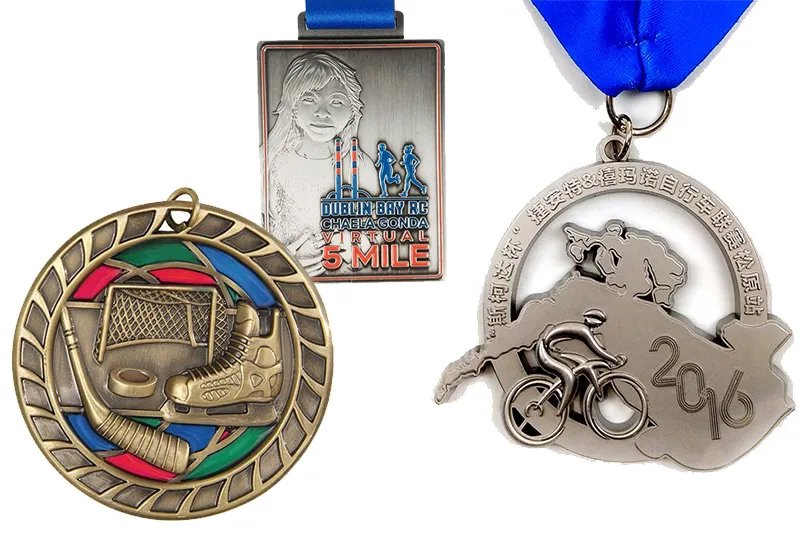
The per-category approach is what we recommend most often. One design for running events (a runner silhouette or track oval), one for field events (shot, discus, javelin), one for jumps (high jump, long jump, pole vault), and one general “meet” design for relay or team awards. Your engraving or printing layer carries the event name and place. For the design options themselves, see our medal design guide; if you are new to specifying a medal, start with the types of custom sports medals.
That moves you from 20 molds to 4. On a 500-piece order, that difference is real money.
If your meet hands out more than podium medals — ribbons for heats and participants, pins for the letter jacket, a trophy for the team sweepstakes — put those on the same purchase order rather than sourcing them separately. Schools running multi-event competitions under a state league usually consolidate place medals, neck ribbons and pins into one run so the school colors and crest match across all of it. Our UIL medals and meet ribbons program covers that combined order, from place medals through to the team trophy.
Symbols That Read at a Glance
A track medal has a hard job: it must be identifiable across a crowd, from a few feet away, without any explanation. Overdetailed art defeats that.
| Event group | Symbol that works | Symbol that fails |
|---|---|---|
| Sprint / hurdles | Running figure, motion lines | Detailed starting blocks |
| Distance | Striding runner, mile marker | Specific track layout |
| Throws | Shot, discus, javelin silhouette | Detailed implement texture |
| Jumps | Arc over a bar, sand pit | Full body pose mid-jump |
| Relay | Baton, four connected figures | Individual runner |
Sprint and distance both use a runner figure, and that is fine — differentiate them by color fill or by the text layer. Trying to make each visually distinct at a glance forces you into tiny details that die-casting will not hold cleanly at 2mm minimum wall thickness.
The rule we use: if a symbol is not readable as a single black shape at thumbnail size, it will not read on a medal either.
Ribbons and Color Coding
At a live meet, ribbons do as much identification work as the medals. Standard ribbon spec is 860-900mm long and 20-30mm wide, which sits correctly on an adult neck without the medal swinging into the chest during a ceremony.
Color is the fastest lever you have:
| Coding | Use | Why it works |
|---|---|---|
| Red / White / Blue | Place within one event | Instant place read, traditional |
| Color per event group | Identify sport on a crowded podium | Officials can sort without checking medals |
| Color per division | Separate age or gender divisions | Reduces handout errors at the table |
| Single color | Uniform ceremony look | Cleaner photos, simpler ordering |
One caution: if you color-code by place, make sure your ribbon order matches your medal order exactly. Mixing a gold medal onto a silver ribbon is the single most common ceremony error we hear about, and it happens because the two were ordered separately.
If your meet runs multiple divisions, order ribbons grouped by division rather than by place. It costs nothing extra and it removes the sorting step on the day.
Plating Tiers Across a Large Set
Gold, silver, and bronze are the default, and for good reason. But a meet set has a specific risk: the three plating colors must look like a coherent family, not three medals from three different suppliers.
| Finish | Look | Wear over a season | Cost tier |
|---|---|---|---|
| Shiny gold | Bright, reflective | Shows fine scratches | $$ |
| Antique gold | Muted, aged depth | Hides handling marks | $$ |
| Matte gold | Soft, non-reflective | Very forgiving | $$ |
| Shiny silver | Clean, bright | Shows fingerprints and marks | $$ |
| Antique bronze | Warm, dark relief | Most forgiving of the three | $$ |
For meets where medals get handled a lot — passed down a table, sorted into bags, worn over a warm-up jacket — antique finishes hold up best. They hide the small scuffs that accumulate in an afternoon. The plating and finishes comparison covers how each finish wears in more detail.
Whatever you pick, pick all three places in the same finish family. Shiny gold with antique bronze reads as a mismatch. Antique gold with antique silver and antique bronze reads as one set.
Quantity, MOQ and Timing
Our MOQ is 100 pcs per design, which for a meet usually means one order covering several events rather than 20 tiny orders.
| Order size | Practical note |
|---|---|
| 100-300 pcs | Covers a small meet or one conference dual |
| 300-600 pcs | Typical high school invitational |
| 600-1,200 pcs | Large invitational or championship |
| 1,200+ pcs | Multi-day or multi-school championship |
Sample and production timing is the part that catches meet directors. A design proof comes back within 24 hours of us receiving your artwork. Sampling runs 7-10 days. Full production runs 7-15 days after sample approval. If your meet is in eight weeks, you have room. If it is in three, you do not — and the fix is to order from stock tooling rather than commissioning new art.
The safest sequence: send us your event list and entry estimate 8-10 weeks out, approve the design at week 6, and take delivery at week 2.
What We Ask Meet Directors to Lock First
Four decisions drive everything else, and changing any of them late costs the most.
- Event list and expected entries per event. This sets your piece count and your place breakdown.
- Design count. Per-event, per-category, or universal. Decide before artwork starts.
- Plating family. Pick one and apply it to all three places.
- Ribbon coding. By place, by event group, or by division — never a mix.
We run a three-stage QC on every batch: after casting, after plating, and after assembly. That matters more for a meet than for most orders, because a meet is a single day. You cannot discover a short count or a bad plating run the week after. Ribbon specs are covered in our medal ribbon guide, and volume pricing in the bulk custom medals section.
If you are planning a meet and want a proof against your event list, send us the list and your entry estimate and we will quote the design set for you.
Data to confirm: Confirm current lead times and MOQ with the factory before quoting to a client, as seasonal demand for spring track season can shift both.
FAQ
How many medal designs do we need for a 20-event meet? Four to six covers most meets using a per-category approach: running, throws, jumps, and a general meet design. You differentiate individual events with the engraving or printing layer rather than with separate molds.
What size ribbon is standard for track medals? 860-900mm long and 20-30mm wide. That length sits correctly on an adult neck and keeps the medal from swinging during a ceremony.
Should we order gold, silver, and bronze in the same finish style? Yes. Order all three places in the same finish family — for example antique gold, antique silver, and antique bronze. Mixing a shiny gold with an antique bronze makes the set look assembled from different suppliers.
What is the minimum order for custom track medals? 100 pcs per design. For a meet, that usually means one combined order across several events rather than a separate order per event.
How long does production take before meet season? Design proof within 24 hours of artwork, sampling 7-10 days, full production 7-15 days after approval. For a spring meet, start the conversation 8-10 weeks out to leave buffer for artwork rounds.
Can we add event names after the medals are cast? Yes — that is exactly what the text layer is for. Laser engraving, rotary engraving, or pad printing all handle variable event names on a single shared mold.
Related reading: spinning medals for sports programmes — medals with a rotating centre, including 3D inner elements and custom plating.