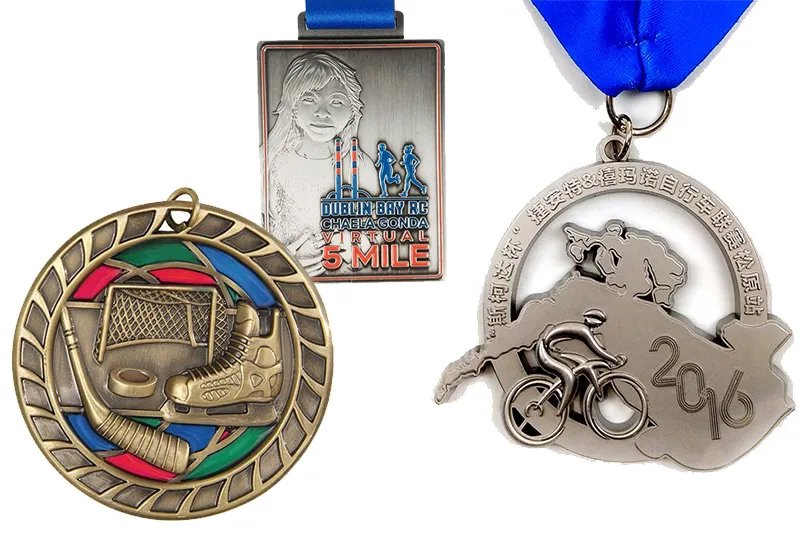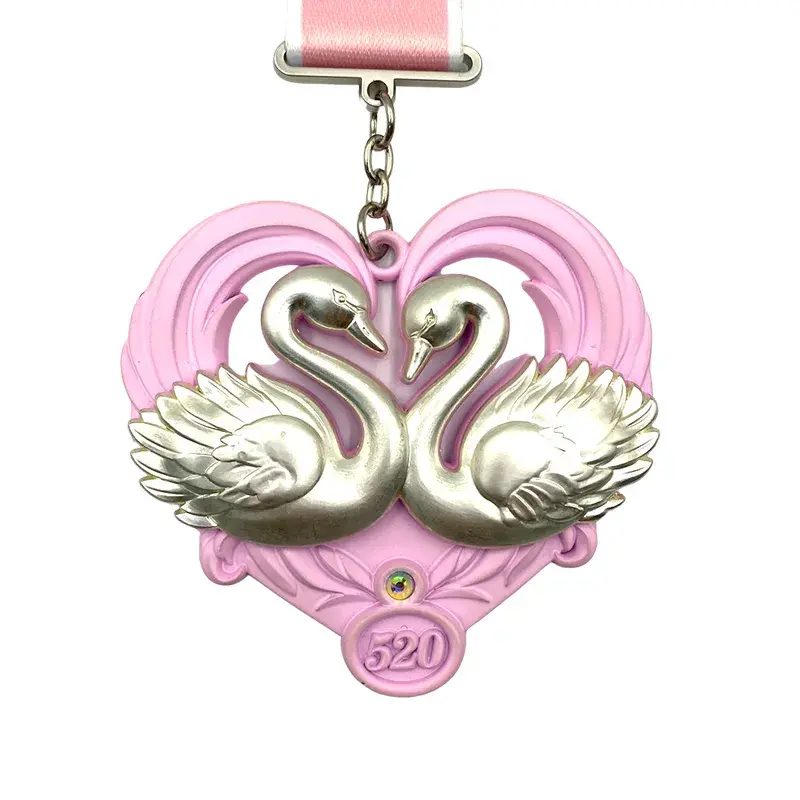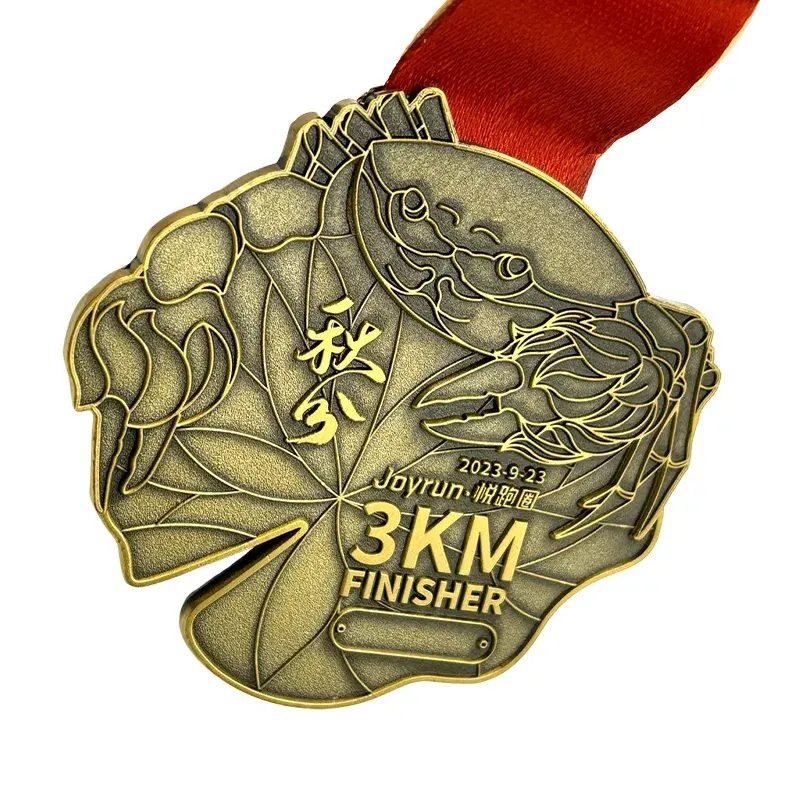
Martial arts medals are not just sports medals with a different icon. Belt systems, weight classes, and the culture of the dojo change what an award should say. A wrestling medal for a high school dual meet and a BJJ medal for a belt promotion are answering different questions. We produce custom sports medals for martial arts clubs and tournaments, so here’s how we spec them across the main disciplines.
What we’ll cover:
- How medal logic differs across karate, BJJ, judo, taekwondo, and wrestling
- Podium tiers and how to distinguish first from third
- Belt rank, weight class, and what belongs on the medal
- Design details that read as authentic to practitioners
[Image: sports-medals.jpg — Custom martial arts medals for karate, judo, and taekwondo events]
How Martial Arts Awards Differ From Team Sports
In team sports, the season ends and everyone gets something. In martial arts, competition is usually individual and often double-elimination — meaning most competitors go home earlier than they’d like. That changes what an award has to do.
Three differences shape the spec:
Individual results, not team placement. There’s no division title to share. Each medal belongs to one competitor, which means personalization matters more than in team sports.
Tiers are stricter. Podium place is the whole story in most disciplines. First, second, and third need to be visually distinct at a glance from across a gym floor.
Advancement is separate from competition. Belt promotion, grading, and rank advancement are milestone events that deserve their own award, distinct from tournament placement.
That third point is where clubs most often under-award. A student who spent eight months preparing for a belt test and passed should get something — and it shouldn’t be the same medal they got for placing second at a tournament.
| Discipline | Competition award | Advancement award | Typical size |
|---|---|---|---|
| Karate | Kata and kumite podium tiers | Belt promotion, dojo milestone | 50–60mm |
| BJJ | Division podium, absolute division | Belt promotion, stripe milestone | 55–65mm |
| Judo | Weight class podium | Rank promotion, kata certification | 50–60mm |
| Taekwondo | Poomsae and sparring podium | Dan and geup promotion | 50–60mm |
| Wrestling | Dual meet, tournament placement | Season completion, varsity letter | 55–65mm |
[Image: process-01-design.jpg — Designing martial arts medal artwork with discipline-specific iconography]
Podium Tiers: Making First, Second, and Third Read Instantly
Tournament days move fast. Medals get handed out on a mat with a crowd watching, and the difference between first and third has to register without explanation.
The efficient structure is one mold with plating variants. Cast a single design that works for every place, then vary the finish. Plating changes require no new tooling, so tier distinction costs a fraction of what a second mold would.
| Place | Plating | Relative cost | Signal |
|---|---|---|---|
| First | Imitation gold, mirror finish | $$ | Highest, brightest, reads at distance |
| Second | Nickel silver, mirror finish | $$ | Clearly distinct from gold |
| Third | Antique bronze or copper | $ | Third tier, warmer tone |
Two notes from experience. First, bronze reads as third place to most audiences, but copper and antique bronze are close enough that you should confirm the proof shows a clear difference from the gold. Second, mirror finishes photograph better under gym lighting than matte finishes, which matters if your event does social coverage.
Some tournaments add a fourth tier for participation or for competitors who placed but didn’t medal. Antique tin or a dedicated design in a smaller size handles this well — and because antique finishes use single-pass electrophoresis or barrel plating, that inclusive tier costs less per piece than your podium tiers. Our enamel medals page covers the full finish range.
If you’re running multiple disciplines or age brackets at one tournament, order them all as one combined run. Setup — loading the mold, mixing enamel, warming the plating tanks — costs about the same whether you run 100 pieces or 10,000. Our minimum is 100 pieces per design, and our floor runs over 30,000 pieces a day.
[Image: process-07-plating.jpg — Medals on a plating line receiving gold and nickel finishes]
Belt Rank and Weight Class: What Belongs on the Medal
This is the design decision that separates a martial arts medal practitioners respect from one that feels generic. Get it right and the medal becomes a keepsake.
Weight class on judo and wrestling medals. Both sports organize competition by weight, and weight class is a significant part of the athlete’s identity. Casting or engraving the class onto the medal is a detail that lands. In judo, the weight class is often as memorable as the place.
Division on BJJ and karate medals. BJJ uses belt-based divisions plus absolute (open-weight) divisions. Karate splits kata and kumite, and often splits by age. Cast the division and event type — a kata medal should say kata.
Belt promotion medals are a distinct product. A belt promotion isn’t a placement, so it shouldn’t look like a tournament medal in a different color. Consider a different shape or a distinct design: a belt motif, the dojo crest, the new rank, and the promotion date. This is one of the highest-value awards a club can make, because it marks months of work rather than a day’s result.
Rank insignia need accuracy. Belt colors, dan/geup systems, and insignia vary between organizations and dojos. We’ve had clubs catch color inaccuracies in proofs, and they were right to. Send a reference image of your specific belt colors or insignia rather than relying on a designer’s assumption about what a green belt looks like.
A practical note on enamel colors: every color is a separate fill-and-bake cycle, with a low-temperature cure of 60 to 70°C for 60 to 90 minutes and a full cure at 100°C for 60 minutes. Belt colors are often distinct enough that you’ll need three or four fills. If your design can use relief and plating to carry some of the differentiation instead of pure color, you’ll reduce both cost and risk of color drift between belts.
[Image: process-09-color-filling.jpg — Technician filling enamel color into a martial arts medal design]
Iconography That Reads as Authentic
Practitioners notice iconography that’s wrong. These are the details that consistently work, per discipline.
| Discipline | Iconography that lands | Common mistake to avoid |
|---|---|---|
| Karate | Gi silhouette, stance, kata sequence frame, dojo crest | Generic “martial arts” figure |
| BJJ | Gi with belt knot, closed guard position, academy crest | Using a karate figure |
| Judo | Throw silhouette, tatami edge, judogi | Mistaking judo for jujitsu |
| Taekwondo | Kicking silhouette, dobok, board break | Reusing a karate figure |
| Wrestling | Mat stance, takedown position, singlet | Using a boxing figure |
The single most common error we see is cross-discipline iconography — a karate figure on a BJJ medal, or a boxing figure on a wrestling medal. To a practitioner, that’s the equivalent of a wrong flag. Send a reference image with your artwork brief and we’ll match the posture and the uniform detail.
Two design approaches work particularly well in this category. A silhouette against a raised background reads clean at a distance and holds up in photos — good for large tournaments where the medal is presented publicly. A detailed 3D sculpted figure costs the same in zinc but rewards a close look, and suits club-level awards where the medal is kept and refinished rather than handed out en masse.
Zinc alloy is the right material for both. Zamak 3, 5, and 7 melt at 385°C and flow into a mold cavity easily, so an 88-ton die-casting press captures fine silhouette and relief detail in a single shot. Neither stamped brass nor stamped iron can hold this level of 3D detail, which is why martial arts medals with sculpted figures are almost always die-cast. Full material comparisons are on our medal materials guide page.
[Image: process-03-die-casting.jpg — Die-casting press forming a sculpted martial arts figure in relief]
Ordering for a Tournament or a Club
Two different orders, two different logics.
For a tournament, the priority is tier coverage and turnaround. You know roughly how many competitors you’ll have but not exactly who places. Cast the place text where possible so you’re not engraving everything at the last minute, and reserve the back panel for names you’ll add after the bracket resolves. Build in four to five weeks: a free design proof takes 24 hours, samples take 7 to 10 days, and production ships in 7 to 15 days after approval. Our experience is that martial arts tournament organizers work closer to deadlines than most sports, so start earlier than you think you need to.
For a club, the priority is variety across a season. A club typically needs three things: tournament placement medals, belt promotion medals, and recognition awards for attendance or attitude. Casting what’s constant — the dojo crest, the discipline icon — and engraving what varies — name, date, rank — lets one mold serve the whole year. That’s a significant cost reduction over ordering separate designs each time.
One last detail worth getting right: ribbon width. Martial arts medals are typically presented and worn briefly, then stored. A 25mm ribbon is comfortable and standard; a 30mm ribbon suits larger, more formal awards. We standardize ribbons at 860–900mm long by 20–30mm wide, and printing them in the same run as the medals keeps the colors consistent. Details are on our medal ribbons page.
Send us your discipline, brackets, and club crest through our contact page and we’ll quote it as one combined run with a free design proof inside 24 hours.
[Image: factory-workshop-05.jpg — Production floor finishing a martial arts club’s medal order]
FAQ: Martial Arts Medals
What size are martial arts medals? Most karate, judo, and taekwondo medals run 50–60mm, while BJJ and wrestling medals often run slightly larger at 55–65mm. The difference reflects presentation context: larger medals read better at a distance on a competition mat or in a gym, while smaller medals suit the closer audience of a grading or club ceremony.
How do I make first, second, and third place look clearly different? Use one mold with plating variants. Imitation gold for first, nickel silver for second, and antique bronze or copper for third. Plating changes require no new tooling, so tier distinction costs a fraction of a second mold, and mirror finishes photograph better under gym lighting than matte ones.
Should belt promotion medals look different from tournament medals? Yes. A belt promotion marks months of preparation rather than a single day’s result, so it deserves a distinct design — consider a belt motif, the dojo crest, the new rank, and the promotion date. Awarding the same design as a tournament medal undersells the achievement.
Can you match our specific belt colors? Yes, and please send a reference image. Belt colors and insignia vary between organizations and dojos, and we work to Pantone matching rather than assumption. Accurate references prevent the color mismatches that clubs rightly catch in proofs.
What’s the minimum order for martial arts medals? Our minimum is 100 pieces per design. Since setup costs are largely fixed, combining multiple disciplines, age brackets, or award tiers into a single production run spreads that setup across more units and lowers your per-piece cost.
How far ahead should a tournament order medals? Allow four to five weeks. A free design proof comes back within 24 hours, samples take 7 to 10 days, and full production ships in 7 to 15 days after you approve the sample. Add time if you plan to engrave individual competitor names after the bracket resolves.
Recommended Reading
- Custom BJJ Medals: A Guide for Academies and Tournaments — Jiu-Jitsu specific design and ordering
- Types of Custom Sports Medals: Which Fits Your Event? — comparing medal types for athletic events
- Medal Plating & Finishes: Gold, Silver, Nickel, Antique — choosing the finish that distinguishes your tiers
Data to confirm: size ranges and tier structures reflect our standard guidance and common practice across disciplines. Belt color, insignia, and rank conventions vary by organization — supply references for your specific system. Actual per-piece pricing depends on artwork complexity, color count, and quantity.
Related product page: medals with a rotating centre — our spinning medal range: a moving inner disc on a die-cast body, 100-piece minimum.